Cafe loyalty, social enquiries and reservation automation
Hafiz Abdullah Aamir developed cafe automation projects connecting QR loyalty signup and customer segmentation with birthday and win-back communication, Instagram enquiries, table and event reservations, review workflows and content preparation. The collection follows the customer relationship across visits and channels, with consent, maintained booking information and brand review built into the operating discussion.
By Advenno · Project team lead: Hafiz Abdullah Aamir · Published · Updated
Where the work gets stuck.
A loyalty programme needs more than a place to store telephone numbers. The cafe must connect a customer's signup with an ongoing relationship and distinguish active customers from people who have stopped returning. Paper loyalty records and separate messaging activity make that relationship difficult to manage as one process. This project addressed the operational link between joining a loyalty programme, keeping customer information usable and preparing relevant follow-up for the people the business wanted to reach again.
A system built around the work.
The workflow started with QR signup and customer data capture with consent. That gave the loyalty process a clear entry point and created the information needed for subsequent communication. Customer segmentation then separated different activity patterns, including regular and lapsing customers. Scheduled campaigns supported birthday and win-back communication instead of treating the entire list as a single audience. The implementation connected these stages so that customer acquisition into the loyalty programme and later retention activity formed one workflow. The wider cafe collection also included Instagram enquiry responses, table and event reservations, review workflows and brand-voice content preparation, connecting the loyalty relationship with the other channels customers used.
How the pieces connect.
Join through a QR signup
The customer entered the loyalty journey through a QR-linked signup step, giving the programme a practical way to capture interest during a cafe visit.
Capture customer details with consent
The signup collected the customer information needed for the loyalty relationship and its follow-up, with consent included in the capture process rather than assumed later.
Organise customer activity
Customer records fed the segmentation stage, allowing the loyalty workflow to distinguish patterns of engagement instead of relying on an undifferentiated contact list.
Identify relevant customer groups
The segmentation supported groups such as regular and lapsing customers, providing the basis for deciding which audience a particular follow-up should address.
Schedule loyalty and win-back communication
Birthday and win-back campaigns used the customer records and groups, connecting the original signup with later communication intended to bring customers back to the cafe.
What the project delivered.
The delivered system brought digital loyalty signup, customer grouping and scheduled follow-up into a connected process. It supported an opted-in customer list and differentiated communication for customer segments. The cafe could use that capability for loyalty and win-back activity, with signup, segmentation and campaign preparation linked to each other rather than managed as unrelated tasks.
The systems behind the workflow.
Each module handles a different part of the work. Together, they connect the operational handoffs around this project.
QR loyalty and win-back communication
The loyalty workflow connected QR signup, permission-based customer capture, activity segments and scheduled follow-up. It supported birthday communication and relevant messages to customers whose visiting pattern had changed, rather than treating the entire contact list as one audience.
- How it works
A QR-linked form and customer store feed segmentation and scheduled WhatsApp or SMS communication through workflow orchestration.
- Operational consideration
Consent and restrained frequency matter to the relationship. The system’s ability to schedule a message is separate from evidence that the customer wants that specific offer.
Instagram menu, hours and booking responses
The enquiry module handled recurring questions arriving in Instagram messages, including the menu, opening hours and reservations. It worked alongside loyalty rather than making staff operate a separate manual process for every social enquiry.
- How it works
An approved social messaging connection routes supported questions to maintained business information and the relevant booking step.
- Operational consideration
Social-platform access and app-review requirements affect what an account can automate. Response tone must also suit the cafe and the kind of question being asked.
Table and event reservations
The booking module linked a customer’s request with a calendar for tables or small events. It carried the enquiry towards a reservation record so that weekend and event activity could be coordinated with the cafe team.
- How it works
A conversational or form-based booking step connects to a maintained calendar and the associated customer details.
- Operational consideration
Calendar changes must be reflected in the workflow. Double bookings are an operational risk to manage, not a result that disappears merely because a bot answers the enquiry.
Review replies and alerts
The reputation workflow prepared responses to feedback and raised alerts for reviews needing attention. It gave the owner a review task connected to the customer experience rather than requiring every reply to begin with a blank page.
- How it works
Language-model drafting supports a review-and-approval step, with alerts directing attention to negative or important feedback.
- Operational consideration
A useful reply addresses the actual experience. Approval helps avoid generic text, inappropriate tone or a response that sounds like a promise the cafe cannot keep.
Weekly content planning and captions
Content preparation supported a weekly calendar and captions in the cafe’s voice. It complemented the customer-facing workflows by organising what the business wanted to communicate about menus, offers or events, with the owner retaining control of what is ready to publish.
- How it works
Brand-voice drafting and a scheduler support preparation of captions and the content calendar.
- Operational consideration
The owner or social-media colleague still needs to check whether a caption is accurate, timely and recognisably the cafe’s own voice rather than a generic promotion.
Inside the system.
Choose a workflow to open the full diagram. Zoom in to follow its decisions and handoffs, or read the stages in the text view.
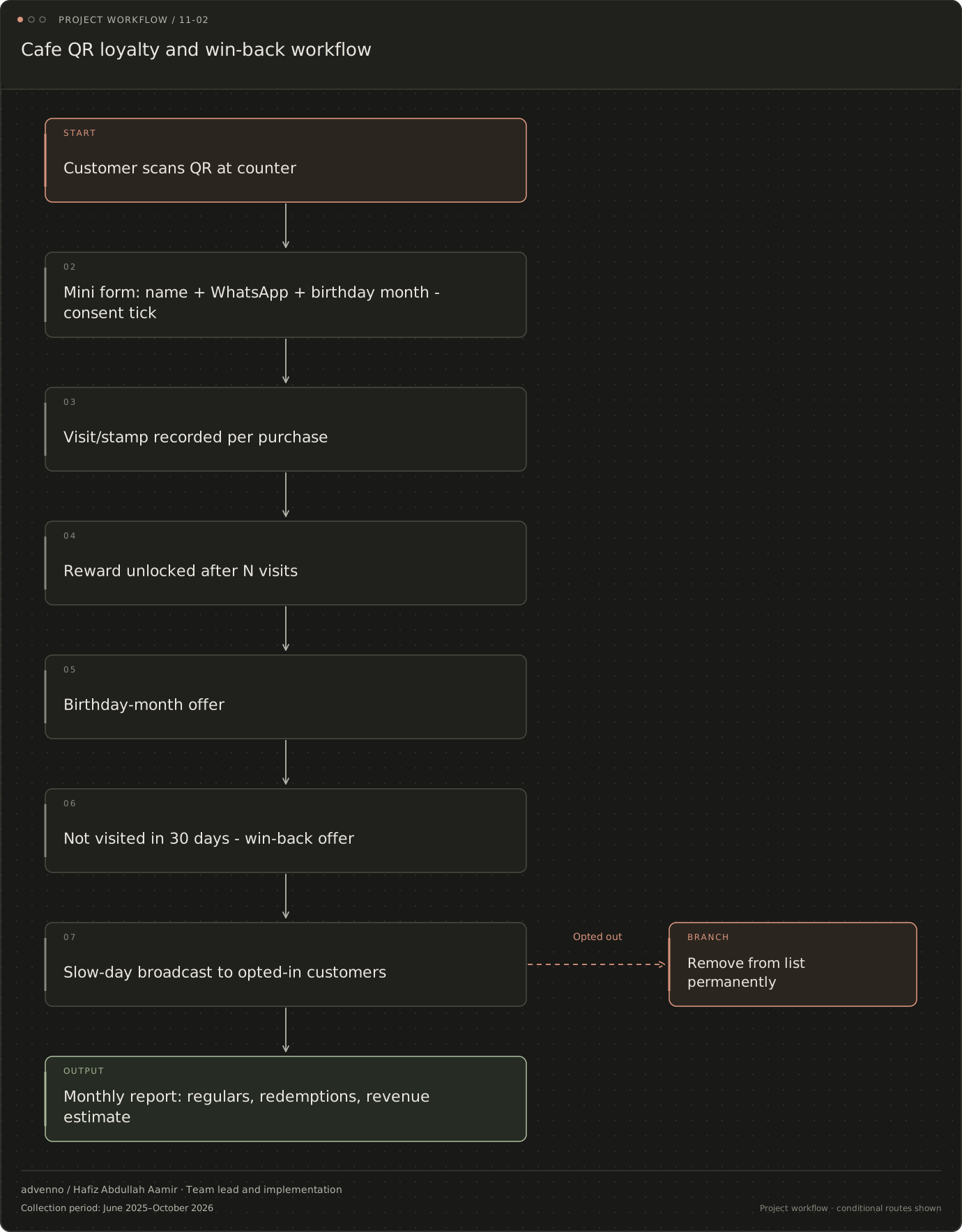
Cafe QR loyalty and win-back workflow
The project’s operational flow, including decision points and exception routes. Named channels reflect the original project context; a similar implementation is scoped around your systems.
Read the stages and decision branches
- Customer scans QR at counter
- Mini form: name + WhatsApp + birthday month - consent tick
- Visit/stamp recorded per purchase
- Reward unlocked after N visits
- Birthday-month offer
- Not visited in 30 days - win-back offer
- Slow-day broadcast to opted-in customers
- Monthly report: regulars, redemptions, revenue estimate
- Remove from list permanently
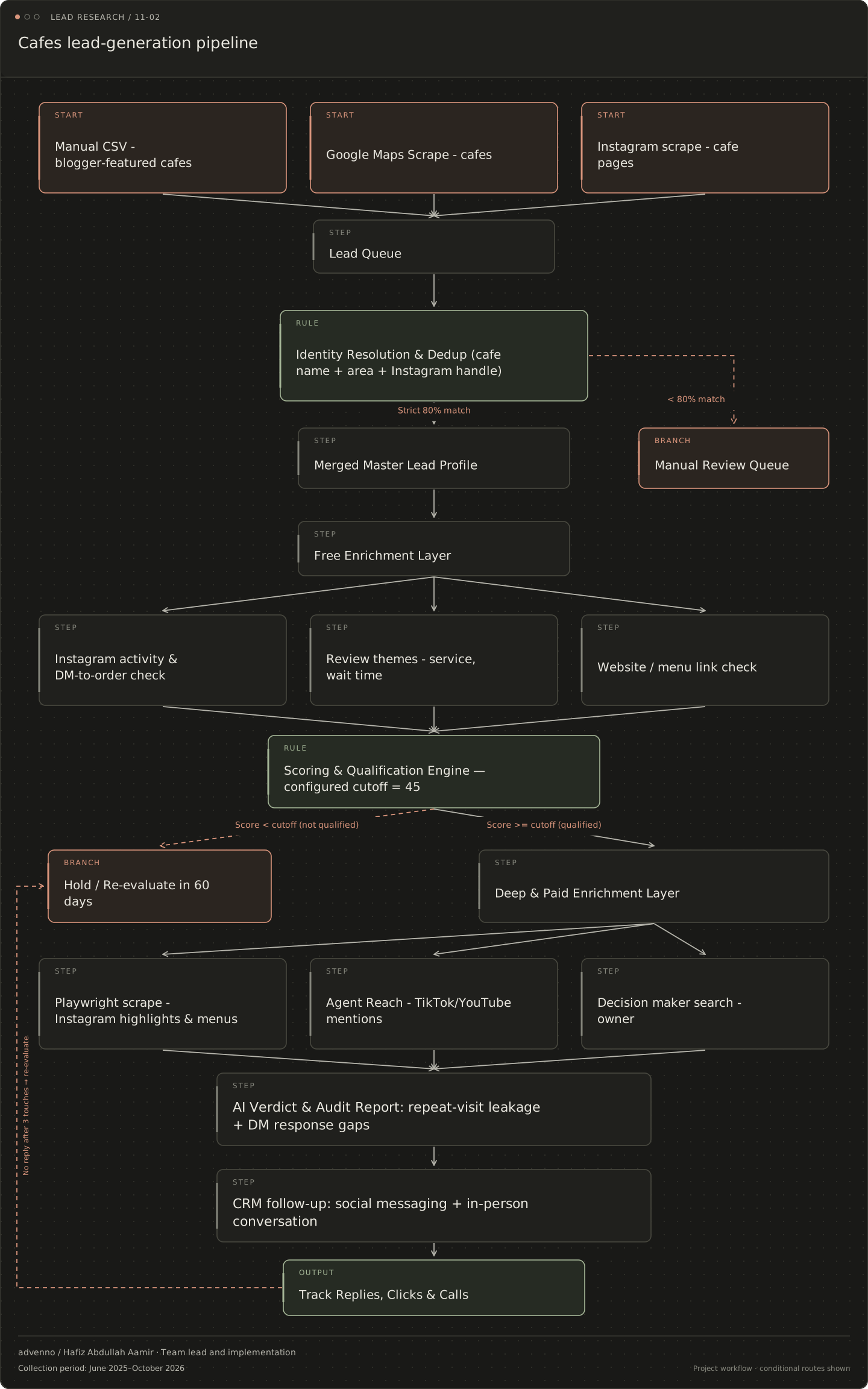
Related acquisition workflow: Cafes
A separate lead-research and CRM workflow configured for this business niche. It connects evidence gathering, qualification and follow-up; it is distinct from the operational system shown above.
Read the stages and decision branches
- Manual CSV - blogger-featured cafes
- Google Maps Scrape - cafes
- Instagram scrape - cafe pages
- Lead Queue
- Identity Resolution & Dedup (cafe name + area + Instagram handle)
- Strict 80% match: Merged Master Lead Profile
- < 80% match: Manual Review Queue
- Merged Master Lead Profile
- Manual Review Queue
- Free Enrichment Layer
- Instagram activity & DM-to-order check
- Review themes - service, wait time
- Website / menu link check
- Scoring & Qualification Engine — configured cutoff = 45
- Score < cutoff (not qualified): Hold / Re-evaluate in 60 days
- Score >= cutoff (qualified): Deep & Paid Enrichment Layer
- Hold / Re-evaluate in 60 days
- Deep & Paid Enrichment Layer
- Playwright scrape - Instagram highlights & menus
- Agent Reach - TikTok/YouTube mentions
- Decision maker search - owner
- AI Verdict & Audit Report: repeat-visit leakage + DM response gaps
- CRM follow-up: social messaging + in-person conversation
- Track Replies, Clicks & Calls
- no reply after 3 touches: Hold / Re-evaluate in 60 days
What makes the system useful.
Connecting the cafe relationship across visits and channels
The cafe work covered more than a digital replacement for a paper loyalty card. A customer might join through a QR code, ask a menu question on Instagram, reserve a table, leave a review and return for an event. The owner, manager and social-media colleague needed those activities to support a consistent relationship. The project collection connected loyalty and retention with incoming enquiries, table and event bookings, reputation work and content preparation, while keeping each workflow’s purpose clear.
Segmentation and booking records give the conversation context
Customer data capture included consent. Recency, frequency and monetary-value segmentation supplied a way to distinguish activity patterns, including regular and lapsing customers, before preparing birthday or win-back communication. Social messages had a different role: answering menu, opening-hour and booking questions. Reservation requests needed a calendar record rather than an untracked conversation. Brand-voice text generation supported replies and content, but it did not replace the customer data, campaign audience or availability information on which those activities depended.
Evaluating loyalty, response and booking activity separately
A useful evaluation separates signup from subsequent behaviour. Track loyalty signups, repeat visits and redemptions, alongside DM response time. Those measures answer different questions: collecting more contacts does not establish that more people returned, and a fast message does not confirm a reservation. These are suggested evaluation measures, not measured outcomes claimed for the project. Staff should also review audience selection, message frequency and booking changes so that automation stays useful to customers as the cafe’s offers and schedule change.