Catering quotation, procurement and operations automation
Hafiz Abdullah Aamir developed catering automation projects covering event enquiries, maintained pricing and quotations, recipe-based procurement lists, corporate meal orders and monthly invoices, staff scheduling and event content. The collection connects commercial information with the purchasing, coordination and recurring administration needed to deliver the catering work.
By Advenno · Project team lead: Hafiz Abdullah Aamir · Published · Updated
Where the work gets stuck.
Catering quotations combine menu selection, the number of guests and service requirements. Once an event is booked, those choices must be translated into preparation and buying requirements. Treating the commercial quote and procurement list as separate exercises means working through the same event details in different contexts. The project addressed that handoff by connecting enquiry information with pricing and recipe-based quantity preparation, so the process could follow an event from the customer's request towards the operational work required to deliver it.
A system built around the work.
The implemented workflow collected the event details through an enquiry step and used maintained pricing information to prepare a quotation. Calculation rules determined prices, while the conversational component supported gathering the customer's requirements. The quote could be presented as a branded document for the customer. For a booked event, the menu and headcount also fed the procurement preparation step. Recipe data connected the selected dishes with their raw-material requirements. This brought quotation and purchasing preparation into one operational sequence, while preserving the distinction between answering a customer's enquiry and calculating the quantities required to fulfil the catering order.
How the pieces connect.
Collect the event enquiry
The intake captured the customer's event requirements, including the menu and headcount information needed to prepare a catering quotation and understand the service being requested.
Apply the pricing rules
The quotation process used maintained menu and pricing information to calculate the proposal, keeping the calculation separate from the conversational task of gathering and presenting event details.
Prepare the customer quotation
The workflow generated a branded quotation document, connecting the collected requirements with a customer-facing proposal that represented the menu and service under discussion.
Carry the booked menu into preparation
For the booked event, the selected menu and guest count became the inputs to procurement preparation, preserving the connection between the customer's choices and the operational requirements.
Generate the raw-material list
Recipe information translated the menu and headcount into purchasing quantities, giving procurement a list tied to the event rather than a separate calculation reconstructed from the quotation.
What the project delivered.
The delivered capability connected an event's commercial and procurement information. Menu selection and guest count supported both quotation preparation and the subsequent raw-material list. The project provided a workflow for producing customer-facing quotes and preparing the corresponding buying requirements, rather than leaving those tasks as unrelated calculations based on the same event details.
The systems behind the workflow.
Each module handles a different part of the work. Together, they connect the operational handoffs around this project.
Event intake, quotation and follow-up
The sales workflow collected event requirements, applied pricing rules and prepared a branded quotation. Follow-up communication kept the proposal connected to the booking discussion rather than treating the PDF as the end of the process.
- How it works
A form or assistant, maintained price information, document generation and scheduled workflow steps connect enquiry to follow-up.
- Operational consideration
Prices must be owner-maintained and current. The event details and maintained prices stay together so the booking team can review the proposal and follow-up in context.
Recipe-scaled procurement lists
For a booked event, the selected menu and headcount fed a raw-material list. Recipe-based quantity preparation linked what had been sold with the purchasing work needed to prepare it, preserving the relationship between the commercial record and the kitchen.
- How it works
A recipe database and calculation step translate menu and headcount into a bill of materials.
- Operational consideration
Reliable recipe entry is a prerequisite. For a similar implementation, agree how recipe quantities are maintained and reviewed before allowing them to drive purchasing preparation.
Corporate meal orders and monthly invoices
The recurring-meal workflow collected daily orders and carried them towards monthly invoices. It addressed a different operating pattern from a single wedding or corporate event: quantities can change from day to day while the contract continues.
- How it works
Order forms or messaging, structured daily records and invoice-document generation support the recurring workflow.
- Operational consideration
Changing headcounts have to be reflected in the underlying order records. An invoice should follow the recorded service, rather than assume that every day had the same quantity.
Per-event staff schedules and alerts
Staffing work connected the event with a schedule and notifications for the people involved. It gave the supervisor a defined preparation step alongside procurement rather than leaving the staff handoff outside the booking workflow.
- How it works
A maintained schedule and messaging alerts link the event record with the relevant staff.
- Operational consideration
Staff phone access and adoption matter to delivery. Automated reminders support coordination; urgent decisions and changes on the event day remain with the people running it.
Event content and caption preparation
The supporting content workflow prepared captions around event material. It kept post-event content preparation connected with the catering work while leaving publication decisions with the people who know the event and customer context.
- How it works
Language-model drafting supports captions for approved event-photo or reel material.
- Operational consideration
Content needs an editorial check for accuracy and an appropriate tone. The caption should accurately describe the event material and fit the caterer’s own way of communicating.
Inside the system.
Choose a workflow to open the full diagram. Zoom in to follow its decisions and handoffs, or read the stages in the text view.
Catering quotation and procurement workflow
The project’s operational flow, including decision points and exception routes. Named channels reflect the original project context; a similar implementation is scoped around your systems.
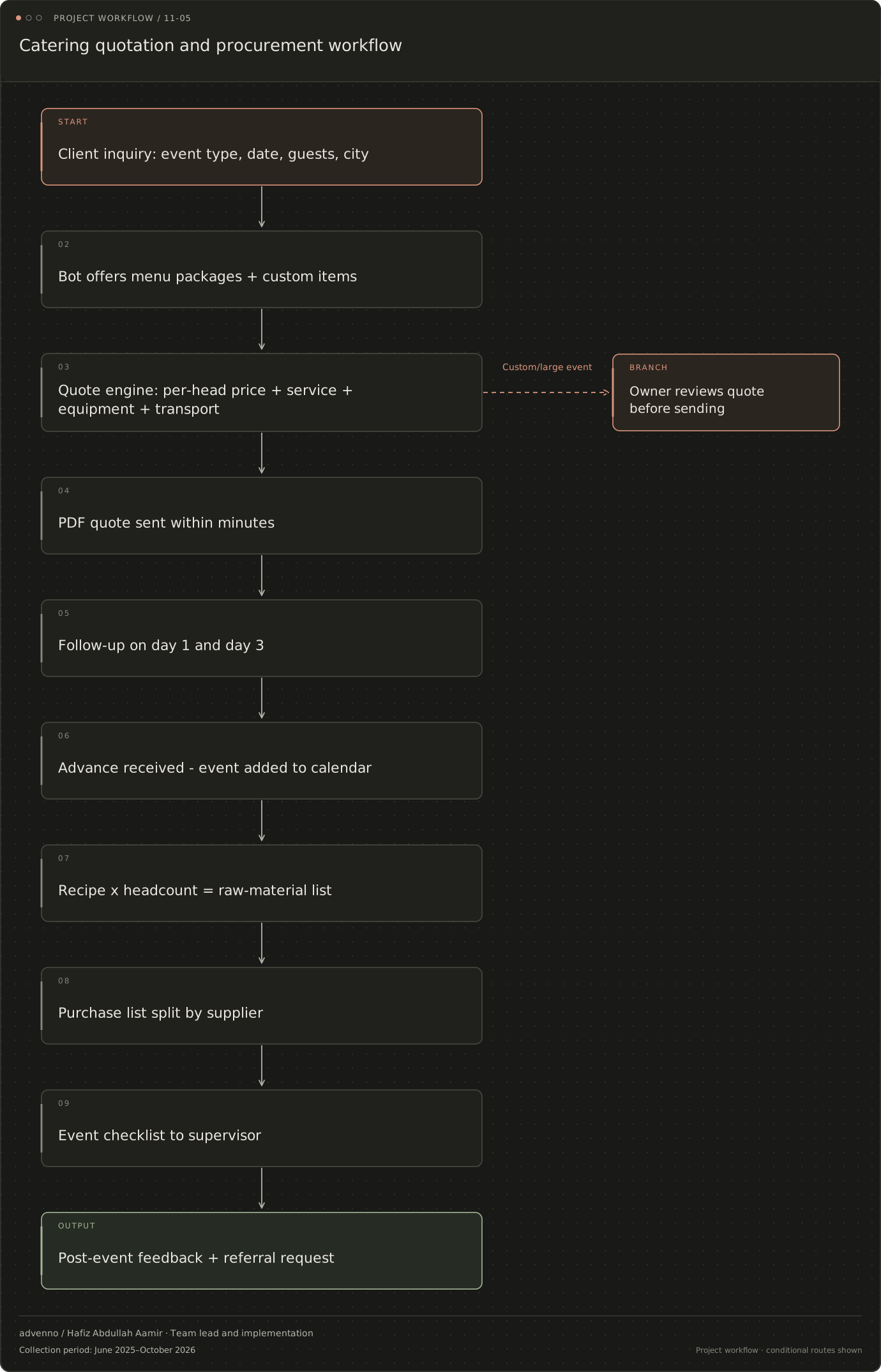
Read the stages and decision branches
- Client inquiry: event type, date, guests, city
- Bot offers menu packages + custom items
- Quote engine: per-head price + service + equipment + transport
- PDF quote sent within minutes
- Custom/large event: Owner reviews quote before sending
- PDF quote sent within minutes
- Follow-up on day 1 and day 3
- Advance received - event added to calendar
- Recipe x headcount = raw-material list
- Purchase list split by supplier
- Event checklist to supervisor
- Post-event feedback + referral request
- Owner reviews quote before sending
Related acquisition workflow: Catering companies
A separate lead-research and CRM workflow configured for this business niche. It connects evidence gathering, qualification and follow-up; it is distinct from the operational system shown above.
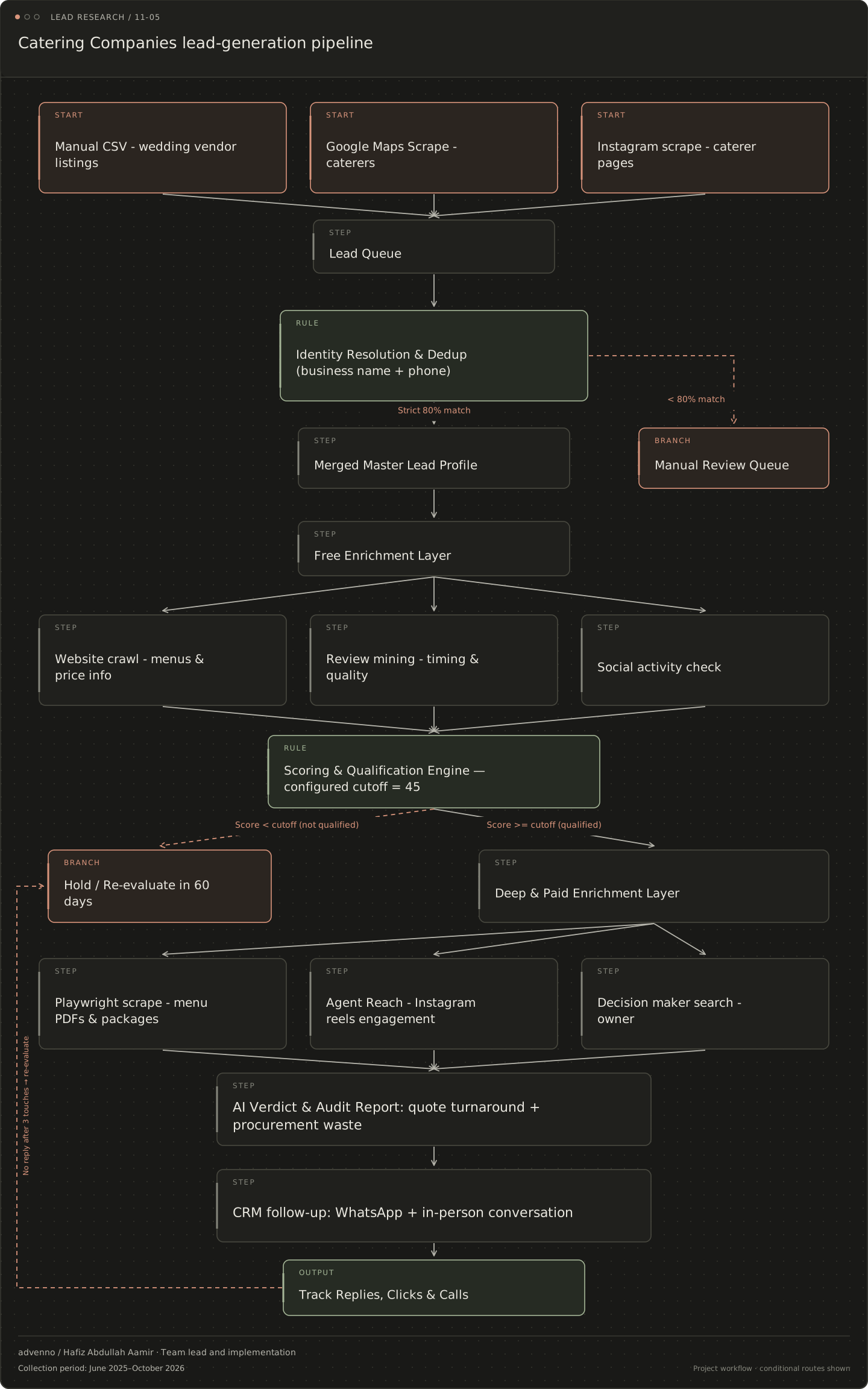
Read the stages and decision branches
- Manual CSV - wedding vendor listings
- Google Maps Scrape - caterers
- Instagram scrape - caterer pages
- Lead Queue
- Identity Resolution & Dedup (business name + phone)
- Strict 80% match: Merged Master Lead Profile
- < 80% match: Manual Review Queue
- Merged Master Lead Profile
- Manual Review Queue
- Free Enrichment Layer
- Website crawl - menus & price info
- Review mining - timing & quality
- Social activity check
- Scoring & Qualification Engine — configured cutoff = 45
- Score < cutoff (not qualified): Hold / Re-evaluate in 60 days
- Score >= cutoff (qualified): Deep & Paid Enrichment Layer
- Hold / Re-evaluate in 60 days
- Deep & Paid Enrichment Layer
- Playwright scrape - menu PDFs & packages
- Agent Reach - Instagram reels engagement
- Decision maker search - owner
- AI Verdict & Audit Report: quote turnaround + procurement waste
- CRM follow-up: WhatsApp + in-person conversation
- Track Replies, Clicks & Calls
- no reply after 3 touches: Hold / Re-evaluate in 60 days
What makes the system useful.
The catering work connects sales, purchasing and delivery preparation
A catering enquiry becomes several related records: the menu and headcount in a quote, the ingredient quantities needed by procurement, and the people needed at the event. The owner, booking manager, chef, purchaser and supervisor use different parts of the same event information. The project collection also covered recurring corporate meals, where daily quantities accumulate towards monthly invoicing. Connecting those responsibilities makes the system larger than a quote generator, while retaining a clear role for people supervising food preparation and event-day delivery.
Price calculations and recipe quantities are different rule sets
The quotation engine used maintained commercial information for menu, headcount and service pricing. Recipe data supplied a separate bill of materials for raw-material preparation. Conversational AI gathered requirements; it did not guess prices or ingredient quantities. A booked menu carried shared inputs into both stages. Corporate meal work followed another rhythm, because changing daily headcounts need to be recorded over an invoicing period. Staff schedules and alerts then used event context to support the supervisor rather than making staffing an unrelated spreadsheet task.
Evaluate the handoff as well as the speed of the quote
Quote turnaround and quote-to-booking rate describe the commercial stage. Procurement waste and administrative hours are separate measurement categories for the wider workflow. They are proposed evaluation measures, not claimed results from this project. The quality of maintained prices, recipe records and daily order entries affects what the system produces. Food prices change, recipe information can take effort to prepare, and event-day emergencies still need people. A sensible implementation can establish quotation first while the operational inputs for procurement are organised.