Charity donor service, donation records and programme administration
Hafiz Abdullah Aamir developed charity automation projects spanning donor assistance, payment reconciliation and receipts, stewardship communication, beneficiary intake and duplicate review, donor and board reporting, and CSR proposal drafts. The collection connects donor-facing service with the records and review needed for wider charity administration.
By Advenno · Project team lead: Hafiz Abdullah Aamir · Published · Updated
Where the work gets stuck.
A charity's donation process includes both communication and accounting work. A donor may ask for payment instructions, provide a transfer reference and then expect an acknowledgement or receipt. The team needs to connect that conversation with the payment record rather than treating the message and the donation as unrelated items.
The project addressed the operational handoff between answering the donor and recording the contribution. It focused on donation administration and approved information, including the distinction between receiving a payment screenshot and matching a payment against a financial record. The religious or tax treatment of a donation was not the assistant's role to decide.
A system built around the work.
The completed workflow combined a donation-question assistant with payment-information extraction, statement matching and receipt generation. The assistant used the charity's approved information for donor questions. Payment details then supported the reconciliation stage, connecting the donor's submission with the corresponding payment information before a receipt was prepared.
This brought conversation handling and donation records into the same administrative path. The AI-assisted elements supported understanding questions and extracting information; reconciliation and receipt preparation addressed the donation-processing work. A donor's submitted payment information supports the process, while the matching stage connects that submission with the financial record used for the receipt.
How the pieces connect.
Answer the donation enquiry
Use the charity's approved information to support donor questions about the donation process and the available next steps.
Read the payment information
Extract the relevant donation details supplied by the donor so they can be used in the payment-matching stage.
Match the contribution
Connect the submitted payment information with the financial record as part of the donation-reconciliation workflow.
Prepare the receipt
Generate the receipt and donation acknowledgement as the administrative completion of the recorded contribution.
What the project delivered.
The delivered project connected donor questions with the administrative work around a donation. It covered approved answers, payment matching and receipt generation, so the interaction could progress from an enquiry to a documented contribution. The operational link is between what the donor asks or submits and the contribution that the charity records and acknowledges.
The systems behind the workflow.
Each module handles a different part of the work. Together, they connect the operational handoffs around this project.
Approved-information donor assistant
The donor assistant connected incoming questions and pledges with the organisation's approved campaign information. It supported routine donor service while keeping sensitive religious or unsupported questions on a human-review path.
- How it works
Intent classification and retrieval organise multilingual enquiries around an approved knowledge base.
- Operational consideration
Use official organisation and payment information. When approved material does not answer the question, hand it to the responsible person instead of generating a ruling or policy.
Payment reconciliation and receipts
The accounting workflow connected submitted payment information with a financial record before preparing a receipt. This joined donor communication with the accountant's need to establish which donation had actually been received.
- How it works
Vision extraction reads payment details; deterministic matching compares them with a statement; document generation prepares the receipt.
- Operational consideration
A screenshot can be wrong, edited or duplicated. Receipt eligibility should follow the confirmed financial record, not the visual plausibility of the donor's submission.
Donor stewardship communication
Stewardship linked the recorded donation with a thank-you, an impact update and relevant later campaign communication. The workflow continued the donor relationship after the initial transaction.
- How it works
Donor records, recency/frequency/value segmentation and scheduled communication support email or opted-in messaging at the appropriate stage.
- Operational consideration
A receipt-related message and a future campaign appeal serve different purposes. Respect communication choices and provide a way to stop optional follow-up.
Beneficiary intake and duplicate detection
The programme module organised beneficiary applications and highlighted potentially repeated records. It connected incoming forms and identity information with the casework needed to review an application.
- How it works
Forms, document extraction and fuzzy matching assist intake and possible-duplicate detection.
- Operational consideration
Similar names or identity-field errors can produce false matches. A person reviews the case; sensitive beneficiary data should be available only to the relevant team.
Monthly donor and board reports
Report preparation brought together the organisation's recorded figures and a narrative explaining them. It supported recurring communication to donors and the board without asking staff to reconstruct every number manually.
- How it works
Code computes the figures from records; a language model assists the explanatory draft for review.
- Operational consideration
Keep financial and programme numbers tied to their evidence. Do not convert a pledge into received income or invent a programme outcome to complete a narrative.
CSR proposal drafting
The proposal module helped organise the charity's own programme information into a draft for a corporate funding conversation. It reused institutional knowledge rather than relying on a generic description of charitable work.
- How it works
Retrieval from the charity's knowledge material supports a structured proposal draft and human editing.
- Operational consideration
The organisation must review commitments, beneficiary descriptions and budgets before sharing a proposal. Drafting does not establish that a funder will accept it.
Inside the system.
Choose a workflow to open the full diagram. Zoom in to follow its decisions and handoffs, or read the stages in the text view.
Charity donation assistant and receipt workflow
The project’s operational flow, including decision points and exception routes. Named channels reflect the original project context; a similar implementation is scoped around your systems.
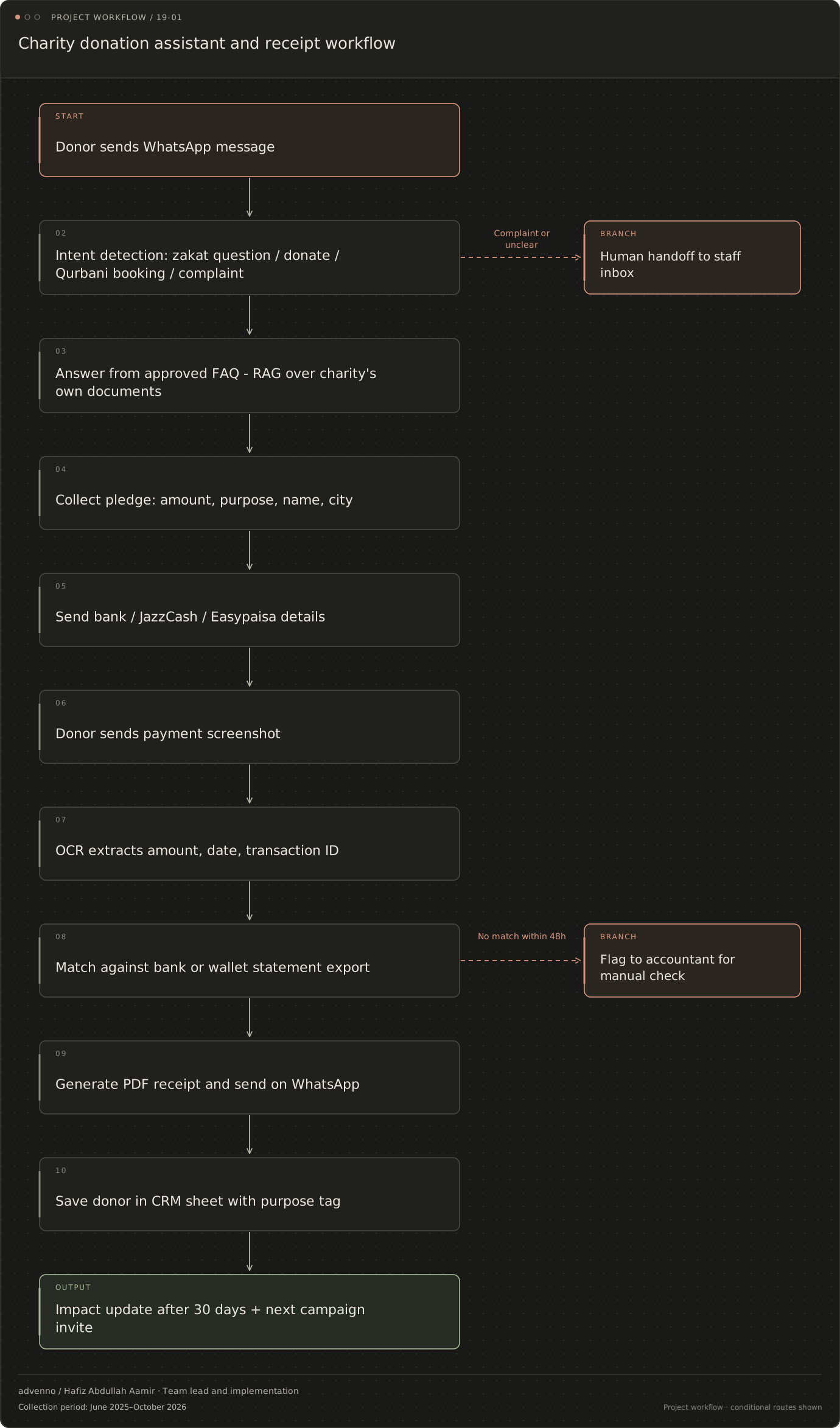
Read the stages and decision branches
- Donor sends WhatsApp message
- Intent detection: zakat question / donate / Qurbani booking / complaint
- Answer from approved FAQ - RAG over charity's own documents
- Complaint or unclear: Human handoff to staff inbox
- Answer from approved FAQ - RAG over charity's own documents
- Collect pledge: amount, purpose, name, city
- Send bank / JazzCash / Easypaisa details
- Donor sends payment screenshot
- OCR extracts amount, date, transaction ID
- Match against bank or wallet statement export
- Generate PDF receipt and send on WhatsApp
- No match within 48h: Flag to accountant for manual check
- Generate PDF receipt and send on WhatsApp
- Save donor in CRM sheet with purpose tag
- Impact update after 30 days + next campaign invite
- Human handoff to staff inbox
- Flag to accountant for manual check
Related acquisition workflow: Charities
A separate lead-research and CRM workflow configured for this business niche. It connects evidence gathering, qualification and follow-up; it is distinct from the operational system shown above.
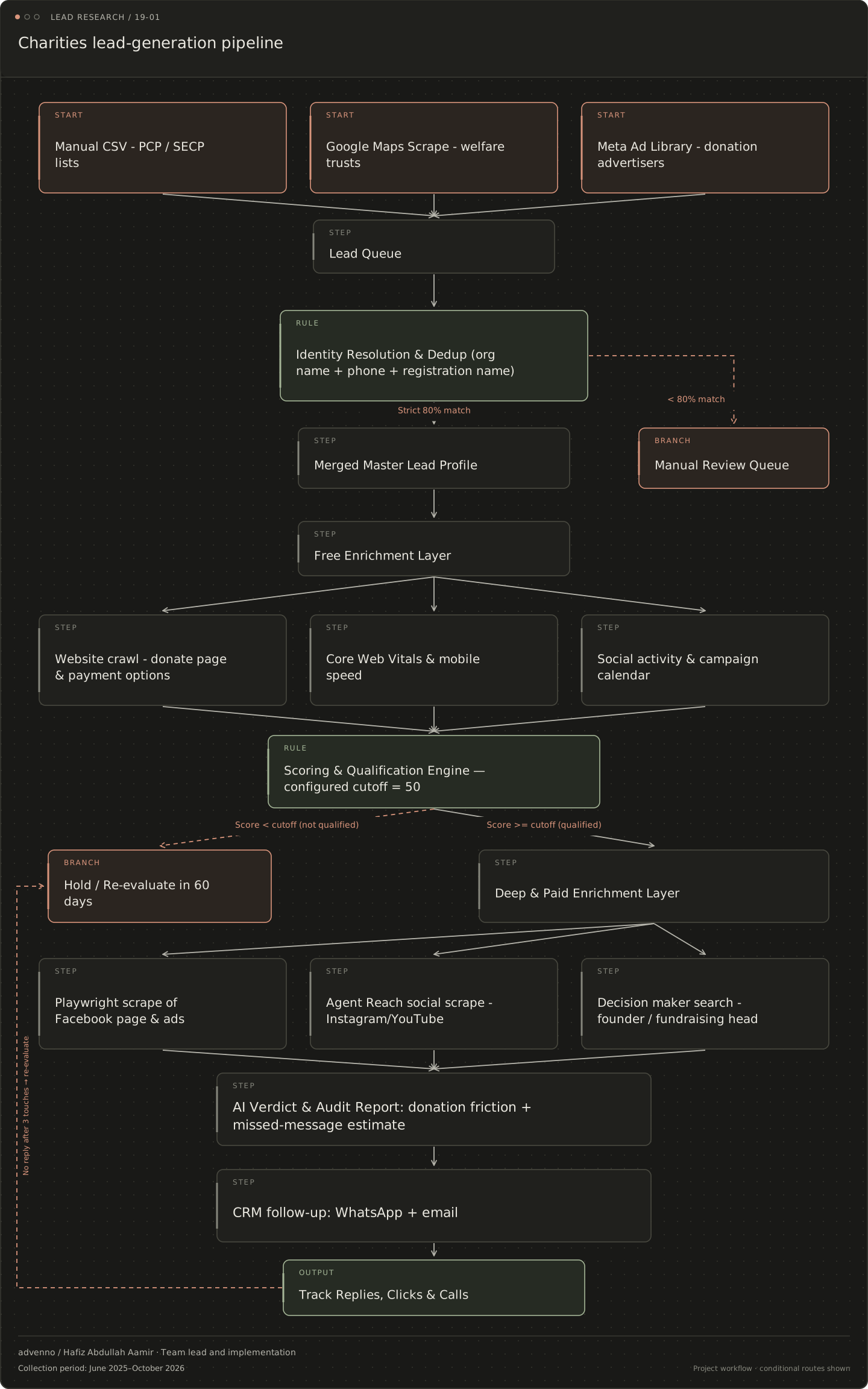
Read the stages and decision branches
- Manual CSV - PCP / SECP lists
- Google Maps Scrape - welfare trusts
- Meta Ad Library - donation advertisers
- Lead Queue
- Identity Resolution & Dedup (org name + phone + registration name)
- Strict 80% match: Merged Master Lead Profile
- < 80% match: Manual Review Queue
- Merged Master Lead Profile
- Manual Review Queue
- Free Enrichment Layer
- Website crawl - donate page & payment options
- Core Web Vitals & mobile speed
- Social activity & campaign calendar
- Scoring & Qualification Engine — configured cutoff = 50
- Score < cutoff (not qualified): Hold / Re-evaluate in 60 days
- Score >= cutoff (qualified): Deep & Paid Enrichment Layer
- Hold / Re-evaluate in 60 days
- Deep & Paid Enrichment Layer
- Playwright scrape of Facebook page & ads
- Agent Reach social scrape - Instagram/YouTube
- Decision maker search - founder / fundraising head
- AI Verdict & Audit Report: donation friction + missed-message estimate
- CRM follow-up: WhatsApp + email
- Track Replies, Clicks & Calls
- no reply after 3 touches: Hold / Re-evaluate in 60 days
What makes the system useful.
What does a charity operations workflow connect beyond answering donors?
A donation conversation is only the beginning of the operational work. The donor-relations team answers a question, finance checks the payment, a programme team records beneficiary information and the organisation later explains how funds were used. This project collection covered donor support, receipt processing, stewardship, beneficiary intake, reporting and CSR proposal preparation.
These functions use different evidence. An approved FAQ supports an answer about a campaign; a bank record supports payment confirmation; programme records support a board report. Connecting them is useful, but treating all of them as a single chatbot response would lose the distinction between a question, a pledge, a confirmed donation and a programme activity.
How are donor answers and payment confirmation kept separate?
The conversational part used intent routing and retrieval from the charity's approved information. The original project context included Urdu, Roman Urdu and English questions about donations and religious giving. Questions outside approved information needed a human handoff, particularly where an answer would amount to a religious ruling.
Payment processing followed another path. Vision extraction read details such as an amount and transaction identifier from a submitted image. Rules then compared that information with a bank statement or export before receipt preparation. A language model could assist extraction and explanation, but it was not the authority that decided whether money had arrived.
How would a charity evaluate this collection without inventing impact?
Useful measures include donor response time, unresolved payment matches, receipt corrections and administrative time spent on reconciled donations. Repeat-donor activity and the time required to prepare reports can also be evaluated. These are suggested measures, not published results from this project.
A practical review should include an edited payment screenshot, a duplicate beneficiary record and a donor question the approved FAQ cannot answer. Each tests a different boundary. Beneficiary information also needs restricted access and appropriate storage; identifying a possible duplicate is a reason to review a case, not a reason to deny support automatically.