Public-service complaint, correspondence and records workflows
Hafiz Abdullah Aamir developed public-service workflow modules covering multilingual complaint classification and routing, official correspondence drafting, and scanned-record digitisation and search. The collection supports the preparation and organisation of information for staff, while officers retain responsibility for reviewing correspondence and interpreting, investigating and resolving matters.
By Advenno · Project team lead: Hafiz Abdullah Aamir · Published · Updated
Where the work gets stuck.
A public-service office receives information in several forms: a complaint written in the reporter’s own words, correspondence requiring an appropriate official response, and scanned documents that staff need to find again. Each requires a different preparation step before it can support the office’s work. Complaint category, department and urgency guide routing; correspondence needs responsible-officer review; digitised records need a usable text and search layer. The collection addressed these information-handling tasks while preserving the staff’s responsibility for interpretation and decisions.
A system built around the work.
The complaint module supported intake and classification of the issue, department and urgency across Urdu, Roman Urdu and English. Routing logic connected that information with the next handling step. Alongside it, official correspondence drafts used approved templates and remained subject to officer review. Scanned-record digitisation added OCR and search to help staff work with document collections, with the original scans available for checking extraction errors. These modules supported different parts of public-service administration; staff retained responsibility for interpreting records, approving correspondence and resolving the matter.
How the pieces connect.
Receive the complaint text
Bring the complainant's account into the module as the input to the triage and routing workflow.
Identify the issue category
Support classification of the reported matter so the incoming account can be organised within the complaint-handling process.
Support routing and urgency
Prepare the departmental and urgency information used to help direct the complaint towards its next handling stage.
Pass to the handling workflow
Carry the organised complaint information forward for the responsible people to review and handle within the wider service process.
What the project delivered.
The delivered collection covered complaint preparation and routing, reviewed correspondence drafting, and digitised records with search. It connected incoming information with usable administrative outputs for the responsible staff. The workflow supported review and coordination while preserving human accountability for official decisions, investigation and resolution.
The systems behind the workflow.
Each module handles a different part of the work. Together, they connect the operational handoffs around this project.
Complaint classification and routing
The intake module organised complaint text into a category, an appropriate handling department and an urgency signal. It supported the next administrative step within a wider complaint-handling system.
- How it works
A multilingual classifier, routing rules and ticket records connect the incoming description with a handling path.
- Operational consideration
Ambiguous, sensitive or misrouted complaints need staff review. The system assists organisation of information; it does not decide the complaint's validity or final resolution.
Official letter drafting
The correspondence module helped prepare Urdu and English letters using approved wording and templates. It supported the officer's drafting work while keeping approval before an official communication.
- How it works
Template-guided drafting uses the relevant case information and returns a document for responsible review.
- Operational consideration
An official statement needs authorised wording and approval. A generated draft must not invent a decision, commitment or factual finding absent from the case.
Scanned record digitisation and search
The records module turned scanned files into searchable material. It connected the staff member's search with extracted text while preserving the need to check the underlying document.
- How it works
OCR and a search index make document content retrievable, including the Urdu/English material described in the project.
- Operational consideration
Extraction quality varies with language and scan condition. A search result should lead back to the original record, especially when a name, date or instruction is consequential.
Inside the system.
Choose a workflow to open the full diagram. Zoom in to follow its decisions and handoffs, or read the stages in the text view.
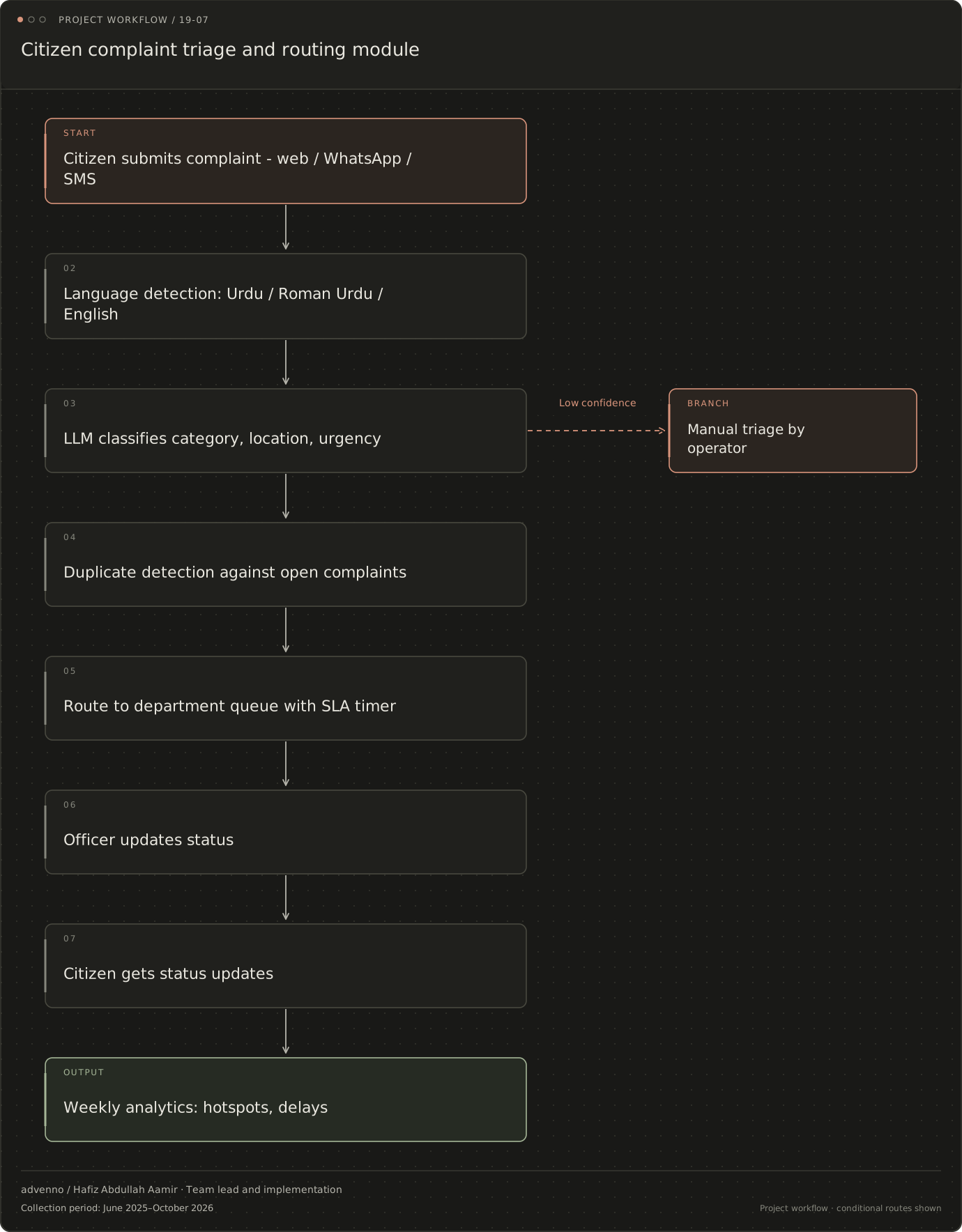
Citizen complaint triage and routing module
The project’s operational flow, including decision points and exception routes. Named channels reflect the original project context; a similar implementation is scoped around your systems.
Read the stages and decision branches
- Citizen submits complaint - web / WhatsApp / SMS
- Language detection: Urdu / Roman Urdu / English
- LLM classifies category, location, urgency
- Duplicate detection against open complaints
- Low confidence: Manual triage by operator
- Duplicate detection against open complaints
- Route to department queue with SLA timer
- Officer updates status
- Citizen gets status updates
- Weekly analytics: hotspots, delays
- Manual triage by operator
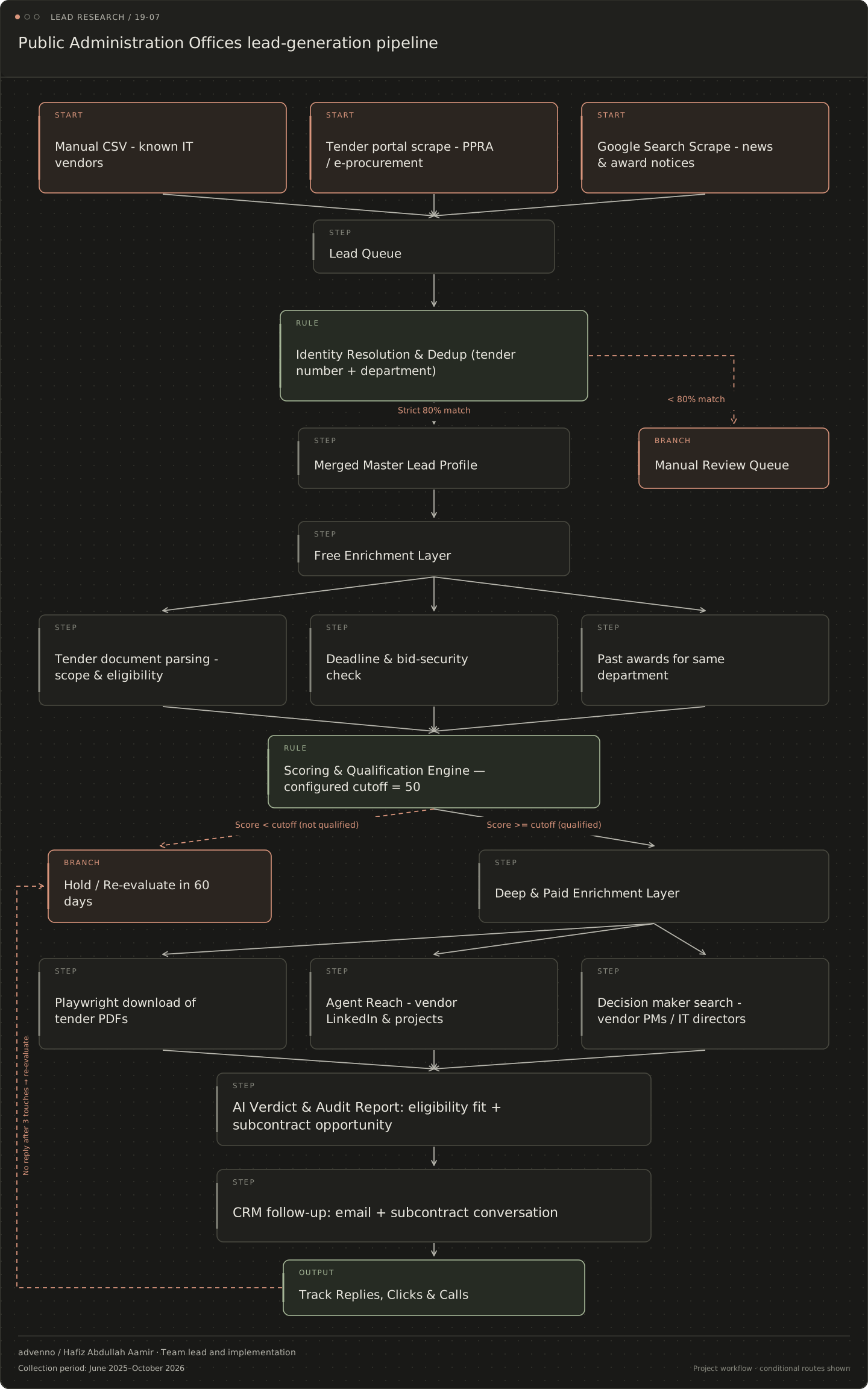
Related acquisition workflow: Public administration
A separate lead-research and CRM workflow configured for this business niche. It connects evidence gathering, qualification and follow-up; it is distinct from the operational system shown above.
Read the stages and decision branches
- Manual CSV - known IT vendors
- Tender portal scrape - PPRA / e-procurement
- Google Search Scrape - news & award notices
- Lead Queue
- Identity Resolution & Dedup (tender number + department)
- Strict 80% match: Merged Master Lead Profile
- < 80% match: Manual Review Queue
- Merged Master Lead Profile
- Manual Review Queue
- Free Enrichment Layer
- Tender document parsing - scope & eligibility
- Deadline & bid-security check
- Past awards for same department
- Scoring & Qualification Engine — configured cutoff = 50
- Score < cutoff (not qualified): Hold / Re-evaluate in 60 days
- Score >= cutoff (qualified): Deep & Paid Enrichment Layer
- Hold / Re-evaluate in 60 days
- Deep & Paid Enrichment Layer
- Playwright download of tender PDFs
- Agent Reach - vendor LinkedIn & projects
- Decision maker search - vendor PMs / IT directors
- AI Verdict & Audit Report: eligibility fit + subcontract opportunity
- CRM follow-up: email + subcontract conversation
- Track Replies, Clicks & Calls
- no reply after 3 touches: Hold / Re-evaluate in 60 days
What makes the system useful.
What did the public-service project collection cover?
The complaint-routing module formed part of a wider collection that also covered approved letter drafting and scanned-record search. These functions support the staff receiving public enquiries, directing cases, preparing correspondence and retrieving documents. The work is described as an assistive module for a broader service system, rather than a claim to have replaced an entire government platform.
The original complaint context included Urdu, Roman Urdu and English. A citizen's description needed a useful category, department and urgency indication before the handling team could act. That preparation is different from deciding whether a complaint is valid, what remedy applies or whether it has been resolved.
How do classification, routing rules and document search fit together?
The complaint approach used language assistance to interpret incoming text, explicit rules to connect categories with handling routes and ticket records to keep the operational context. SLA tracking supports delayed-case escalation, while complaint analytics and geographic hotspot views help staff review patterns in the recorded activity. Urgency labels and departmental routing help staff prioritise work; they do not remove the responsible officer's judgement.
The document lane used OCR to make scanned material searchable, with particular attention to the quality of Urdu extraction. Correspondence drafting used approved templates and human review. A retrieved scan, an extracted text passage and a draft official response remain different artefacts with different authority.
What should a service team evaluate before adopting the modules?
For a new adaptation, useful tests include mixed-language complaints, unclear department ownership, incorrectly extracted document text and letters that require an exception to the normal template. Routing accuracy, the amount of correction work and overdue handling are sensible evaluation areas; they are proposed checks, not measured results published for this project.
Citizen data and official records require an agreed access and processing arrangement. Do not send them to an external model service without the organisation's approval. Define responsibility for record access, exception handling and approval before connecting these modules to an organisation's live service platform.