Cloud kitchen analytics, payouts and operations automation
Hafiz Abdullah Aamir developed cloud-kitchen automation projects spanning combined order analytics, menu engineering, aggregator payout reconciliation, direct ordering, preparation forecasting and brand-specific review alerts. The collection connects reporting and operational decisions around the existing kitchen systems, with computed metrics supplying the basis for written business summaries.
By Advenno · Project team lead: Hafiz Abdullah Aamir · Published · Updated
Where the work gets stuck.
A cloud kitchen can run several brands through multiple ordering channels while preparing the food in one operation. That creates different views of the same business: individual brands, channel reports, menu items and promotions. The project addressed the work needed to bring those views together. Operators needed to examine how menu items were performing across their trading activity, rather than interpret each source in isolation and manually reconstruct the relationship between orders, item popularity and commercial performance.
A system built around the work.
The implementation consolidated order information across brands and channels and normalised it for reporting. That common data view supported menu engineering: examining item popularity alongside profitability instead of treating order count alone as the whole picture. The hub provided a reporting layer around the existing operation rather than a replacement for the point-of-sale system. Computed metrics also supplied the basis for written business summaries. The language-model component worked with those calculated results to produce action notes, keeping the analysis grounded in the reporting data rather than asking generated text to invent business figures.
How the pieces connect.
Collect order inputs
The reporting workflow brought together the available order information for the kitchen's brands and channels, creating a starting point for analysis across the operation rather than within one report.
Normalise the reporting data
Data preparation aligned the incoming information for a shared analytics view, connecting the brands and channels with the menu items and orders that needed to be examined together.
Build the combined order view
The hub presented order activity across the participating sources, supporting a broader reading of the kitchen's business than a set of separate brand or channel summaries.
Examine the menu performance
Menu engineering related item popularity to profitability, giving the reporting process a way to examine commercial performance alongside the volume of orders associated with each item.
Prepare business summaries
Calculated metrics fed written action notes, connecting the numerical reporting layer with a concise operational summary while keeping the business figures derived from the underlying analysis.
What the project delivered.
The delivered hub provided a combined view of multi-brand order activity and menu performance. It connected source data with item-level analysis and written summaries, giving operational review a shared reporting base. The project covered the flow from order inputs to decision-support outputs, with brands and channels considered together rather than as disconnected reports.
The systems behind the workflow.
Each module handles a different part of the work. Together, they connect the operational handoffs around this project.
Unified orders and menu engineering
The analytics hub brought brands and channels into a common order view. Menu engineering related item popularity to profitability, while written action notes helped communicate the calculated results. It connected reporting with decisions without requiring replacement of the existing POS.
- How it works
An extraction and normalisation layer feeds a structured reporting store, dashboard and summaries based on computed metrics.
- Operational consideration
Report access determines coverage. Incomplete exports or inconsistent item definitions need attention before a combined view can support a meaningful comparison across brands.
Aggregator payout reconciliation
The finance workflow compared order-related information with payout reports and surfaced discrepancies for review. It gave the accounts side of the operation its own check rather than assuming that a sales dashboard also explained whether the expected money had arrived.
- How it works
Structured report inputs and reconciliation rules produce exception information for the accounts review.
- Operational consideration
Aggregator report formats can change. A flagged difference requires interpretation; it is not automatically evidence of a payout error or a proven amount that can be recovered.
Direct ordering for repeat customers
The sales module added a web-cart and messaging route for customers ordering directly. It complemented the multi-channel analytics by making a separate customer-ordering path part of the wider operating system.
- How it works
A structured web cart connects customer orders with messaging and the relevant operational records.
- Operational consideration
Direct ordering still requires an accurate menu, usable order information and communication planning. The operating team needs to review how those direct orders fit alongside the channels it already handles.
Preparation forecasting
Preparation planning used historical demand as an input for anticipating kitchen needs. It addressed a different question from the retrospective dashboard: what the kitchen might need to prepare next, rather than only what it sold previously.
- How it works
A simple time-series forecast uses available order history to support preparation decisions.
- Operational consideration
History quality and coverage affect a forecast. The kitchen still decides actual quantities, using the forecast as decision support alongside current operational information.
Review sentiment and alerts by brand
The reputation module kept quality signals attached to the relevant virtual brand. It helped surface issues that could disappear in an aggregated view of the kitchen, giving operations another route from customer experience to review.
- How it works
Permitted feedback access or exports feed sentiment classification and brand-specific alerts.
- Operational consideration
Source access must be appropriate for the channel. Review text provides a signal to investigate, not a complete explanation of why an order or brand received a poor rating.
Inside the system.
Choose a workflow to open the full diagram. Zoom in to follow its decisions and handoffs, or read the stages in the text view.
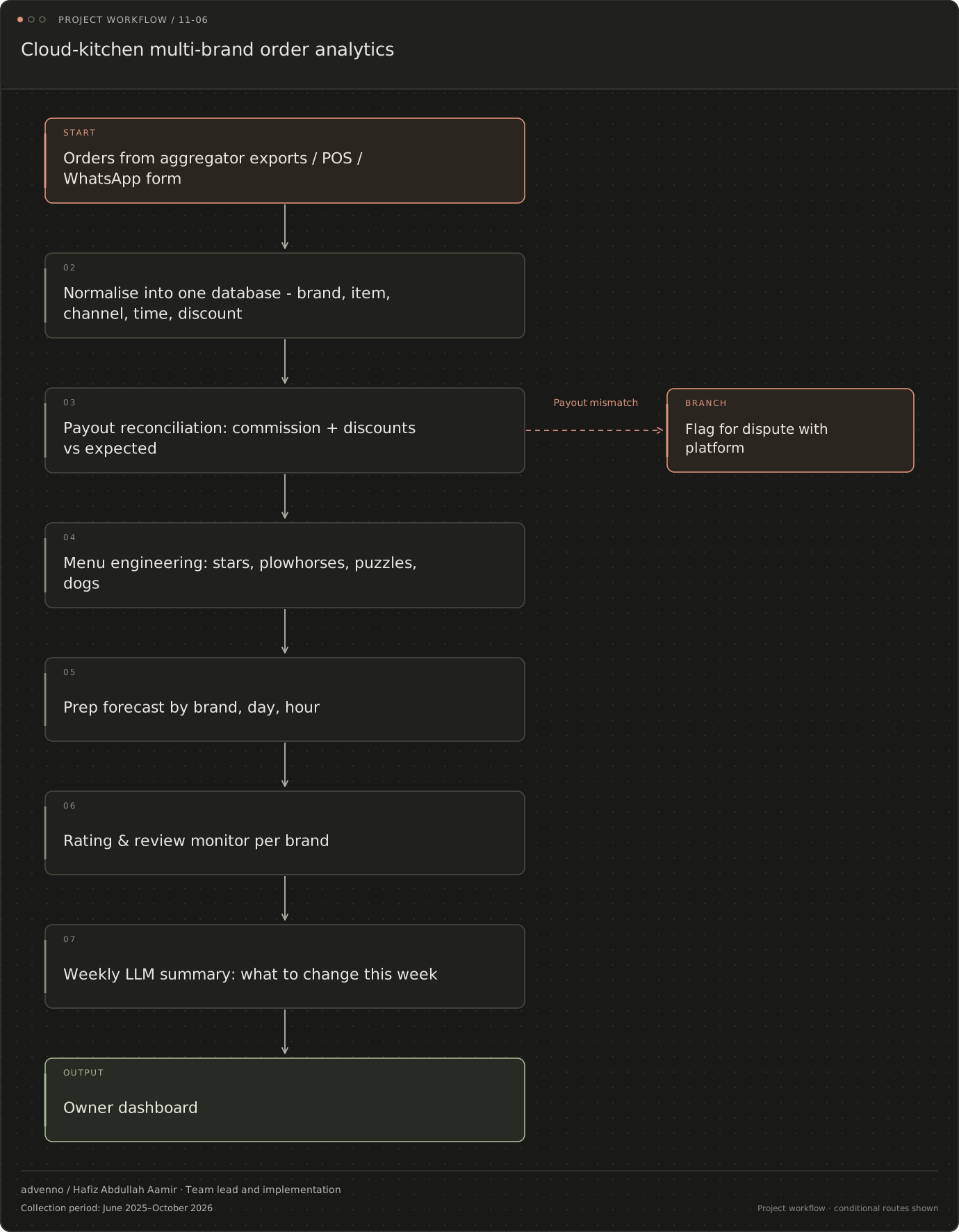
Cloud-kitchen multi-brand order analytics
The project’s operational flow, including decision points and exception routes. Named channels reflect the original project context; a similar implementation is scoped around your systems.
Read the stages and decision branches
- Orders from aggregator exports / POS / WhatsApp form
- Normalise into one database - brand, item, channel, time, discount
- Payout reconciliation: commission + discounts vs expected
- Menu engineering: stars, plowhorses, puzzles, dogs
- Prep forecast by brand, day, hour
- Rating & review monitor per brand
- Weekly LLM summary: what to change this week
- Owner dashboard
- Flag for dispute with platform
Related acquisition workflow: Cloud kitchens
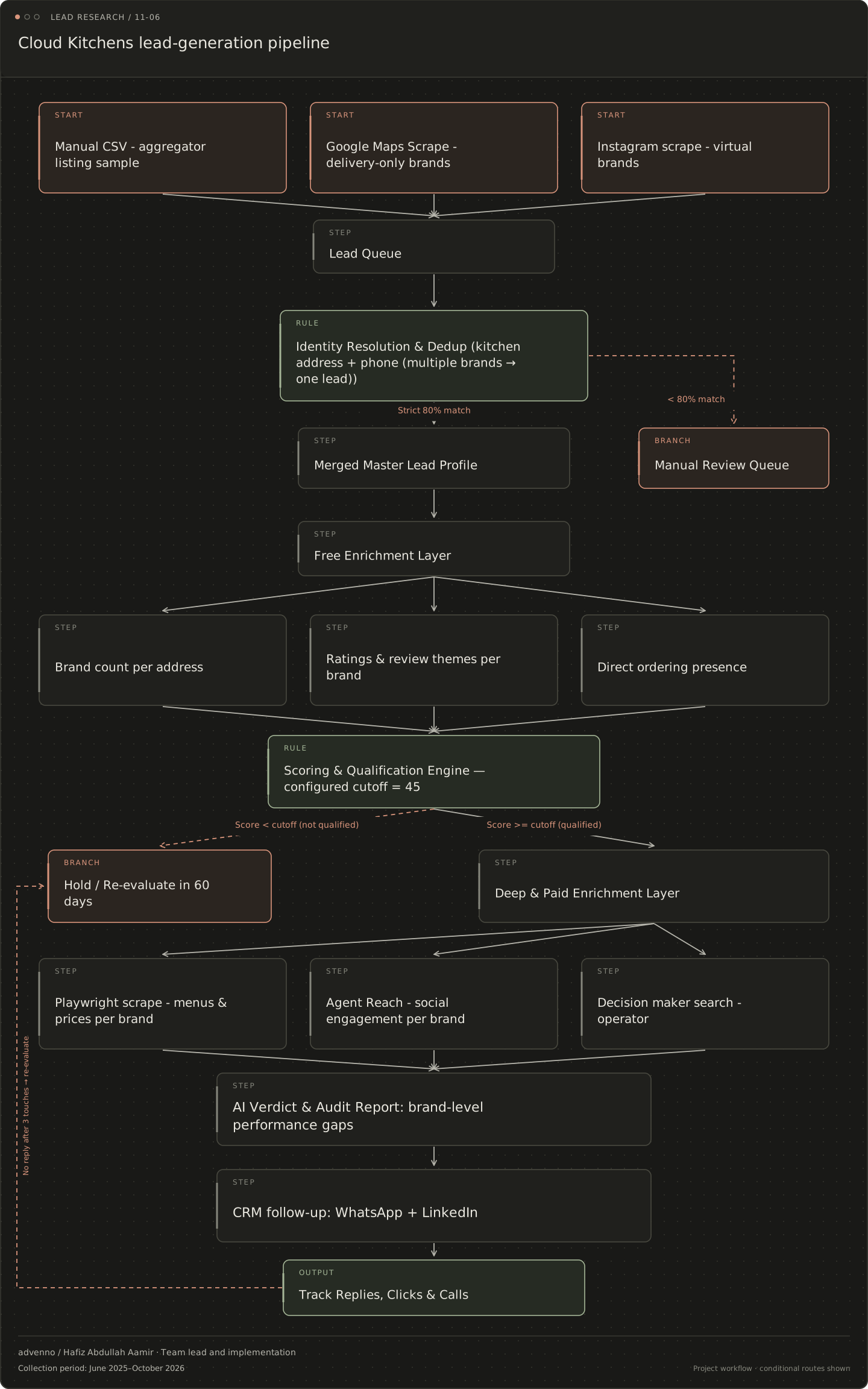
A separate lead-research and CRM workflow configured for this business niche. It connects evidence gathering, qualification and follow-up; it is distinct from the operational system shown above.
Read the stages and decision branches
- Manual CSV - aggregator listing sample
- Google Maps Scrape - delivery-only brands
- Instagram scrape - virtual brands
- Lead Queue
- Identity Resolution & Dedup (kitchen address + phone (multiple brands → one lead))
- Strict 80% match: Merged Master Lead Profile
- < 80% match: Manual Review Queue
- Merged Master Lead Profile
- Manual Review Queue
- Free Enrichment Layer
- Brand count per address
- Ratings & review themes per brand
- Direct ordering presence
- Scoring & Qualification Engine — configured cutoff = 45
- Score < cutoff (not qualified): Hold / Re-evaluate in 60 days
- Score >= cutoff (qualified): Deep & Paid Enrichment Layer
- Hold / Re-evaluate in 60 days
- Deep & Paid Enrichment Layer
- Playwright scrape - menus & prices per brand
- Agent Reach - social engagement per brand
- Decision maker search - operator
- AI Verdict & Audit Report: brand-level performance gaps
- CRM follow-up: WhatsApp + LinkedIn
- Track Replies, Clicks & Calls
- no reply after 3 touches: Hold / Re-evaluate in 60 days
What makes the system useful.
Several virtual brands create several views of one operation
A cloud kitchen can prepare food for multiple virtual brands while receiving order and performance information through different channels. The founder, kitchen manager, brand colleague and accountant need different views of those records. The project collection connected unified order analytics with menu performance, payout reconciliation, preparation planning, direct ordering and brand-specific review alerts. That scope matters because one brand’s sales volume, a channel payout and a kitchen preparation decision are related, but they are not the same business question.
Computed measures come before generated business summaries
The reporting layer normalised channel and brand data before comparing item popularity and profitability. That distinction prevents order count alone from becoming a proxy for commercial performance. Calculated metrics then supplied the basis for written weekly action notes. The language model explained the analysis rather than inventing sales or margin figures. The system sat around the existing POS and operating records, with source exports and access determining the available reporting coverage. Separate reconciliation and forecast modules used the relevant data for their own purposes.
Evaluate data quality and operating decisions separately
Gross margin by brand, payout discrepancies, waste and direct-order share are useful evaluation categories for this system. They are not reported improvements from the project. Before interpreting them, review whether channel exports are complete, item and brand definitions are aligned, and report formats have changed. Preparation forecasting also needs usable history. A clear written summary is only as dependable as the calculated records beneath it. The operator and accounts team remain responsible for examining exceptions and deciding what to change in menus, preparation or commercial arrangements.