Employer branding stories, events and campaign reporting
Hafiz Abdullah Aamir developed employer-branding automation projects covering employee-story collection and approved content, campus-drive registration and attendance, monthly campaign reports and employer-brand monitoring. The collection connects contributor material, event participation and campaign evidence with the work of writers, reviewers and agency account teams.
By Advenno · Project team lead: Hafiz Abdullah Aamir · Published · Updated
Where the work gets stuck.
An employee story involves more than producing a social post. Someone needs to collect the employee's account, turn it into a usable draft and coordinate the review before it becomes public. Employer-branding agencies also need the content to reflect the client's tone while preserving what the employee actually meant.
The project addressed those handoffs between the contributor, writer and reviewer. Content production worked from authentic source material, while the wider collection also supported campus-drive participation, campaign reporting and monitored employer-brand feedback. AI-assisted drafting formed one stage of that process; the approval step remained important because a polished draft is not the same as a story that the employee and organisation have agreed to publish.
A system built around the work.
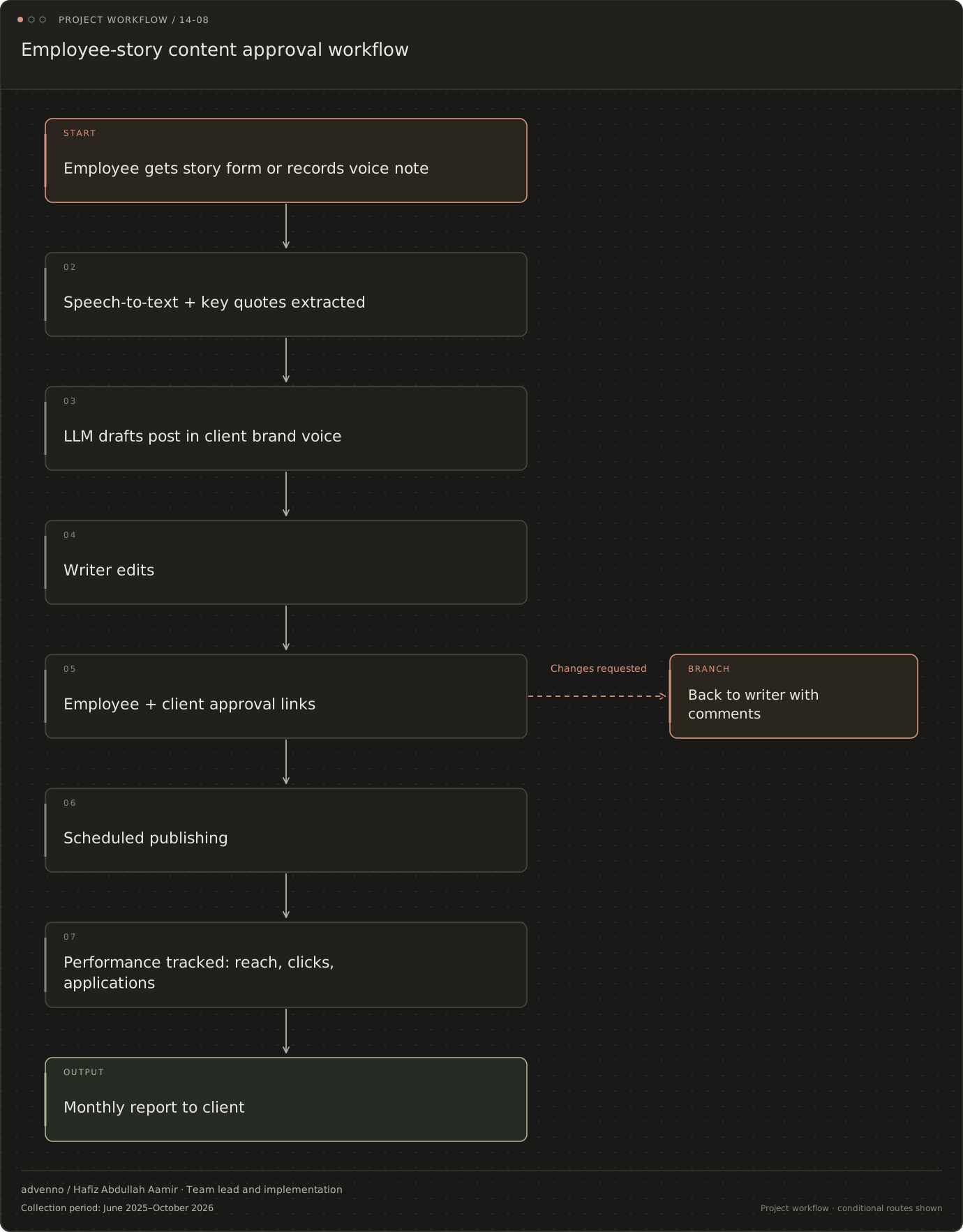
The completed workflow connected story collection through forms or voice material with transcription, AI-assisted drafting and approval. The drafting stage used the collected account and brand guidance as inputs. Review then sat between the draft and publishing, keeping the contributor's story and the organisation's approval within the production sequence.
This created an operational path for employer-branding content rather than a standalone text-generation task. The project connected the intake of the employee's experience with the work of preparing and approving its public presentation. The handoff from drafting to approval is central because the employee account and the agency's prepared version must meet before publication.
How the pieces connect.
Collect the employee account
Gather story material through the intake process so the content begins with the employee's own experience and information.
Prepare the draft
Use the collected account, transcription where relevant and brand guidance to support an initial written version of the story.
Review and approve
Bring the draft through the employee and organisational review needed before the story is ready for public use.
Move to publication
Carry the approved story into the publishing stage as the final part of the employer-branding production workflow.
What the project delivered.
The project delivered a connected employee-story production workflow. Story intake, drafting, review and publication were treated as stages of the same piece of content, giving the agency a process for moving from source material to an approved output. The writer works from the collected account, and the publication stage follows the approval of the resulting story.
The systems behind the workflow.
Each module handles a different part of the work. Together, they connect the operational handoffs around this project.
Employee story pipeline
Story production connected forms or voice interviews with transcription, drafting, review and publication. It gave the agency a path from the employee's original account to a version the relevant people had approved.
- How it works
Speech-to-text and brand-guided drafting support the writer; an approval workflow records employee and organisational sign-off.
- Operational consideration
Preserve meaning and avoid invented quotations. A later revision may need renewed review if it changes what the employee or client originally approved.
Campus-drive registration
The event module handled registration, reminders and QR check-in for campus activity. It connected the agency's event preparation with the attendance information needed after the drive.
- How it works
Forms and event records drive reminders and a QR-supported check-in process.
- Operational consideration
Student information needs a clear purpose and access boundary. A person registered for one campus event should not automatically be treated as an unrestricted marketing contact.
Monthly campaign reports
Reporting brought campaign data into a draft explanation for the client. It addressed the account manager's recurring task of turning channel exports into a coherent report.
- How it works
Analytics exports provide the measured figures; a language model assists the narrative and the account team reviews it.
- Operational consideration
Numbers must come from the source data. Describe what each measure represents and do not infer recruitment impact solely from content views or engagement.
Employer-brand monitoring
Monitoring organised relevant public employer-brand activity into material a strategist could review. It supported contextual research alongside the agency's own content and event work.
- How it works
Permitted source collection and reviewed summaries identify themes in public employer-brand material.
- Operational consideration
Source access conditions and factual accuracy matter. A summary should not imply access to competitors' private results or present a public impression as measured business performance.
Inside the system.
Choose a workflow to open the full diagram. Zoom in to follow its decisions and handoffs, or read the stages in the text view.
Employee-story content approval workflow
The project’s operational flow, including decision points and exception routes. Named channels reflect the original project context; a similar implementation is scoped around your systems.
Read the stages and decision branches
- Employee gets story form or records voice note
- Speech-to-text + key quotes extracted
- LLM drafts post in client brand voice
- Writer edits
- Employee + client approval links
- Scheduled publishing
- Changes requested: Back to writer with comments
- Scheduled publishing
- Performance tracked: reach, clicks, applications
- Monthly report to client
- Back to writer with comments
Related acquisition workflow: Employer branding agencies
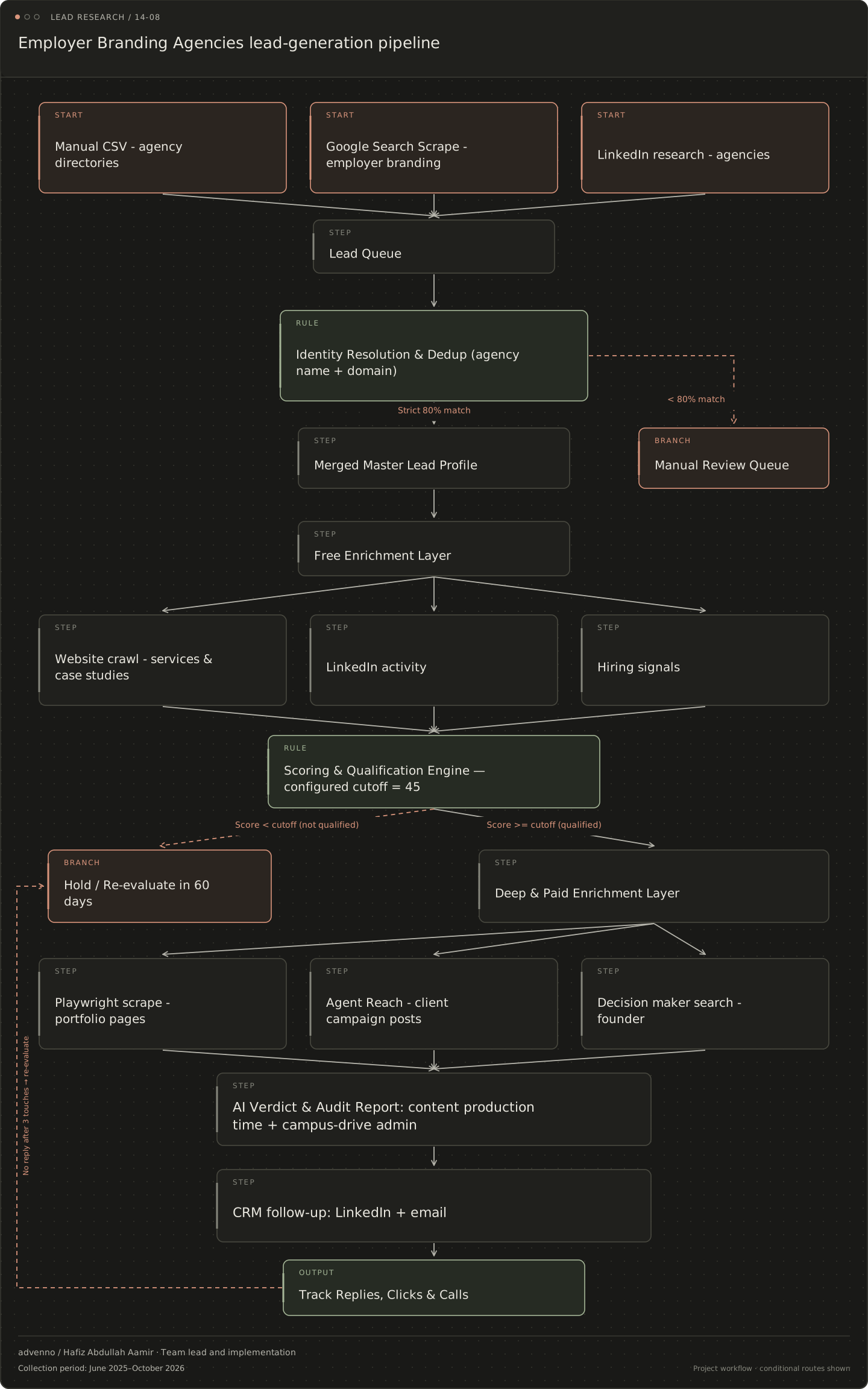
A separate lead-research and CRM workflow configured for this business niche. It connects evidence gathering, qualification and follow-up; it is distinct from the operational system shown above.
Read the stages and decision branches
- Manual CSV - agency directories
- Google Search Scrape - employer branding
- LinkedIn research - agencies
- Lead Queue
- Identity Resolution & Dedup (agency name + domain)
- Strict 80% match: Merged Master Lead Profile
- < 80% match: Manual Review Queue
- Merged Master Lead Profile
- Manual Review Queue
- Free Enrichment Layer
- Website crawl - services & case studies
- LinkedIn activity
- Hiring signals
- Scoring & Qualification Engine — configured cutoff = 45
- Score < cutoff (not qualified): Hold / Re-evaluate in 60 days
- Score >= cutoff (qualified): Deep & Paid Enrichment Layer
- Hold / Re-evaluate in 60 days
- Deep & Paid Enrichment Layer
- Playwright scrape - portfolio pages
- Agent Reach - client campaign posts
- Decision maker search - founder
- AI Verdict & Audit Report: content production time + campus-drive admin
- CRM follow-up: LinkedIn + email
- Track Replies, Clicks & Calls
- no reply after 3 touches: Hold / Re-evaluate in 60 days
What makes the system useful.
What did the wider employer-branding project collection cover?
The employee-story workflow was one part of a broader employer-branding collection. It also covered campus-drive registration, campaign reporting and employer-brand monitoring. These modules support an agency's writers, account managers, strategists and event coordinators at different points in delivering work for a client.
A story starts with an employee's account, while a campus event starts with registration and attendance. A campaign report starts with measured channel information. They should not be collapsed into a generic content generator: each workflow has a different source of truth and a different approval requirement. The collection connected these administrative steps around the agency's delivery process.
How do voice notes become content without losing the employee's meaning?
The story approach used forms or voice material for intake, transcription to make spoken material usable, and brand guidance to assist drafting. Employee and legal review then sat before publication. The writer's role was to preserve the person's meaning and improve the draft, not to manufacture a quote or an experience that was never provided.
Campaign reporting used a separate pattern. Analytics exports supplied the numbers and a language model helped draft the explanation. Public-source monitoring similarly supported reviewed summaries for strategy work. In both cases, a fluent narrative needs to stay grounded in its source material rather than presenting speculation as a campaign result or competitor fact.
What should an agency evaluate across content and campus workflows?
Content output, approval-cycle time, campus registrations and attendance are useful measures. They are proposed evaluation categories, not achieved performance figures. A useful content review should also track corrections and whether employee approvals remain clear through revisions.
Campus events introduce student information, reminders and event-day check-in. Registration should not silently become permission for unrelated marketing. For reporting, keep counts and their definitions consistent so that registration, attendance and campaign engagement remain distinct. This makes the report useful to the client without exaggerating what the activity achieved.