Executive search research, reporting and knowledge workflows
Hafiz Abdullah Aamir developed executive-search workflows supporting market mapping, candidate and interview research, consultant approach drafts, client reporting and private retrieval of past-search knowledge. The collection brings research and reusable information into the consultant’s preparation process, while assessment, confidentiality and relationship decisions remain with the search team.
By Advenno · Project team lead: Hafiz Abdullah Aamir · Published · Updated
Where the work gets stuck.
An executive search involves assembling a detailed picture of a role and the people who might fit it. Researchers map relevant organisations, review professional information and prepare a longlist. Consultants then approach candidates, conduct conversations and report progress to the client. The information collected at one stage needs to remain useful at the next.
The project addressed the preparation and documentation work around that process. It focused on research assistance and draft outputs, recognising that a candidate's suitability and an approach to a senior person require a consultant's judgement. A generated summary is supporting material, not an independently verified assessment.
A system built around the work.
The delivered assistant supported market mapping, candidate-profile research, personalised outreach drafts, interview summaries and client-report preparation. It brought these related activities together around the retained-search workflow, helping organise information from initial research through to the material a consultant reviews for a client.
Consultants remained responsible for reviewing the outputs and making decisions. The system's role was to assist with assembling, summarising and drafting search material. This distinction applies throughout the project: an outreach draft requires an appropriate human approach, and a report draft remains subject to the consultant's assessment of the underlying information.
How the pieces connect.
Map the search
Use the role requirements to organise the market and company research that informs the executive-search assignment.
Prepare research material
Develop candidate-profile summaries and longlist material for the consultant's review of relevant people and professional experience.
Assist the conversation
Prepare personalised approach drafts and interview summaries as supporting material for consultant-led candidate communication and assessment.
Draft the client report
Bring research and assessment material into a report draft that the consultant reviews before it is used with the client.
What the project delivered.
The completed project delivered research and reporting assistance across several stages of an executive search. Its outputs supported market mapping, longlist preparation, candidate communication and client-facing reporting. The consultant continues to decide which people to consider, how to approach them and which information belongs in the client report.
The systems behind the workflow.
Each module handles a different part of the work. Together, they connect the operational handoffs around this project.
Market-map and target-list drafts
Research assistance helped organise target companies, roles and potential candidate context around a retained-search brief. This supported the researcher's preparation before a consultant decided which parts of the market to pursue.
- How it works
Reviewed research and structured templates give the language model a bounded drafting task rather than asking it to invent a market.
- Operational consideration
Check every company and person against reliable source information. A plausible generated name is not evidence that an organisation or candidate fits the search.
Interview summaries against competencies
Interview material was converted into summaries that could be reviewed against the search firm's assessment rubric. This connected the conversation with the evidence needed for consultant and client reporting.
- How it works
Speech-to-text produces interview material; language-model assistance organises it against defined competency headings.
- Operational consideration
A transcript may contain errors and a summary may omit context. Consultants need to review both before treating a statement as assessment evidence.
Consultant approach drafts
The project included preparation of personalised approach messages in a consultant's tone. The draft supported the professional initiating a conversation rather than substituting a generic mass message for the relationship.
- How it works
Tone guidance and verified candidate context provide inputs for a draft the consultant can edit.
- Operational consideration
A suggested approach should not reveal confidential client information or invent familiarity. The consultant decides whether, when and how to contact the person.
Client-report preparation
Reports brought together research, interview notes and the consultant's reviewed assessment. Templates helped organise the submission so that preparation work could move into a coherent client-facing document.
- How it works
Structured report sections and reviewed narrative drafts use the evidence assembled during the search.
- Operational consideration
The final reviewer checks names, claims and recommendations. Fluent writing cannot replace evidence or the consultant's responsibility for the assessment.
Private past-search archive
The knowledge module made earlier search material available for later research. It supported reuse of market understanding within the firm rather than turning confidential records into a public candidate database.
- How it works
Retrieval-augmented search connects an authorised question to relevant material from the firm's past-search archive.
- Operational consideration
Define which assignments and records each person may access. Reuse must respect the original confidentiality and the current relevance of the information.
Inside the system.
Choose a workflow to open the full diagram. Zoom in to follow its decisions and handoffs, or read the stages in the text view.
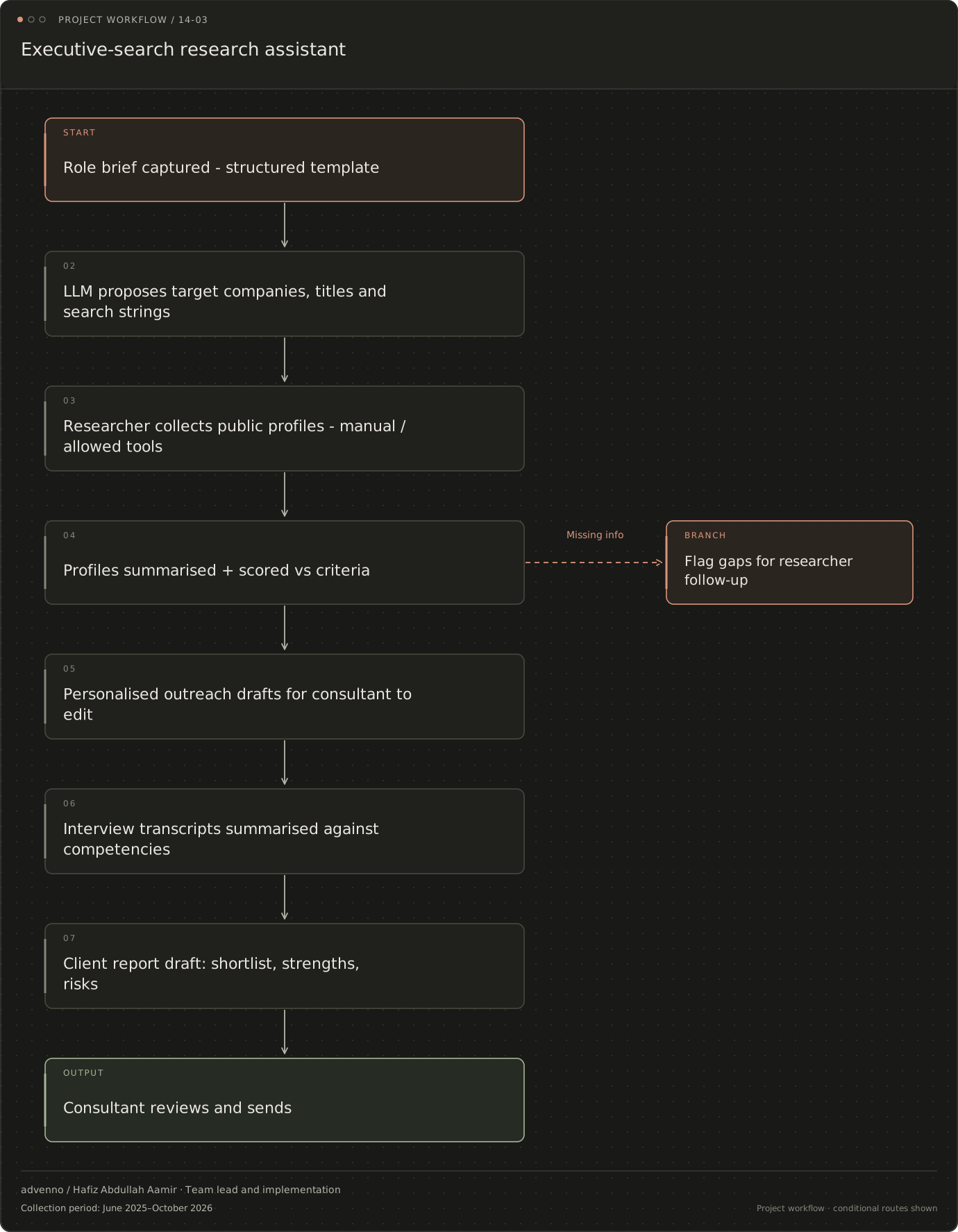
Executive-search research assistant
The project’s operational flow, including decision points and exception routes. Named channels reflect the original project context; a similar implementation is scoped around your systems.
Read the stages and decision branches
- Role brief captured - structured template
- LLM proposes target companies, titles and search strings
- Researcher collects public profiles - manual / allowed tools
- Profiles summarised + scored vs criteria
- Personalised outreach drafts for consultant to edit
- Interview transcripts summarised against competencies
- Client report draft: shortlist, strengths, risks
- Consultant reviews and sends
- Flag gaps for researcher follow-up
Related acquisition workflow: Executive search firms
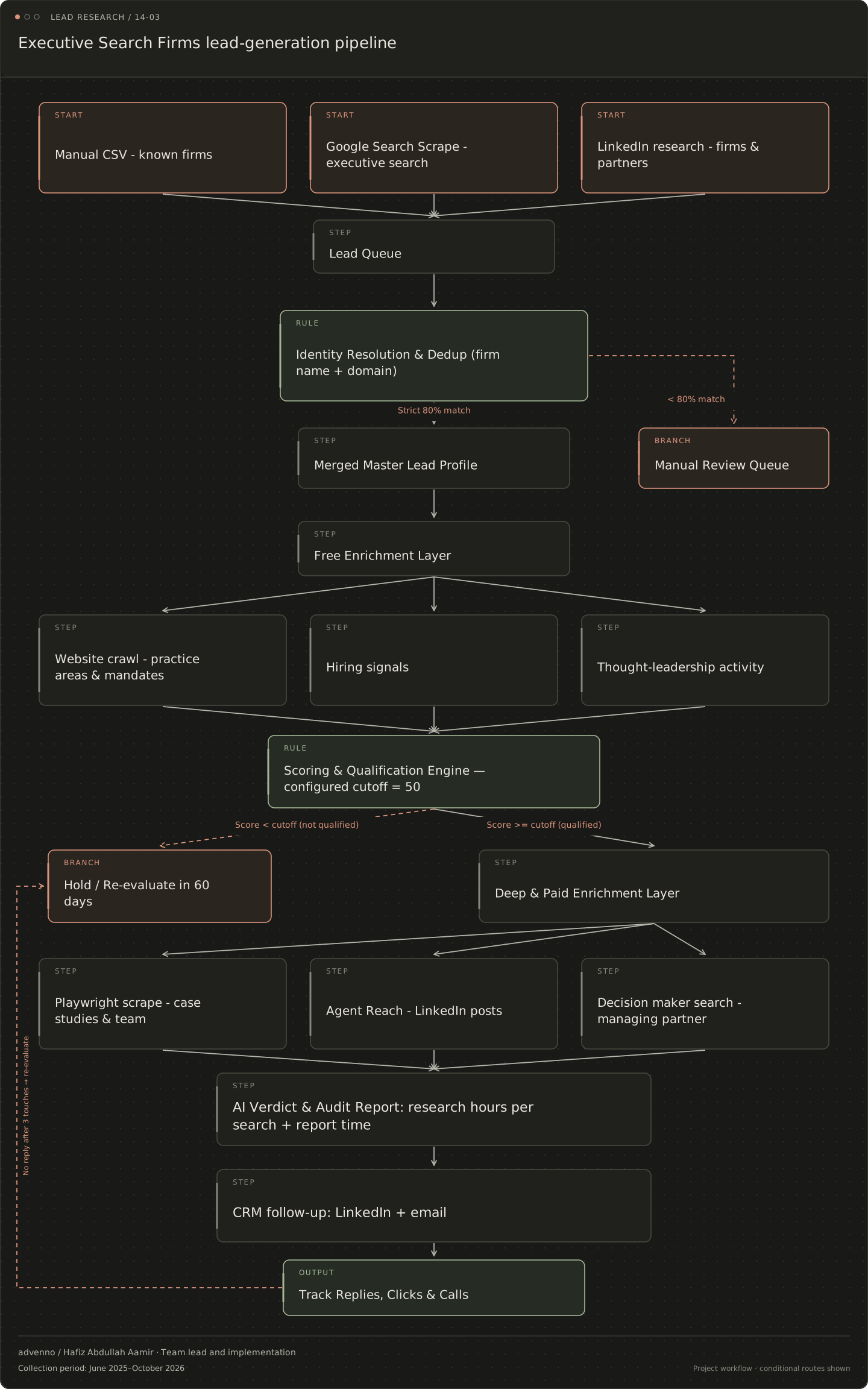
A separate lead-research and CRM workflow configured for this business niche. It connects evidence gathering, qualification and follow-up; it is distinct from the operational system shown above.
Read the stages and decision branches
- Manual CSV - known firms
- Google Search Scrape - executive search
- LinkedIn research - firms & partners
- Lead Queue
- Identity Resolution & Dedup (firm name + domain)
- Strict 80% match: Merged Master Lead Profile
- < 80% match: Manual Review Queue
- Merged Master Lead Profile
- Manual Review Queue
- Free Enrichment Layer
- Website crawl - practice areas & mandates
- Hiring signals
- Thought-leadership activity
- Scoring & Qualification Engine — configured cutoff = 50
- Score < cutoff (not qualified): Hold / Re-evaluate in 60 days
- Score >= cutoff (qualified): Deep & Paid Enrichment Layer
- Hold / Re-evaluate in 60 days
- Deep & Paid Enrichment Layer
- Playwright scrape - case studies & team
- Agent Reach - LinkedIn posts
- Decision maker search - managing partner
- AI Verdict & Audit Report: research hours per search + report time
- CRM follow-up: LinkedIn + email
- Track Replies, Clicks & Calls
- no reply after 3 touches: Hold / Re-evaluate in 60 days
What makes the system useful.
What does an executive-search research system need to preserve?
Retained search involves a partner defining the brief, researchers mapping the market, consultants approaching people and a client assessing the final recommendation. The project collection connected market mapping, interview summaries, approach drafts, client reporting and a private archive of past searches. The important information is not simply a list of names: it is the evidence and context that let a consultant explain a recommendation.
The archive adds a longer-term knowledge layer. Previous market research and search material can inform a later assignment without requiring the team to start from an empty document. Access to that material must still reflect the confidentiality of the original search and candidate relationship.
How are research, interview evidence and draft reports separated?
The implementation approach used research assistance for market maps, speech-to-text for interview material and a structured rubric for organising assessment notes. Language models helped summarise and draft; consultants remained responsible for the accuracy of names, facts and judgements. A source transcript, an AI summary and a consultant's assessment are different artefacts and should remain distinguishable.
The same boundary applies to personalised approach messages. A tone-aware draft can help a consultant prepare, but the relationship decision and actual communication remain theirs. The search team can use the draft as preparation while retaining control of the timing, wording and confidentiality of the conversation.
What should a search firm evaluate before relying on the assistant?
Useful checks include factual errors in market maps, unsupported statements in reports and whether summaries preserve the meaning of interview evidence. Research hours, time to a reviewed longlist and report turnaround are possible measures; no measured improvement is claimed here.
Confidential audio, candidate records and past client assignments need an approved processing and access arrangement. A private searchable archive is useful only when the right people can retrieve the right material. External processing of confidential material requires the firm's approval, and generated research needs checking against the underlying evidence.