Food delivery dispatch, cash and subscription automation
Hafiz Abdullah Aamir developed food-delivery automation projects connecting address handling, order batching and rider assignment with customer updates and cash-on-delivery reconciliation. The collection also covers meal-plan pauses, renewals and payment reminders, plus complaint classification and manager alerts, following the order across dispatch, customer service and accounts.
By Advenno · Project team lead: Hafiz Abdullah Aamir · Published · Updated
Where the work gets stuck.
A delivery order creates several linked responsibilities. Someone must decide which rider takes it, the customer wants to know its progress and the business needs to account for the payment collected. Handling dispatch, status enquiries and rider cash separately makes the same order relevant to several disconnected tasks. The project addressed those handoffs by connecting the delivery sequence with customer communication and a per-rider reconciliation process, so the operational and cash-control work could follow the order together.
A system built around the work.
The implementation organised orders for dispatch and rider assignment, including the batching and address context needed by the delivery workflow. Status events supported customer notifications as the order moved through delivery. Cash-on-delivery records then fed a reconciliation step for each rider, bringing collected amounts into a daily reporting process. The scope connected dispatch decisions, status communication and cash checking; it did not treat customer messaging as the entire automation. By following the order through these related activities, the workflow gave delivery and accounts work a common operational reference.
How the pieces connect.
Bring orders into dispatch
Orders entered the dispatch process with the delivery information required for assignment, connecting the customer request with the operational work of getting the order to its destination.
Batch and assign delivery work
The dispatch stage supported grouping orders and assigning riders, using the available order and address context to organise the work that needed to be carried out.
Communicate order progress
Status events supported customer updates, linking communication to the delivery process rather than requiring the customer to begin a separate enquiry for every change in progress.
Collect the rider cash records
The cash-on-delivery step associated collection information with the rider's delivery activity, creating the records needed to review what had been collected during the day's work.
Reconcile the day's collections
The reconciliation process compared the delivery and cash records per rider and produced a daily report, bringing the financial review into the same workflow as dispatch and status communication.
What the project delivered.
The delivered capability covered rider assignment, order-status communication and cash-on-delivery reconciliation within one workflow. It connected delivery activity with per-rider cash records and a daily reconciliation report. This established a practical link between the team moving orders, the customer receiving updates and the people reviewing the money associated with completed deliveries.
The systems behind the workflow.
Each module handles a different part of the work. Together, they connect the operational handoffs around this project.
Address handling, batching and rider assignment
The dispatch module connected orders with location context, grouping and rider assignment. It helped turn incoming requests into delivery work with a clearer destination and assignment rather than leaving the dispatcher to reconstruct every order from messages.
- How it works
Geocoding, batching or routing logic, a structured order store and maps links form the dispatch design.
- Operational consideration
Unclear addresses need resolution, and a customer location pin can help. Dispatch decisions still depend on the quality of the destination information and the delivery work available for assignment.
Per-rider cash-on-delivery reconciliation
The cash workflow associated collections with the rider’s delivery activity and produced a daily reconciliation report. It joined the movement of orders with the financial records needed to review the money collected.
- How it works
A rider-facing form, comparison rules and daily reporting support the accounts handoff.
- Operational consideration
Usable rider records and adoption matter. A mismatch is an exception to review, not an automatic accusation or a verified loss amount.
Order-status notifications
Status communication followed the order’s operational progress. It connected customer updates with the delivery process so that a change in state could support a useful notification rather than requiring a new manual conversation for each update.
- How it works
Order events trigger appropriate WhatsApp utility-template or SMS communication.
- Operational consideration
Messages should refer to the recorded event. Map links and event updates serve different purposes, and communication cost remains part of operating the service.
Meal subscriptions, pauses and renewals
Recurring-plan work covered renewals, pauses, weekly menus and payment reminders. It addressed the ongoing relationship behind a meal subscription, where a customer’s change affects future service rather than only a single delivery.
- How it works
A plan record, messaging or form input, schedule and payment-reminder workflow support recurring service changes.
- Operational consideration
Pauses and renewals need explicit handling. For a similar implementation, agree the billing treatment of each exception against the actual service terms before automating it.
Complaint triage and manager alerts
The support module classified complaints and directed attention to a manager. It linked customer feedback with an operational response point instead of assuming that an automated acknowledgement had resolved the problem.
- How it works
Language-model classification supports complaint categories and manager alerts.
- Operational consideration
Tone and context matter. Classification does not replace judgement about a refund, a failed delivery or the appropriate response to a customer’s experience.
Inside the system.
Choose a workflow to open the full diagram. Zoom in to follow its decisions and handoffs, or read the stages in the text view.
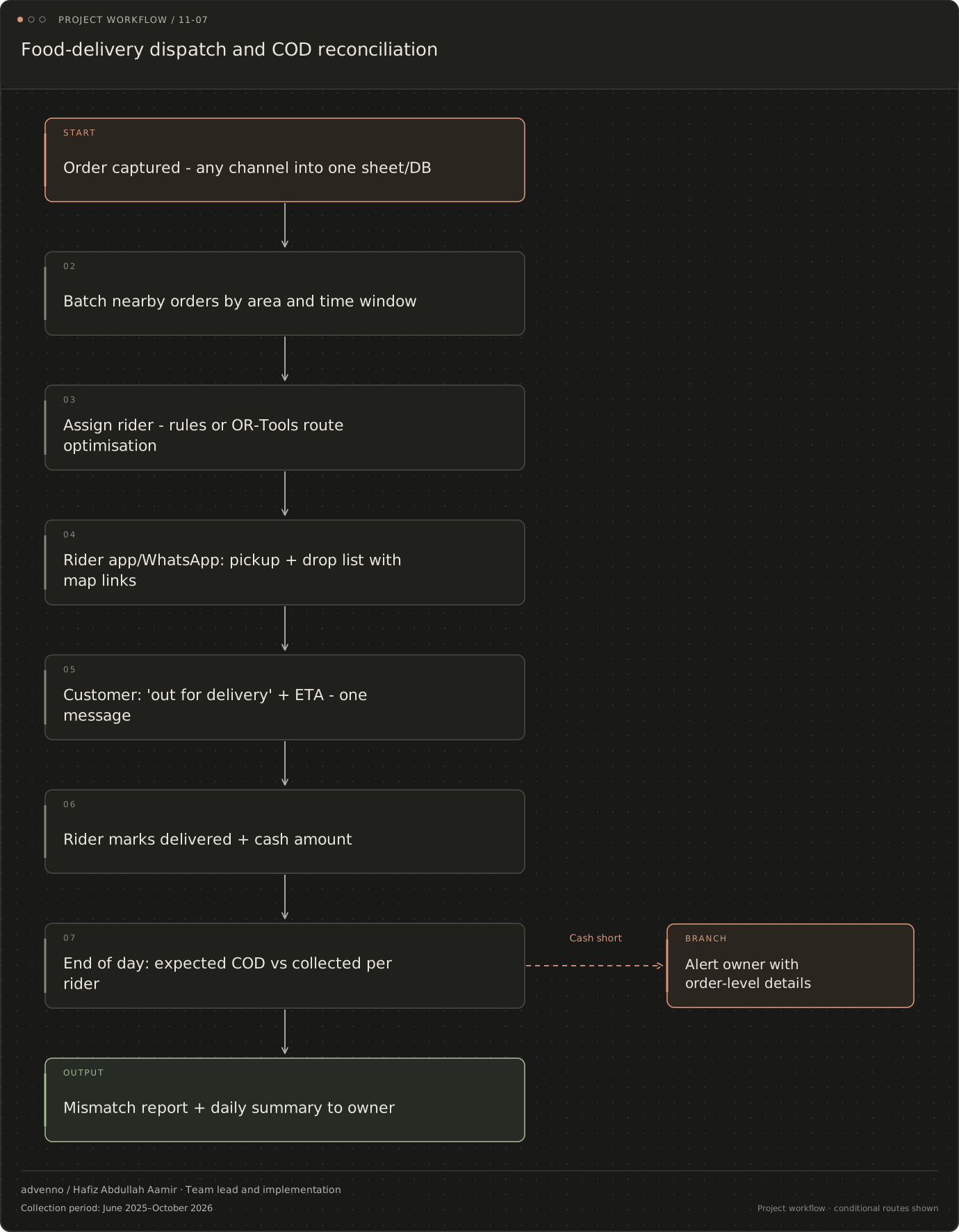
Food-delivery dispatch and COD reconciliation
The project’s operational flow, including decision points and exception routes. Named channels reflect the original project context; a similar implementation is scoped around your systems.
Read the stages and decision branches
- Order captured - any channel into one sheet/DB
- Batch nearby orders by area and time window
- Assign rider - rules or OR-Tools route optimisation
- Rider app/WhatsApp: pickup + drop list with map links
- Customer: 'out for delivery' + ETA - one message
- Rider marks delivered + cash amount
- End of day: expected COD vs collected per rider
- Mismatch report + daily summary to owner
- Alert owner with order-level details
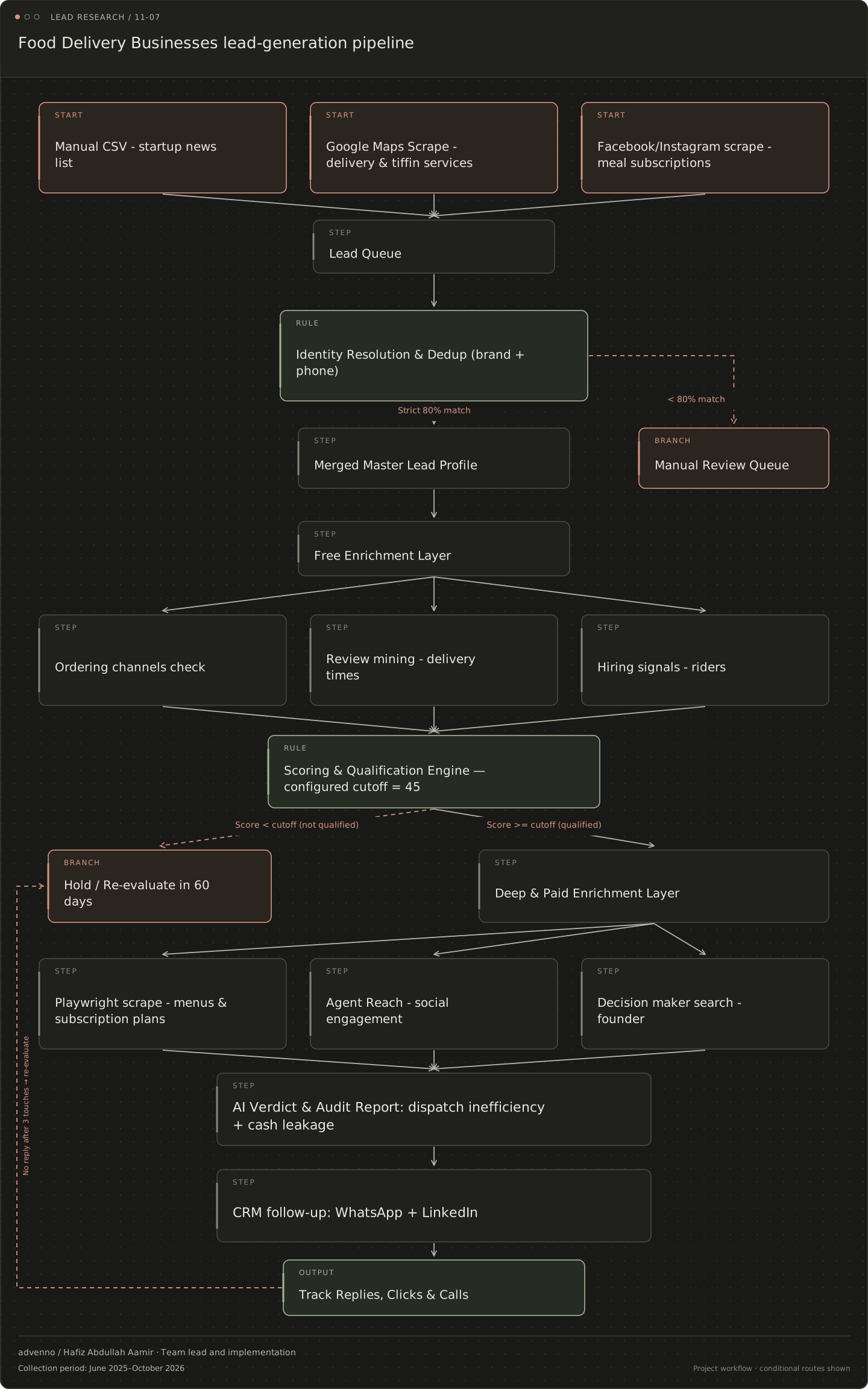
Related acquisition workflow: Food delivery businesses
A separate lead-research and CRM workflow configured for this business niche. It connects evidence gathering, qualification and follow-up; it is distinct from the operational system shown above.
Read the stages and decision branches
- Manual CSV - startup news list
- Google Maps Scrape - delivery & tiffin services
- Facebook/Instagram scrape - meal subscriptions
- Lead Queue
- Identity Resolution & Dedup (brand + phone)
- Strict 80% match: Merged Master Lead Profile
- < 80% match: Manual Review Queue
- Merged Master Lead Profile
- Manual Review Queue
- Free Enrichment Layer
- Ordering channels check
- Review mining - delivery times
- Hiring signals - riders
- Scoring & Qualification Engine — configured cutoff = 45
- Score < cutoff (not qualified): Hold / Re-evaluate in 60 days
- Score >= cutoff (qualified): Deep & Paid Enrichment Layer
- Hold / Re-evaluate in 60 days
- Deep & Paid Enrichment Layer
- Playwright scrape - menus & subscription plans
- Agent Reach - social engagement
- Decision maker search - founder
- AI Verdict & Audit Report: dispatch inefficiency + cash leakage
- CRM follow-up: WhatsApp + LinkedIn
- Track Replies, Clicks & Calls
- no reply after 3 touches: Hold / Re-evaluate in 60 days
What makes the system useful.
An order connects the dispatcher, rider, support team and accounts
Food delivery work follows the same order through several responsibilities. The dispatcher needs an address and a suitable assignment; the rider needs usable delivery information; the customer wants a status update; accounts needs the cash collection record. The project collection joined these handoffs and also covered recurring meal-plan changes and complaint triage. This wider scope reflects businesses with their own delivery operations and subscriptions, where handling an incoming message is only a small part of the work created by an order.
Address context and recorded events drive the workflow
Geocoding and location information supported batching and rider assignment. A location pin could complement an unstructured address rather than asking routing logic to act on incomplete information. Recorded delivery events supplied the basis for customer notifications, and rider cash records supported daily reconciliation. The rider-facing process was designed around a simple web or messaging interface, not an assumed native app. Recurring plans had their own states and actions: weekly-menu communication, renewals, pauses and payment reminders.
Evaluate the delivery, communication and cash paths together
Deliveries per rider, late deliveries, support enquiries and cash discrepancies are different measures of the operation. They are evaluation categories rather than claimed results for this work. A faster customer message does not prove a faster delivery, and a reconciliation flag does not establish rider misconduct. Review incomplete addresses, adoption of rider records and the handling of subscription exceptions as well as the headline counts. Managers remain responsible for resolving cash differences and responding to complaints that need judgement about service or payment.