Fundraising donor journeys, stewardship and campaign preparation
Hafiz Abdullah Aamir developed fundraising automation projects covering donor reactivation, unfinished-donation follow-up, receipts and stewardship messages, major-donor research briefs and campaign-copy variants. The collection connects donor relationships and payment-stage context with reviewed campaign preparation, while actual fundraising results remain dependent on the audience and donation experience.
By Advenno · Project team lead: Hafiz Abdullah Aamir · Published · Updated
Where the work gets stuck.
Fundraising teams work with people at different stages of their relationship with a cause. Someone who donated in the past needs a different conversation from someone who started a donation but did not complete it. A general appeal does not capture that difference, and the relevant information may sit between donor records, campaign activity and payment events.
The project collection addressed these distinct follow-up paths alongside receipt and stewardship communication, major-donor research and campaign-copy preparation. Donor relationship and payment-stage context informed the relevant next action, while the fundraising team reviewed the resulting communication and research.
A system built around the work.
The completed system combined donor segmentation with reactivation-message preparation and event-driven follow-up for abandoned donations. Existing donor information supported the segmentation stage, while the payment journey supplied the context for unfinished-donation follow-up. Message drafts were prepared for the corresponding donor or campaign situation.
This brought the donor relationship and payment-stage context into the same operational process. The work centred on identifying the appropriate follow-up path and preparing the communication associated with it. The two paths remained different: reactivation concerned a previous donor relationship, whereas recovery concerned a donation journey that had not reached completion.
How the pieces connect.
Organise the donor context
Use the donor record and campaign information to distinguish an existing relationship from a donation journey that remains unfinished.
Prepare the reactivation message
Develop message drafts for the relevant donor segment and campaign so the follow-up reflects the relationship being revisited.
Follow the payment event
Use the unfinished donation's event context to start the corresponding follow-up path within the fundraising workflow.
Connect the follow-up activity
Bring the reactivation and abandoned-donation paths into the team's wider process for managing donor communication and campaign follow-up.
What the project delivered.
The project delivered a structured fundraising follow-up capability with separate routes for lapsed donors and unfinished donations. Segmentation and message preparation supported the reactivation route, and payment-event context supported the recovery route. The delivered system established these operational paths; a campaign's eventual donation results depend on the communication, audience and donation experience as well as the workflow.
The systems behind the workflow.
Each module handles a different part of the work. Together, they connect the operational handoffs around this project.
Lapsed-donor reactivation
The retention module organised giving history into segments for more relevant follow-up. It connected the organisation's existing donor relationships with the campaign communication prepared for each group.
- How it works
CRM or spreadsheet records feed recency, frequency and monetary segmentation, then a reviewed communication workflow.
- Operational consideration
Segment membership depends on complete and current history. Honour opt-outs and avoid implying that a donor stopped caring simply because their recorded activity changed.
Abandoned-donation recovery
The recovery module used payment-journey context to support follow-up when a donation had not completed. It kept transaction-related communication separate from general reactivation appeals.
- How it works
Available payment events or webhooks connect the unfinished donation state with an appropriate reminder workflow.
- Operational consideration
Verify gateway access and state meaning. Recheck completion before sending a reminder so that someone who has paid is not told the donation is still unfinished.
Receipt, thank-you and impact follow-up
Stewardship connected a confirmed contribution with an acknowledgement and later communication about the organisation's work. It extended the relationship beyond recovering a transaction.
- How it works
The confirmed donation record drives receipt preparation, an immediate thank-you and a scheduled impact update.
- Operational consideration
A transaction receipt and an impact account require different evidence. Use the recorded payment for one and approved programme information for the other.
Major-donor research briefs
Research briefs helped the fundraising team prepare for conversations using relevant public information. The module supported understanding context rather than replacing the fundraiser's relationship work.
- How it works
Public-source research and reviewed summaries produce a preparation brief for the team.
- Operational consideration
Verify facts and use only appropriate public information. A generated brief should not imply access to private donor finances or create unsupported personal claims.
Campaign copy and A/B variants
The content module prepared campaign drafts and alternatives in the organisation's voice. It supported a structured comparison of wording rather than treating the first generated appeal as the final version.
- How it works
Brand guidance and campaign information supply a drafting process with human review and testable variants.
- Operational consideration
Keep factual claims and urgency supportable. A more emotional version is not necessarily more accurate, and conversion improvement requires actual measurement.
Inside the system.
Choose a workflow to open the full diagram. Zoom in to follow its decisions and handoffs, or read the stages in the text view.
Fundraising donor reactivation and recovery
The project’s operational flow, including decision points and exception routes. Named channels reflect the original project context; a similar implementation is scoped around your systems.
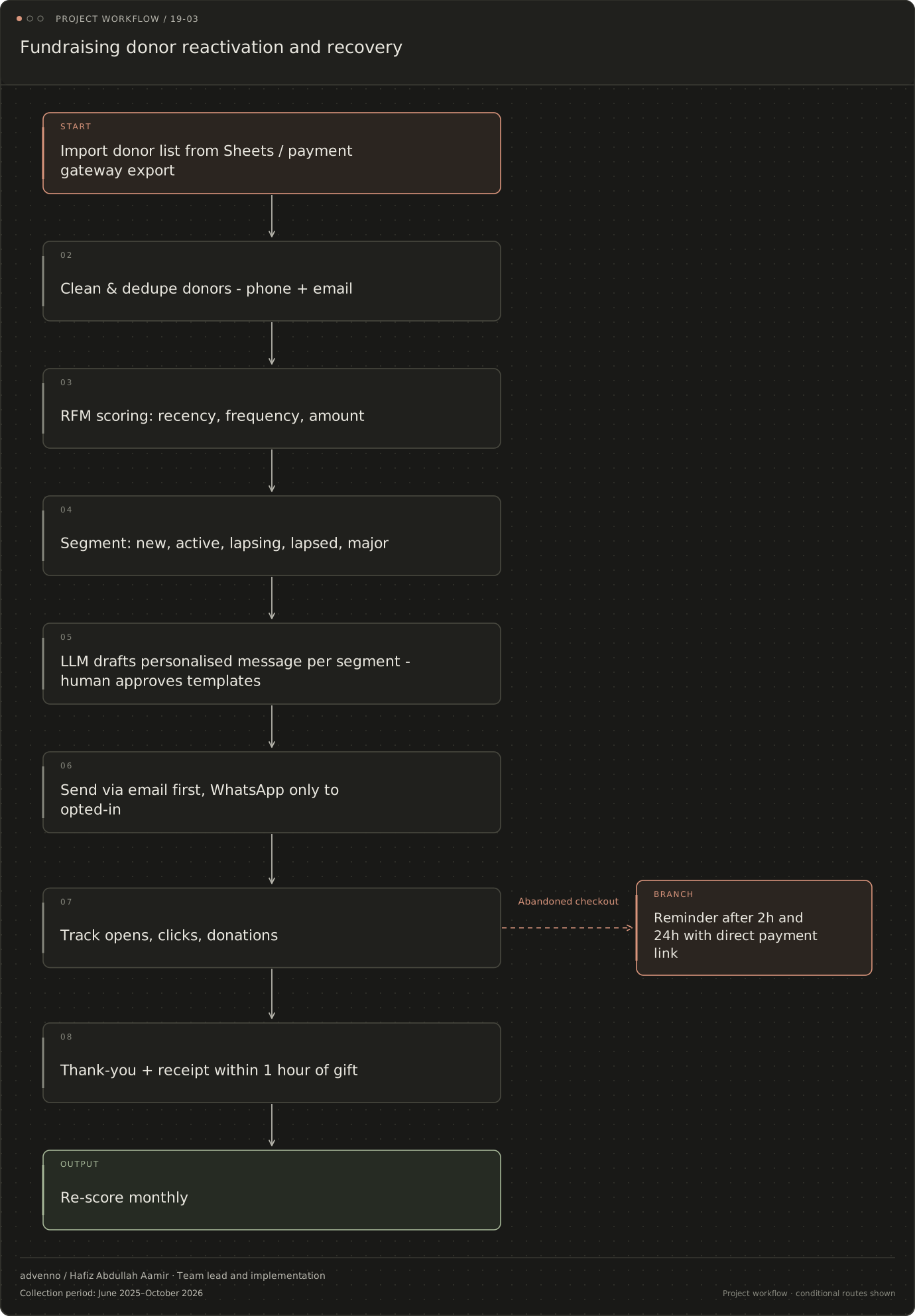
Read the stages and decision branches
- Import donor list from Sheets / payment gateway export
- Clean & dedupe donors - phone + email
- RFM scoring: recency, frequency, amount
- Segment: new, active, lapsing, lapsed, major
- LLM drafts personalised message per segment - human approves templates
- Send via email first, WhatsApp only to opted-in
- Track opens, clicks, donations
- Thank-you + receipt within 1 hour of gift
- Re-score monthly
- Reminder after 2h and 24h with direct payment link
Related acquisition workflow: Fundraising organisations
A separate lead-research and CRM workflow configured for this business niche. It connects evidence gathering, qualification and follow-up; it is distinct from the operational system shown above.
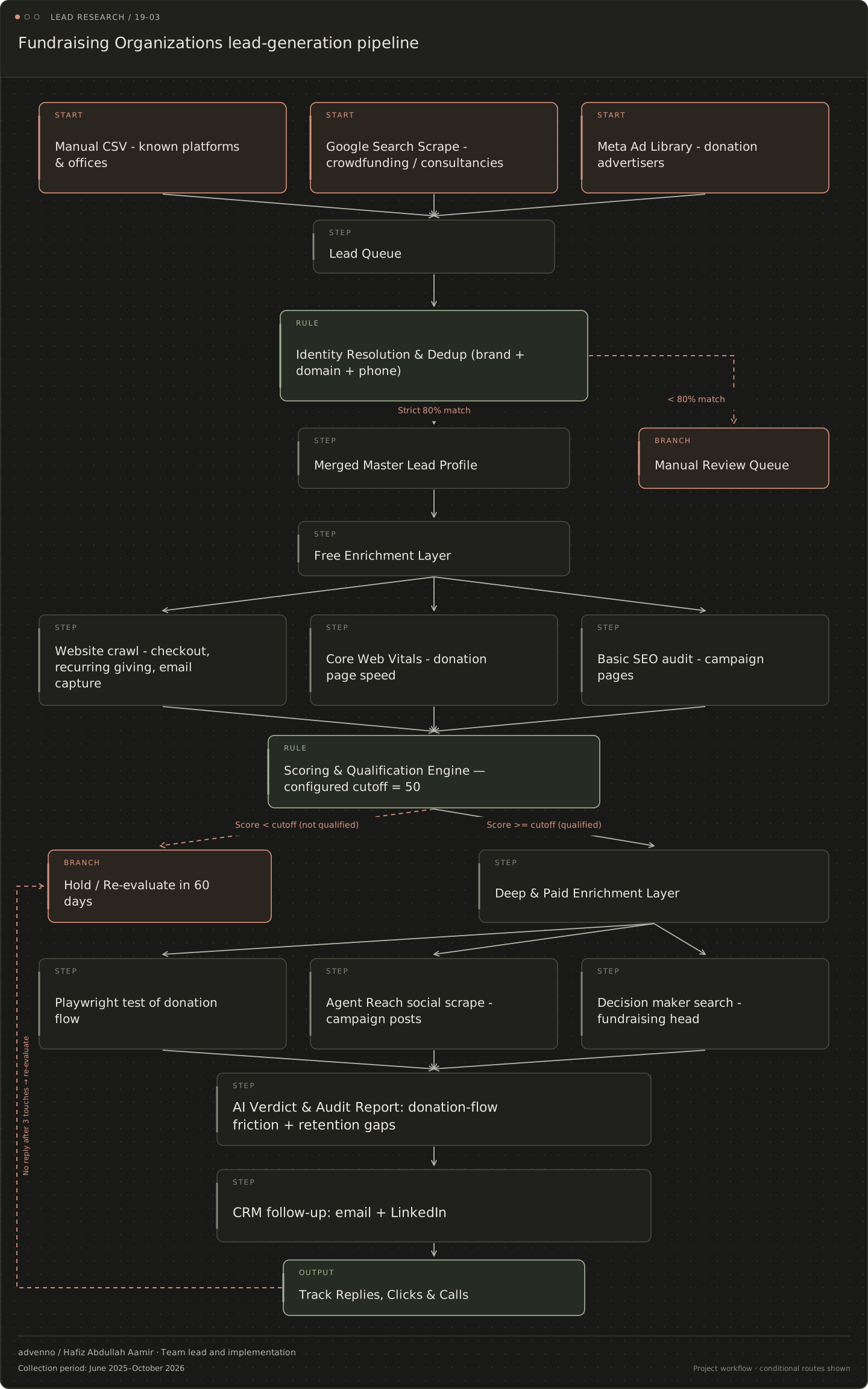
Read the stages and decision branches
- Manual CSV - known platforms & offices
- Google Search Scrape - crowdfunding / consultancies
- Meta Ad Library - donation advertisers
- Lead Queue
- Identity Resolution & Dedup (brand + domain + phone)
- Strict 80% match: Merged Master Lead Profile
- < 80% match: Manual Review Queue
- Merged Master Lead Profile
- Manual Review Queue
- Free Enrichment Layer
- Website crawl - checkout, recurring giving, email capture
- Core Web Vitals - donation page speed
- Basic SEO audit - campaign pages
- Scoring & Qualification Engine — configured cutoff = 50
- Score < cutoff (not qualified): Hold / Re-evaluate in 60 days
- Score >= cutoff (qualified): Deep & Paid Enrichment Layer
- Hold / Re-evaluate in 60 days
- Deep & Paid Enrichment Layer
- Playwright test of donation flow
- Agent Reach social scrape - campaign posts
- Decision maker search - fundraising head
- AI Verdict & Audit Report: donation-flow friction + retention gaps
- CRM follow-up: email + LinkedIn
- Track Replies, Clicks & Calls
- no reply after 3 touches: Hold / Re-evaluate in 60 days
What makes the system useful.
Why are donor reactivation and payment recovery different workflows?
A past donor who has not given recently has a relationship with the organisation. A person who starts a donation but does not complete payment has a different context. This project collection preserved those two paths and connected them with stewardship, major-donor research and campaign drafting. Fundraising, donor relations and finance each use a different part of that information.
The distinction changes the next action. A lapsed-donor message can refer to an established relationship when the records support it. A payment reminder needs to reflect the actual transaction state. Neither should become a generic appeal that ignores whether the person has already donated or asked not to receive further communication.
How do donor history and payment events inform communication?
The reactivation approach used recency, frequency and monetary value to organise donor history into useful segments. Drafts could then reflect the relevant campaign and relationship. The recovery path used payment events to identify an incomplete journey and prepare appropriate follow-up. A started checkout, a failed payment and a confirmed donation are not interchangeable.
The wider collection also connected confirmed donations with receipts, thank-yous and later impact updates. Campaign variants and public-information donor research supported the fundraising team's preparation. These are reviewed assistance workflows; they do not justify fabricating urgency, personal knowledge or an emotional story to increase a response.
How should a fundraising team measure recovery and retention?
Reactivated donors, completed recoveries, response rates and time to a thank-you are useful evaluation measures. No recovered revenue or conversion uplift is claimed here. Before measuring, define what counts as a reactivation and how a donation is attributed to a follow-up rather than another campaign.
Operational review includes opt-outs, duplicate messages, payments that complete after a reminder was prepared and donor records that are no longer current. Payment-provider access also needs checking during adaptation; the project description is not a promise that every gateway exposes the same events or supports the same connection.