Hotel booking, guest communication and operations automation
Hafiz Abdullah Aamir developed hotel automation projects covering direct reservation enquiries, pre-arrival information and offers, approved review replies, banquet quotation, housekeeping and maintenance requests, and rate-monitoring alerts. The collection links guest communication with the operational records and staff responsibilities around a stay, while preserving the hotel team’s personal welcome.
By Advenno · Project team lead: Hafiz Abdullah Aamir · Published · Updated
Where the work gets stuck.
A booking enquiry is the beginning of a sequence, not a complete reservation. Guests need information about rates and availability, then confirmation and practical details before arrival. The hotel may also need to introduce relevant additions to the stay. When each interaction is handled separately, staff have to reconstruct the reservation context repeatedly. The project focused on carrying that context through the direct-booking journey and organising communication around the guest's progress towards arrival.
A system built around the work.
The implementation connected the enquiry assistant with the reservation workflow so the conversation could move towards a quotation and the booking process. Availability was treated as information needed by that process, rather than something the assistant should invent. Booking and payment steps connected to confirmation, followed by pre-arrival communication. The pre-arrival stage also supported offers relevant to the stay, using the trip context described in the workflow. This gave the assistant a defined operational role: support enquiries and the communication surrounding a reservation, while the hotel team continued to handle the guest's arrival and personal welcome.
How the pieces connect.
Receive the reservation enquiry
The assistant collected the guest's booking questions and stay requirements, creating a starting point for the direct-reservation workflow rather than leaving the exchange as an isolated message.
Connect availability and quotation
The reservation process brought availability information and the quotation step into the enquiry journey, connecting what the guest wanted with the booking information the hotel needed to provide.
Progress the booking
The workflow connected the reservation and advance-payment steps with booking communication, keeping the guest's movement towards a confirmed stay within the same operational sequence.
Send pre-arrival information
Scheduled communication followed the reservation into the period before arrival, giving practical guest information its own place in the workflow instead of relying on a fresh enquiry.
Present relevant stay additions
The pre-arrival stage supported offers based on the trip context, linking the hotel's additional services with the upcoming stay while preserving the hotel team's personal guest welcome.
What the project delivered.
The delivered capability covered the communication surrounding a direct reservation, from the initial enquiry through pre-arrival follow-up. Booking context could carry into confirmations and relevant offers. The project established a connected guest-communication workflow without presenting the front-desk welcome itself as an automated task or making the assistant responsible for every part of hotel operations.
The systems behind the workflow.
Each module handles a different part of the work. Together, they connect the operational handoffs around this project.
Direct enquiries, quotes and advances
The reservations workflow connected a guest’s questions with availability information, a quotation and the advance-payment step. It carried the booking context forward into communication rather than leaving the assistant to answer in isolation from the hotel’s room records.
- How it works
The design connects a WhatsApp or web assistant with a reservation source, pricing information and the payment-link or advance process.
- Operational consideration
The PMS interface and availability discipline determine whether confirmation can be immediate. Uncertain stock should become a request for review rather than an invented availability promise.
Pre-arrival information and relevant stay offers
Event-driven communication supported the period before arrival and after the stay. Trip context, such as a family, business or honeymoon visit, informed relevant additions rather than presenting every guest with an undifferentiated list of offers.
- How it works
Reservation events and scheduled messages connect practical guest information with stay-context personalisation.
- Operational consideration
Message relevance and operating cost deserve review. Automated communication supports preparation for the stay; the hotel team still handles the in-person arrival and welcome.
Review drafting and reputation follow-through
The reputation module brought review feedback into a drafting and approval workflow. It supported responses across guest-feedback channels and linked the post-stay experience with work that the hotel could review and act on.
- How it works
Review analysis supplies reply drafts and an approval step for supported Google or OTA feedback channels.
- Operational consideration
Channel access varies. Replies should address the guest’s experience in the hotel’s tone, with a person checking statements that concern service recovery or commitments.
Banquet enquiry and quotation building
The banquet module collected event requirements and prepared package quotations. It addressed the hotel’s event business separately from room-night booking because menu, space and service combinations need their own commercial context.
- How it works
Forms, maintained package-pricing rules and PDF generation support the event-quotation workflow.
- Operational consideration
Complex packages need maintained inputs and review. Custom requests and negotiated packages need a clear route back to the banquet team for review.
Housekeeping and maintenance requests
Operational requests moved into a ticket and staff-alert workflow. This connected a request with the people responsible for responding rather than allowing an answered message to be mistaken for a completed housekeeping or maintenance task.
- How it works
A request-handling assistant routes information into tickets and staff communication.
- Operational consideration
Staff adoption is essential to the handoff. A generated acknowledgement does not establish that a room was serviced or a fault repaired; the operational team completes the work.
Competitor-rate observation and alerts
The revenue-support module monitored relevant rate information and prepared alerts for review. It added decision-support context to the hotel’s pricing work without describing an autonomous engine that changed room rates on its own.
- How it works
Permitted rate observations feed comparison and management alerts.
- Operational consideration
Information access must respect the provider’s terms. Observed rates can differ by stay conditions, so a rate alert is an input for judgement rather than a direct pricing instruction.
Inside the system.
Choose a workflow to open the full diagram. Zoom in to follow its decisions and handoffs, or read the stages in the text view.
Hotel direct booking and pre-arrival workflow
The project’s operational flow, including decision points and exception routes. Named channels reflect the original project context; a similar implementation is scoped around your systems.
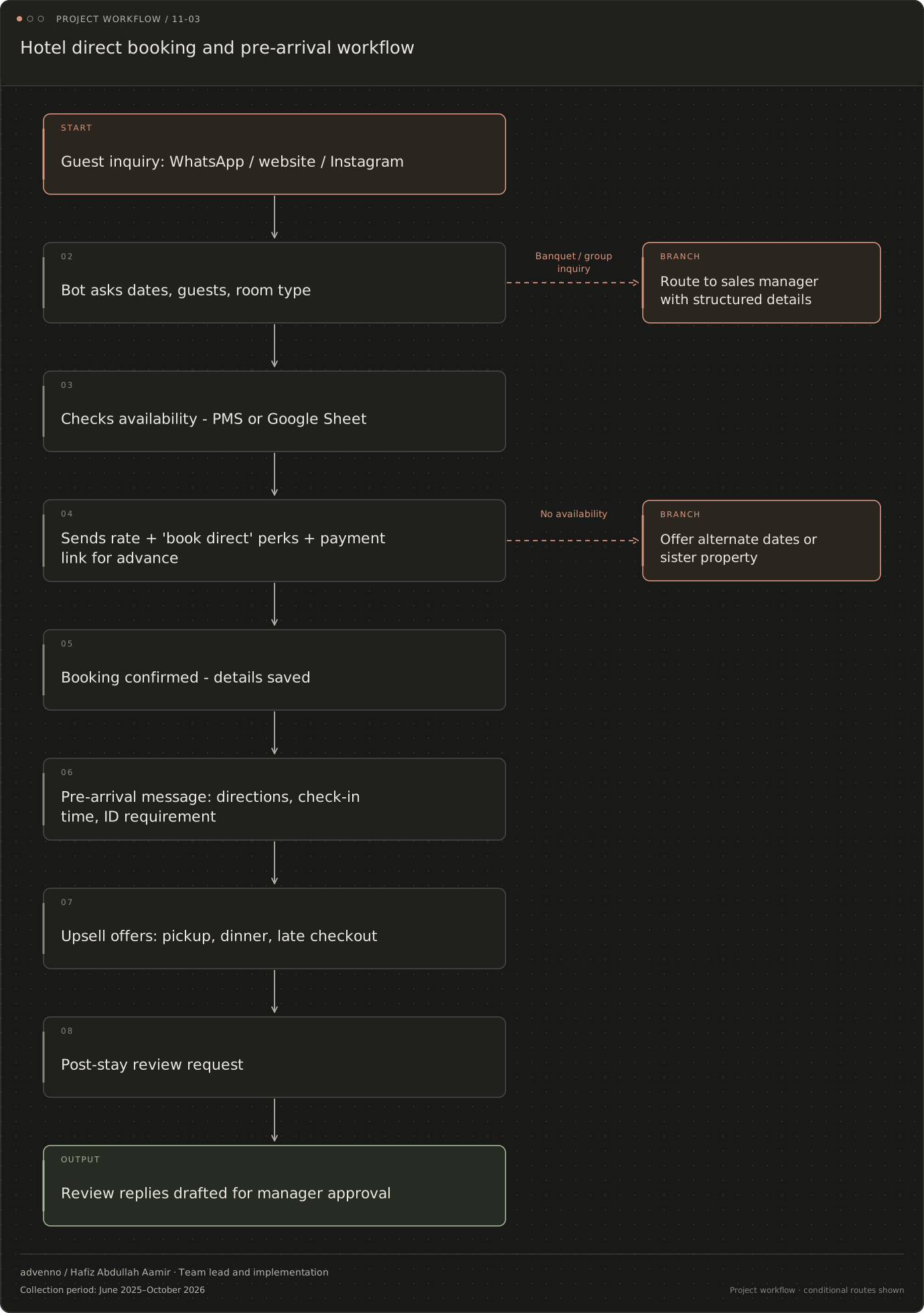
Read the stages and decision branches
- Guest inquiry: WhatsApp / website / Instagram
- Bot asks dates, guests, room type
- Checks availability - PMS or Google Sheet
- Banquet / group inquiry: Route to sales manager with structured details
- Checks availability - PMS or Google Sheet
- Sends rate + 'book direct' perks + payment link for advance
- Booking confirmed - details saved
- Pre-arrival message: directions, check-in time, ID requirement
- Upsell offers: pickup, dinner, late checkout
- Post-stay review request
- Review replies drafted for manager approval
- Route to sales manager with structured details
- Offer alternate dates or sister property
Related acquisition workflow: Hotels
A separate lead-research and CRM workflow configured for this business niche. It connects evidence gathering, qualification and follow-up; it is distinct from the operational system shown above.
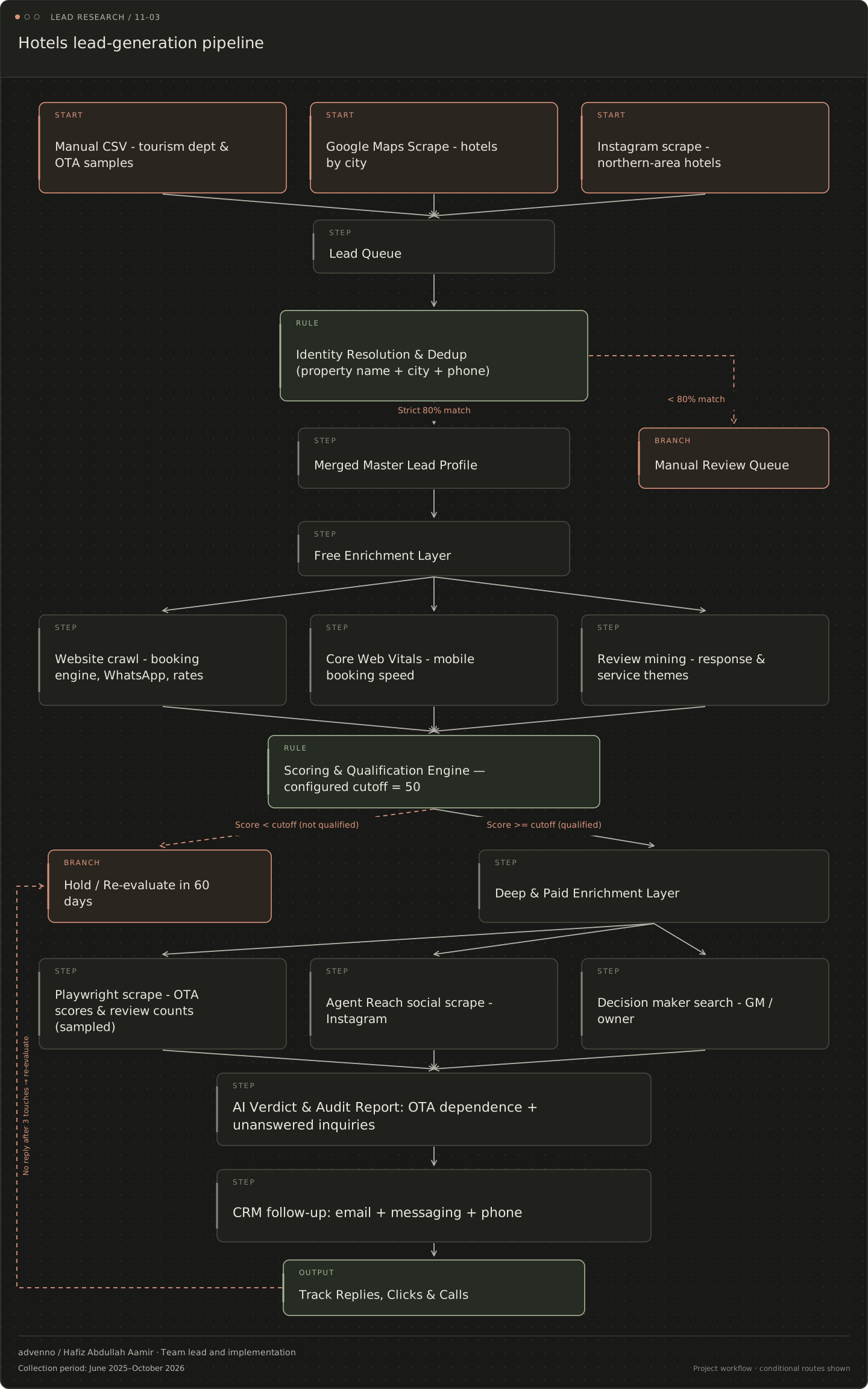
Read the stages and decision branches
- Manual CSV - tourism dept & OTA samples
- Google Maps Scrape - hotels by city
- Instagram scrape - northern-area hotels
- Lead Queue
- Identity Resolution & Dedup (property name + city + phone)
- Strict 80% match: Merged Master Lead Profile
- < 80% match: Manual Review Queue
- Merged Master Lead Profile
- Manual Review Queue
- Free Enrichment Layer
- Website crawl - booking engine, WhatsApp, rates
- Core Web Vitals - mobile booking speed
- Review mining - response & service themes
- Scoring & Qualification Engine — configured cutoff = 50
- Score < cutoff (not qualified): Hold / Re-evaluate in 60 days
- Score >= cutoff (qualified): Deep & Paid Enrichment Layer
- Hold / Re-evaluate in 60 days
- Deep & Paid Enrichment Layer
- Playwright scrape - OTA scores & review counts (sampled)
- Agent Reach social scrape - Instagram
- Decision maker search - GM / owner
- AI Verdict & Audit Report: OTA dependence + unanswered inquiries
- CRM follow-up: email + messaging + phone
- Track Replies, Clicks & Calls
- no reply after 3 touches: Hold / Re-evaluate in 60 days
What makes the system useful.
The hotel system connects reservations with the work around a stay
A direct-booking conversation affects more than the reservations desk. Availability, advance payments and arrival information connect with the front office; banquet enquiries involve a separate sales process; housekeeping and maintenance requests belong with staff who can act on them. The hotel projects brought these responsibilities into related workflows while preserving the personal welcome. Guest communication, reputation and rate-monitoring work supported the wider operation rather than reducing hotel automation to a chatbot answering room-price questions.
Availability and pricing need a dependable source
The booking assistant required access to availability through a suitable PMS or channel-manager interface, or a maintained alternative for a smaller operation. That connection is important because an assistant cannot establish a room is available simply by producing a convincing reply. Where availability cannot be reliably synchronised, request-to-book is the appropriate boundary. Banquet quotations use a different model: event requirements feed package pricing and a quote document. Pre-arrival offers use stay context, while check-in and the guest welcome remain with the hotel team.
Evaluate reservations, guest communication and operational follow-through
Direct-booking share and enquiry response time help assess reservations, while offer uptake or revenue per stay concerns pre-arrival additions. Review-response coverage measures a separate part of guest communication. These are evaluation categories rather than published project results. A sound review also looks at the information behind each action: current availability, accurate package prices, the staff response to a maintenance ticket and the relevance of a drafted review reply. Guest identity information and channel-contract boundaries require appropriate handling in any implementation.