HR outsourcing helpdesk, payroll and client administration
Hafiz Abdullah Aamir developed HR-outsourcing automation projects connecting a policy and employee-record helpdesk with payroll preparation, client-specific deadline calendars, onboarding documents and HR dashboards. The collection supports both employee service and the provider’s administrative work across organisations, with authenticated personal information and client separation shaping the workflow.
By Advenno · Project team lead: Hafiz Abdullah Aamir · Published · Updated
Where the work gets stuck.
An HR outsourcing provider works across client organisations whose policies and employee records are different. A general policy question and a personal payroll question may arrive through the same service channel, but they require different information. The employee needs an answer that applies to their employer and, where relevant, their own record.
The project addressed this combination of repeat questions and organisation-specific context. Employee service connected questions to the relevant policy or payroll information. The wider collection also addressed payroll preparation, per-client deadlines, onboarding documents and client reporting, linking the helpdesk with the provider’s administrative responsibilities. A policy question can draw on an employer's handbook, while an individual payroll enquiry needs the employee's relevant personal information.
A system built around the work.
The completed helpdesk combined policy-based answers with payroll-query assistance. It used the client organisation's policy information for HR questions and included authenticated access to personal records for the employee-specific part of the workflow. The project description also included serving multiple client organisations within the HR outsourcing context.
This joined the policy and personal-record sides of employee service. Policy answers drew on the relevant documents, while payroll enquiries related to the employee's information. The employee-facing interaction therefore connects to two different types of information: organisational documents and records associated with the individual making the enquiry.
How the pieces connect.
Receive the HR question
Bring the employee's policy or payroll enquiry into the helpdesk as the starting point for the service workflow.
Use the relevant policy
Support policy questions with information from the appropriate client organisation's documents, including source-based answers.
Handle the personal enquiry
Use authenticated access for the part of the workflow that relates to the employee's own payroll information and records.
Return employee-service assistance
Bring the applicable policy or record information into the helpdesk response to support the employee's next HR-service step.
What the project delivered.
The project delivered an employee HR helpdesk covering policy questions and payroll-related enquiries. It gave the outsourced HR service a connected interface for these recurring categories of employee questions, with answers related to the relevant organisation and record. The central distinction is between a general HR answer and an answer that depends on the particular employee and employer involved.
The systems behind the workflow.
Each module handles a different part of the work. Together, they connect the operational handoffs around this project.
Policy and personal-record helpdesk
The helpdesk connected employee questions with their employer's policy information and, where authorised, their personal HR or payroll record. This covered both shared policy guidance and individual administrative enquiries.
- How it works
Retrieval with source citations supports policy answers; authentication and tenant-scoped access govern personal records.
- Operational consideration
Client companies and employees must remain separated at the data-access layer. A question without appropriate identity or policy context needs clarification or staff handling.
Payroll calculation and payslips
Payroll operations formed a delivery module alongside the employee assistant. Configured calculations and payroll records supplied the information needed to prepare payslips and related employee documents.
- How it works
A rules engine handles calculation; PDF templates produce documents. The responsible accounting or payroll professional reviews the rules.
- Operational consideration
Changes in applicable rules require maintenance. Do not ask a language model to infer payroll deductions or treat a fluent explanation as professional verification.
Per-client deadline calendar
The calendar module organised recurring HR and administrative dates for each client. It gave the outsourcing team a place to coordinate upcoming actions across employers instead of relying on a single undifferentiated reminder list.
- How it works
Client-specific dated records drive reminders to the people responsible for completing each action.
- Operational consideration
A reminder is only as reliable as its configured due date and owner. It does not guarantee that a filing or obligation has been completed correctly.
Employee onboarding documents
Onboarding connected offer-letter preparation, incoming documents and checklists. The workflow supported the HR team's coordination of a new employee's administrative steps.
- How it works
Reviewed templates, forms and document-status records provide the inputs for onboarding preparation and follow-up.
- Operational consideration
Employment wording needs the appropriate human review. Generated documents should not silently alter approved terms or use another employer's template.
Client HR dashboards
Reporting views brought together relevant HR activity for each client organisation. This extended the system beyond answering individual questions to helping the delivery team see its ongoing administrative work.
- How it works
A reporting layer reads the appropriate client records and presents operational information within the same access boundary.
- Operational consideration
Dashboard figures depend on source quality and correct tenant filtering. A polished chart does not establish that incomplete or mixed records are accurate.
Inside the system.
Choose a workflow to open the full diagram. Zoom in to follow its decisions and handoffs, or read the stages in the text view.
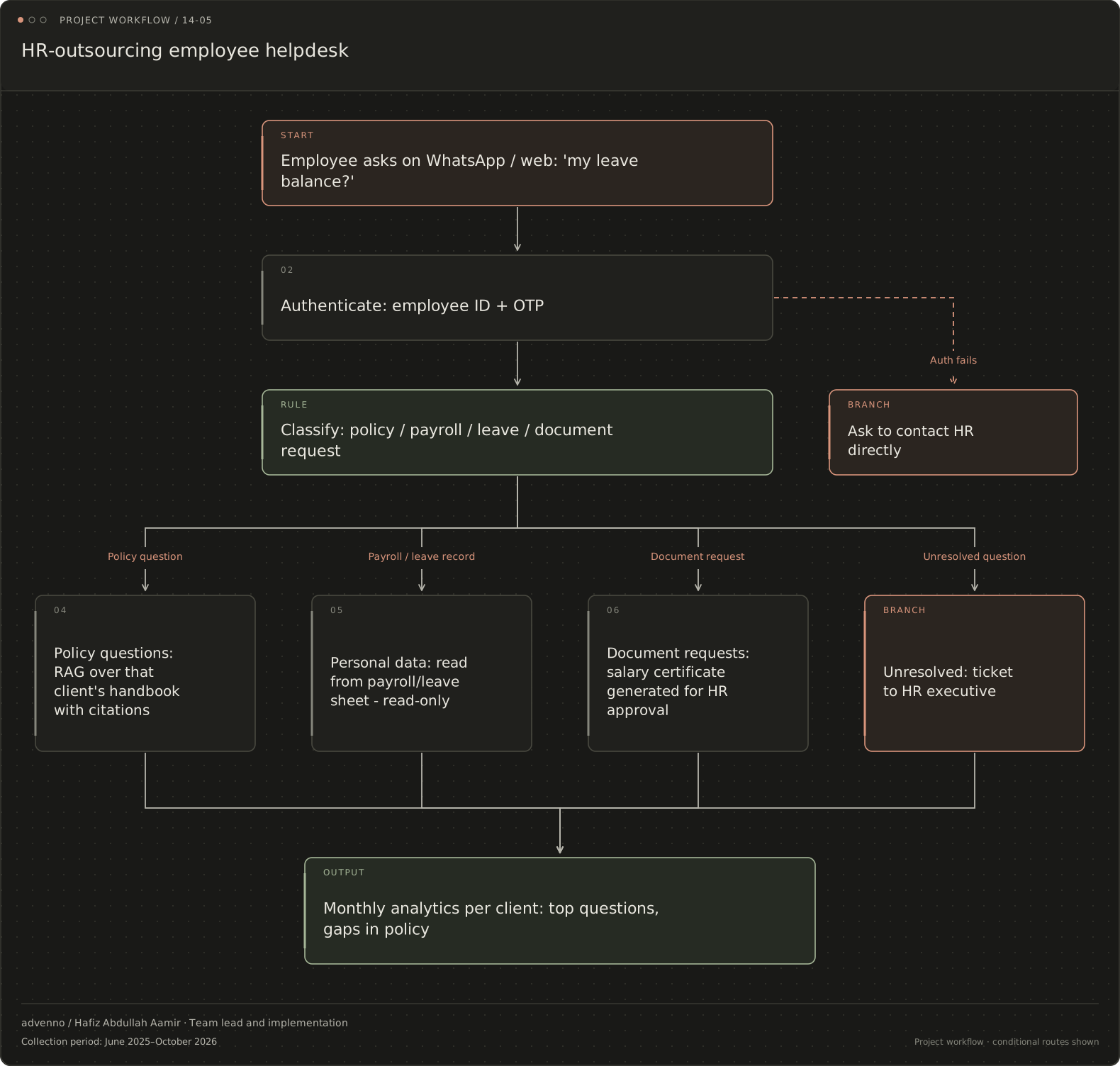
HR-outsourcing employee helpdesk
The project’s operational flow, including decision points and exception routes. Named channels reflect the original project context; a similar implementation is scoped around your systems.
Read the stages and decision branches
- Employee asks on WhatsApp / web: 'my leave balance?'
- Authenticate: employee ID + OTP
- Classify: policy / payroll / leave / document request
- Policy question: Policy questions: RAG over that client's handbook with citations
- Payroll / leave record: Personal data: read from payroll/leave sheet - read-only
- Document request: Document requests: salary certificate generated for HR approval
- Unresolved question: Unresolved: ticket to HR executive
- Policy questions: RAG over that client's handbook with citations
- Personal data: read from payroll/leave sheet - read-only
- Document requests: salary certificate generated for HR approval
- Unresolved: ticket to HR executive
- Monthly analytics per client: top questions, gaps in policy
- Ask to contact HR directly
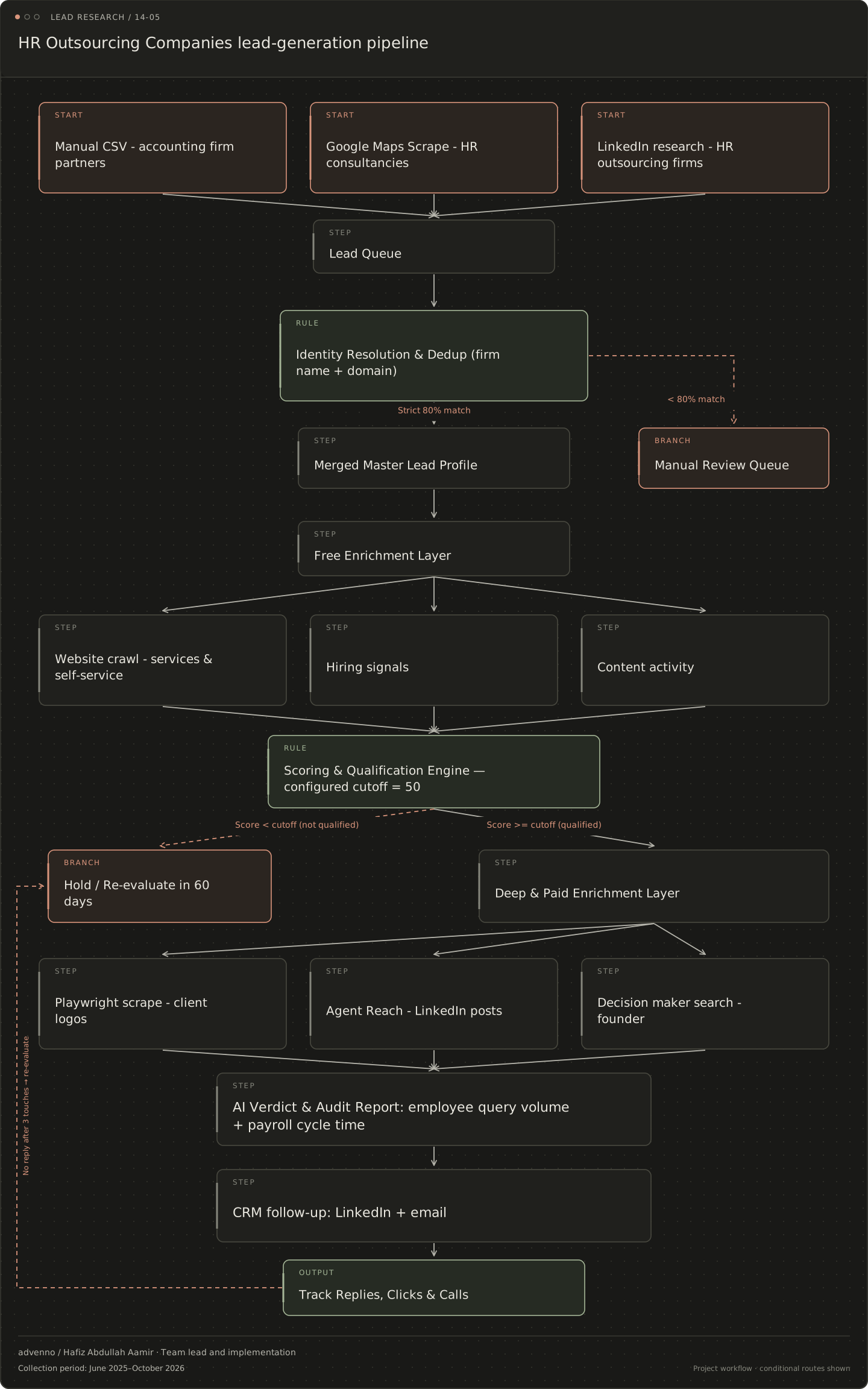
Related acquisition workflow: HR outsourcing companies
A separate lead-research and CRM workflow configured for this business niche. It connects evidence gathering, qualification and follow-up; it is distinct from the operational system shown above.
Read the stages and decision branches
- Manual CSV - accounting firm partners
- Google Maps Scrape - HR consultancies
- LinkedIn research - HR outsourcing firms
- Lead Queue
- Identity Resolution & Dedup (firm name + domain)
- Strict 80% match: Merged Master Lead Profile
- < 80% match: Manual Review Queue
- Merged Master Lead Profile
- Manual Review Queue
- Free Enrichment Layer
- Website crawl - services & self-service
- Hiring signals
- Content activity
- Scoring & Qualification Engine — configured cutoff = 50
- Score < cutoff (not qualified): Hold / Re-evaluate in 60 days
- Score >= cutoff (qualified): Deep & Paid Enrichment Layer
- Hold / Re-evaluate in 60 days
- Deep & Paid Enrichment Layer
- Playwright scrape - client logos
- Agent Reach - LinkedIn posts
- Decision maker search - founder
- AI Verdict & Audit Report: employee query volume + payroll cycle time
- CRM follow-up: LinkedIn + email
- Track Replies, Clicks & Calls
- no reply after 3 touches: Hold / Re-evaluate in 60 days
What makes the system useful.
What makes outsourced HR automation a multi-client problem?
An HR outsourcing company handles several employers, each with its own employees, policies, payroll records and deadlines. The project collection connected the employee helpdesk with payroll documents, a client-specific deadline calendar, onboarding and HR dashboards. The same broad question can require a different answer for each employer, while a payroll enquiry also depends on who is asking.
This makes information boundaries central to the workflow. A general leave-policy answer and a personal payslip enquiry are not interchangeable. The helpdesk needs the relevant employer's documents for one and authenticated access to the employee's own record for the other.
Where does the HR system retrieve information and where does it calculate?
The policy assistant used retrieval over the relevant organisation's documents, with citations supporting the answer. Personal-record access used authentication; OTP is one approach to that identity check. Payroll calculations used explicit rules and reviewed inputs rather than allowing a language model to invent tax or deduction amounts. Document generation then produced items such as payslips and salary letters.
The multi-tenant design connected these capabilities while keeping client data separate. For an adaptation, tenant isolation needs direct testing across policy answers, record access, reports and administration. A separate folder or a client name in a prompt is not sufficient evidence that access controls work.
How should an HR outsourcing team evaluate the system?
Useful measures include the kinds of employee enquiries resolved, payroll cycle time, correction rates and the work required to maintain each client's documents. These are evaluation suggestions, not achieved results reported here. A helpful answer must also be correct for the employee, employer and document version involved.
Operational review should cover policy changes, expired access, misrouted personal questions and inconsistent payroll inputs. Tax-related questions that exceed the approved information need the responsible professional. Payroll information needs an approved handling arrangement, including any external service used to process it.