NGO monitoring, grant preparation and programme workflows
Hafiz Abdullah Aamir developed NGO automation projects covering field-data validation, monitoring-and-evaluation reporting, retrieval and drafting from past proposals, grant-call monitoring, beneficiary feedback and consent-aware success stories. The collection connects programme evidence and grants work with reviewed communication, keeping calculated indicators separate from generated narrative.
By Advenno · Project team lead: Hafiz Abdullah Aamir · Published · Updated
Where the work gets stuck.
An NGO report brings together information gathered in the field and the indicators used to describe a programme. Those are not interchangeable: a submission first needs to be usable data, and an indicator needs an agreed calculation before it can appear in a report. Narrative then explains the information for the intended reader.
The project addressed those stages as a reporting pipeline. Data preparation, calculation and drafting formed the reporting workflow. The wider collection also supported grants knowledge, proposal preparation, grant-call monitoring, beneficiary feedback and consent-aware success stories, with programme information remaining the basis for communication. The reporting team still needed to review the figures, their meaning and the final presentation.
A system built around the work.
The completed workflow connected field-data collection with validation, indicator calculation and draft donor-report preparation. Calculations were handled separately from narrative generation. The report-writing component used the resulting figures as the basis for an explanatory draft, bringing the reporting stages together around the programme's information.
The project covered both the data side and the writing side of recurring reporting. Data checks and indicator preparation supported the material used in the draft, while human review remained part of the report process. Each stage has a different purpose: validation prepares the data, calculation produces the indicator and the narrative explains the resulting information.
How the pieces connect.
Collect the programme data
Bring field submissions into the reporting workflow as the source material for the monitoring-and-evaluation process.
Prepare and validate
Apply the data-preparation and validation stage before the collected information is used in programme indicator calculations.
Calculate the indicators
Produce the reporting figures through the calculation stage, keeping that work distinct from the generation of explanatory prose.
Draft for human review
Use the calculated information to prepare the donor-report narrative for the reporting team's review and interpretation.
What the project delivered.
The delivered capability provided a route from field submissions to a report draft based on calculated indicators. It joined data preparation and reporting tasks that need to agree with one another, while preserving the role of human review. The resulting report is a reviewable output of the data and calculation process, rather than a narrative disconnected from the underlying programme information.
The systems behind the workflow.
Each module handles a different part of the work. Together, they connect the operational handoffs around this project.
Indicator and donor-report pipeline
The reporting module connected field submissions with indicator calculations and a reviewed donor-report draft. It organised the recurring path from collected information to an explanation of programme activity. Indicator dashboards provide a continuing view of the same programme measures between report cycles.
- How it works
Field-data integration and workflow orchestration feed validation, code-based calculations and narrative drafting.
- Operational consideration
The M&E owner reviews indicator definitions and report interpretation. The model does not create missing values or invent figures to make the report sound complete.
Past-proposal knowledge and drafting
The grants module made relevant earlier proposal material useful for a new concept note or application. It helped the team reuse organisational knowledge while adapting it to the current opportunity.
- How it works
Private retrieval over past proposals supplies context for a draft reviewed by the grants team.
- Operational consideration
Earlier commitments or programme descriptions may not fit the new bid. Confidential proposal documents need an approved access and processing arrangement.
Field-data validation and alerts
The data-quality module checked submissions before their values became report inputs. It brought corrections back to the field team when an entry was incomplete, inconsistent or required clarification.
- How it works
Validation rules and notifications connect flagged records with the enumerator or person responsible for correction.
- Operational consideration
Rules that flag too much create extra work. Preserve the context of the original submission and let staff resolve genuine exceptions rather than overwriting them silently.
Grant-call monitoring
The opportunity-monitoring module organised public calls for proposals against the NGO's programme focus. It supported the grants team's review of potentially relevant funding opportunities.
- How it works
Permitted public feeds or pages provide information for relevance classification and reviewed opportunity records.
- Operational consideration
A relevance signal is not a verified eligibility decision. The grants team checks the actual call, deadline and conditions before committing effort.
Beneficiary feedback and complaints
The accountability module connected incoming feedback with categories and a ticket record. It helped the organisation direct concerns to the appropriate handling process rather than losing them in a general message stream.
- How it works
Messaging or IVR intake, categorisation and a ticket log organise the next handling step.
- Operational consideration
Sensitive complaints need a responsible person and restricted access. Classification supports routing; it does not resolve the underlying concern or determine its validity.
Consent-aware success stories
The communications module used field notes and related material to prepare a draft success story. It connected programme information with the consent and review needed for public donor communication.
- How it works
Field notes and interview transcripts support reviewed summaries and a consent checklist. Speech-to-text can assist interview preparation where its accuracy is checked.
- Operational consideration
Preserve beneficiary dignity and the meaning of their account. Do not invent quotations, achievements or consent to make a narrative more compelling.
Inside the system.
Choose a workflow to open the full diagram. Zoom in to follow its decisions and handoffs, or read the stages in the text view.
NGO monitoring, evaluation and reporting pipeline
The project’s operational flow, including decision points and exception routes. Named channels reflect the original project context; a similar implementation is scoped around your systems.
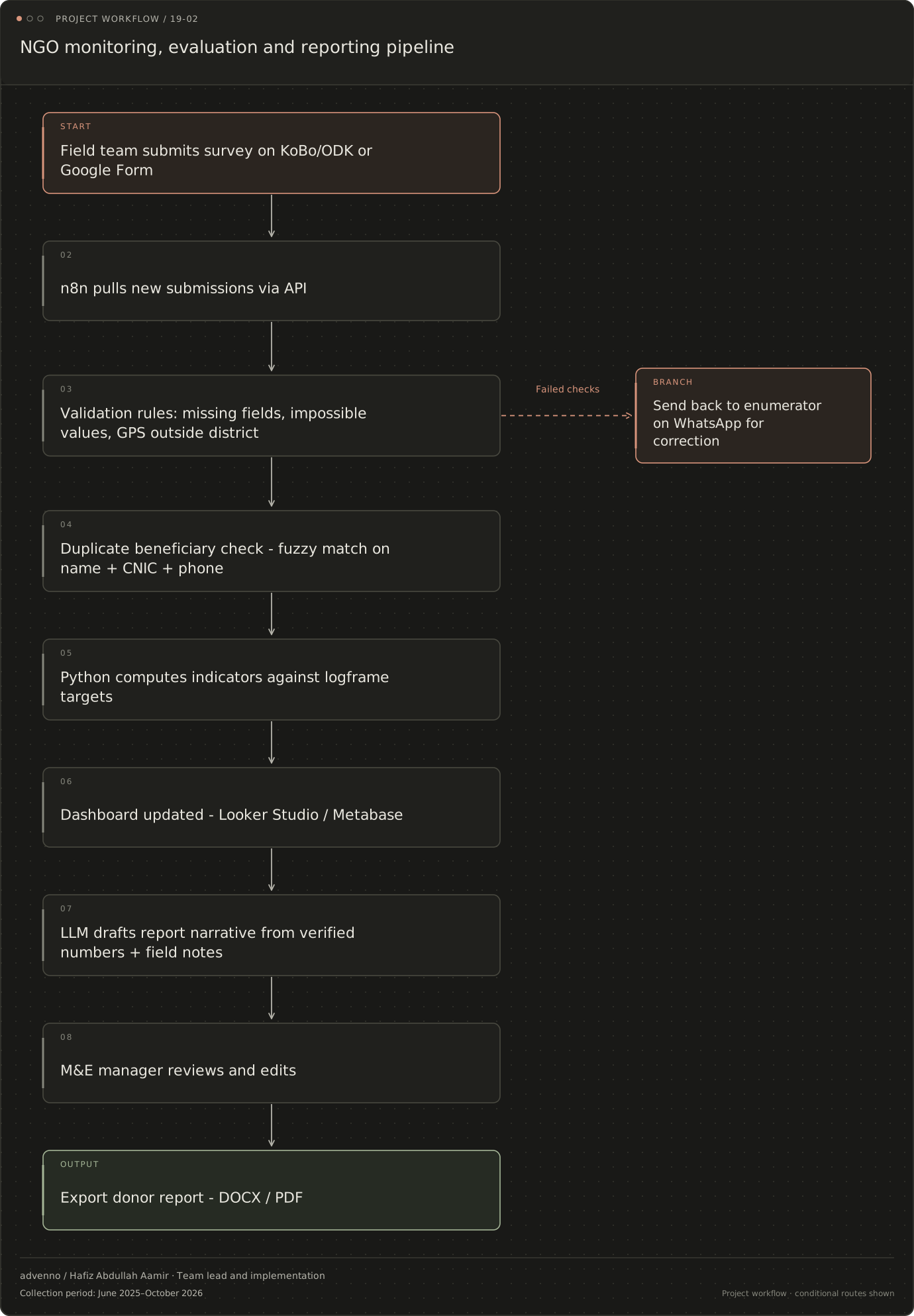
Read the stages and decision branches
- Field team submits survey on KoBo/ODK or Google Form
- n8n pulls new submissions via API
- Validation rules: missing fields, impossible values, GPS outside district
- Duplicate beneficiary check - fuzzy match on name + CNIC + phone
- Python computes indicators against logframe targets
- Dashboard updated - Looker Studio / Metabase
- LLM drafts report narrative from verified numbers + field notes
- M&E manager reviews and edits
- Export donor report - DOCX / PDF
- Send back to enumerator on WhatsApp for correction
Related acquisition workflow: NGOs and development organisations
A separate lead-research and CRM workflow configured for this business niche. It connects evidence gathering, qualification and follow-up; it is distinct from the operational system shown above.
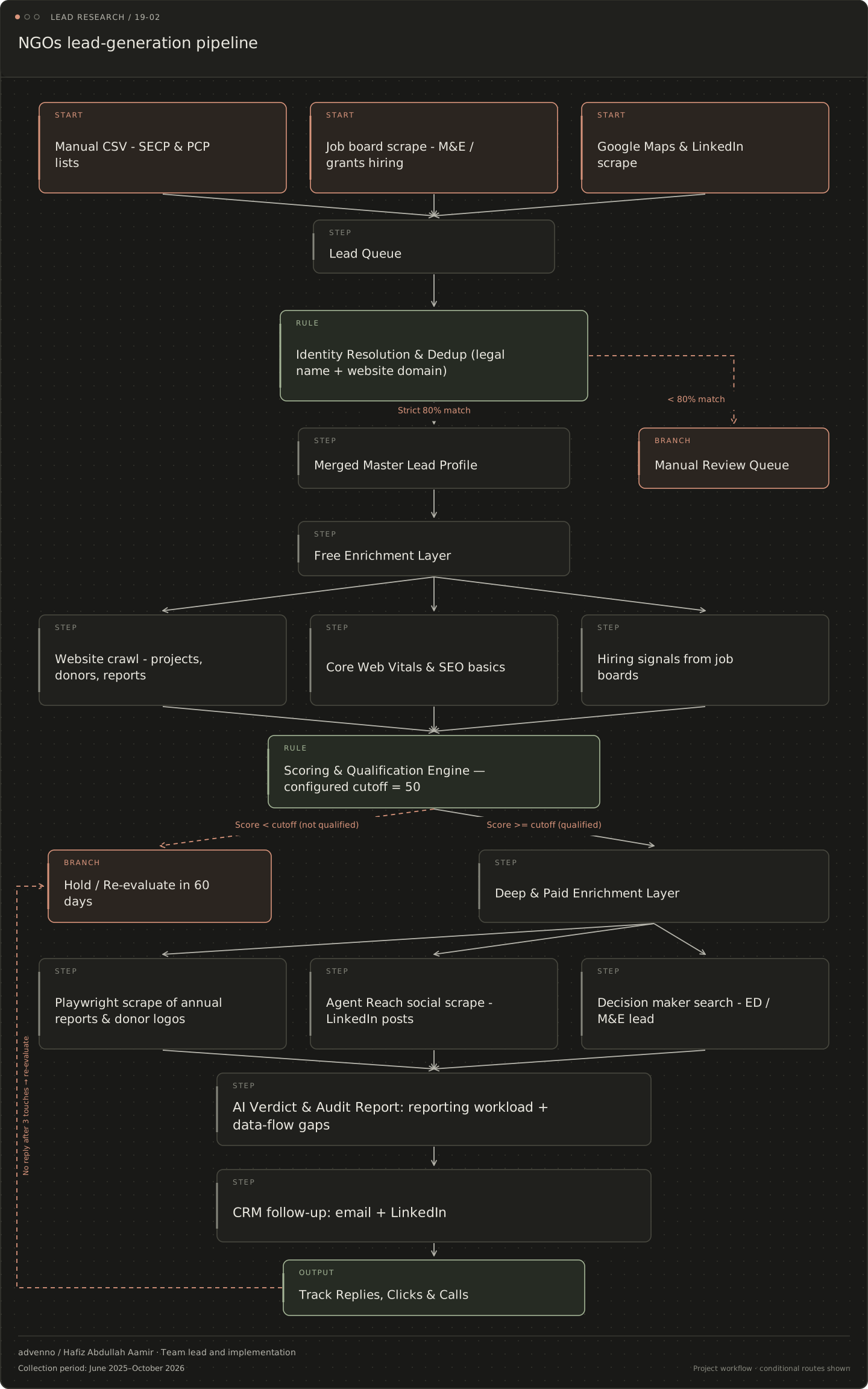
Read the stages and decision branches
- Manual CSV - SECP & PCP lists
- Job board scrape - M&E / grants hiring
- Google Maps & LinkedIn scrape
- Lead Queue
- Identity Resolution & Dedup (legal name + website domain)
- Strict 80% match: Merged Master Lead Profile
- < 80% match: Manual Review Queue
- Merged Master Lead Profile
- Manual Review Queue
- Free Enrichment Layer
- Website crawl - projects, donors, reports
- Core Web Vitals & SEO basics
- Hiring signals from job boards
- Scoring & Qualification Engine — configured cutoff = 50
- Score < cutoff (not qualified): Hold / Re-evaluate in 60 days
- Score >= cutoff (qualified): Deep & Paid Enrichment Layer
- Hold / Re-evaluate in 60 days
- Deep & Paid Enrichment Layer
- Playwright scrape of annual reports & donor logos
- Agent Reach social scrape - LinkedIn posts
- Decision maker search - ED / M&E lead
- AI Verdict & Audit Report: reporting workload + data-flow gaps
- CRM follow-up: email + LinkedIn
- Track Replies, Clicks & Calls
- no reply after 3 touches: Hold / Re-evaluate in 60 days
What makes the system useful.
Which NGO teams does the wider project collection connect?
The reporting pipeline sat within a broader set of NGO operations. Field teams collected programme information, monitoring and evaluation staff defined indicators, grants colleagues prepared proposals and programme teams handled beneficiary feedback. The project collection connected reporting with proposal knowledge, field-data checks, grant-call monitoring, complaints intake and success-story preparation.
These activities share organisational knowledge but not a single approval route. A grants draft draws from earlier proposals; a donor report draws from validated programme data; a sensitive complaint needs a responsible case handler. Keeping those lanes visible lets the organisation connect its work without turning confidential material into a general-purpose writing pool.
How are indicators, narratives and field corrections separated?
The reporting approach used collected data as input, validation rules to identify issues and code to calculate the agreed indicators. Narrative assistance then explained those figures in a draft for review. The indicator definition remained the responsibility of the M&E team, because a correct calculation of the wrong measure would still produce a misleading report.
Field-data validation formed a connected feedback loop. An incomplete or inconsistent submission could be flagged to the enumerator instead of being silently accepted into the report. Duplicate detection and entity matching can support data quality, but a possible match needs review where it could change a beneficiary count or case record.
How can an NGO evaluate reporting and accountability automation?
Report-preparation time, data errors identified, submission timeliness and proposal preparation are useful evaluation categories. No measured improvements are claimed here. A meaningful review should also test whether the narrative preserves the approved figures and whether the correction process keeps the original field information understandable.
Programme information may include sensitive health, identity or complaint data. An adaptation needs an agreed hosting and processing arrangement, including which records may reach an external service. Beneficiary stories need appropriate consent and respectful representation. Those requirements are part of the system's operational design, not details to add after a report has already been generated.