Online academy and faith-organisation administration workflows
Hafiz Abdullah Aamir developed online-academy and faith-organisation administration projects covering enquiry and trial booking, cross-time-zone tutor scheduling, tuition-payment follow-up, student records and separate donation administration. The collection supports the practical work around learning and organisational service, while teaching and religious interpretation remain with qualified people.
By Advenno · Project team lead: Hafiz Abdullah Aamir · Published · Updated
Where the work gets stuck.
An online academy's enquiry does not become a class booking through a reply alone. The family needs information, a suitable trial time and a tutor who is available. When families and tutors are in different countries, the scheduling context matters alongside the enrolment conversation. Administration then continues through the move from a trial class to an ongoing learning arrangement.
The project addressed that connected path. It covered the practical work surrounding trials, enrolment, tutor schedules and fees, with student administration and a separate donation-record workflow in the wider academy and faith-organisation collection. Religious teaching and interpretation remained outside the administrative assistant's scope.
A system built around the work.
The completed workflow connected enquiry response with trial-class booking, tutor availability and scheduling across time zones. An assistant supported questions about packages and the administrative process, while calendar coordination connected the family's interest with an available class. Fee reminders and failed-payment follow-up covered the later administrative stage.
This joined admission enquiries with the scheduling and payment-related work around online tuition. The trial booking was the bridge between the initial conversation and the academy's delivery schedule. Enquiry response, class scheduling and fee follow-up address different moments in the family's relationship with the academy, linked through the same administrative journey.
How the pieces connect.
Respond to the enquiry
Support the family's questions about packages and the academy's administrative process as the first step towards a trial lesson.
Arrange the trial class
Connect the enquiry with trial booking and the tutor-availability information needed to identify a suitable session.
Coordinate the class time
Use the scheduling context across the family's and tutor's time zones to support the online-class arrangement.
Continue enrolment administration
Carry the learning arrangement into fee reminders and payment-related follow-up as part of the academy's ongoing administrative workflow.
What the project delivered.
The project delivered a trial-to-enrolment administration workflow for an online academy. It linked incoming interest with trial scheduling and connected the later learning arrangement with fee follow-up. Admissions, tutor scheduling and fee administration became connected parts of the class arrangement, while the teaching relationship remained with the academy and its tutors.
The systems behind the workflow.
Each module handles a different part of the work. Together, they connect the operational handoffs around this project.
Enquiry response and trial booking
The enquiry module connected an interested family's administrative questions with an available trial lesson. It helped bring the initial conversation into a practical next step for admissions staff and tutors.
- How it works
A scripted assistant and booking workflow use approved package information and calendar availability.
- Operational consideration
The assistant handles administration. Questions requiring religious guidance or an unsupported commitment go to the appropriate person rather than an improvised model answer.
Cross-time-zone tutor scheduling
The scheduling module connected tutor availability with the family's local time. It addressed the coordination needed when the people arranging and delivering lessons were in different countries.
- How it works
Calendar records and timezone-aware scheduling represent each participant's time zone rather than storing only a fixed offset.
- Operational consideration
Daylight-saving changes and availability updates can affect a booking. Check the local time shown to both sides and handle changes before sending a confirmation.
Tuition reminders and failed-payment follow-up
The finance workflow organised recurring tuition communication and follow-up on incomplete payments. It supported the administrative work after a family moved through the trial process.
- How it works
Payment links, recorded billing status and scheduled communication connect the monthly collection steps.
- Operational consideration
A reminder is not settlement. Recheck the current record and confirm the actual provider's cross-border capabilities before promising an integration.
Faith-organisation donation records
The donation module covered contribution logging, receipts and fund-progress updates for organisations such as places of worship. It used a distinct financial record from the academy's tuition process.
- How it works
Forms or messaging feed a donation ledger and reviewed receipt or progress-report output.
- Operational consideration
Verify payment evidence, especially screenshots. A fund-progress update must use recorded contributions rather than generated amounts or an assumed pledge total.
Student administration
The student-record module connected admissions, attendance and fee information for the relevant educational organisation. It supported the administration around learning without claiming to automate the substance of religious teaching.
- How it works
Forms and a structured student record organise the admissions and ongoing attendance or fee workflow.
- Operational consideration
Keep child and student information limited to the administrative purpose and restrict access. A recorded application is not automatically an approved admission.
Inside the system.
Choose a workflow to open the full diagram. Zoom in to follow its decisions and handoffs, or read the stages in the text view.
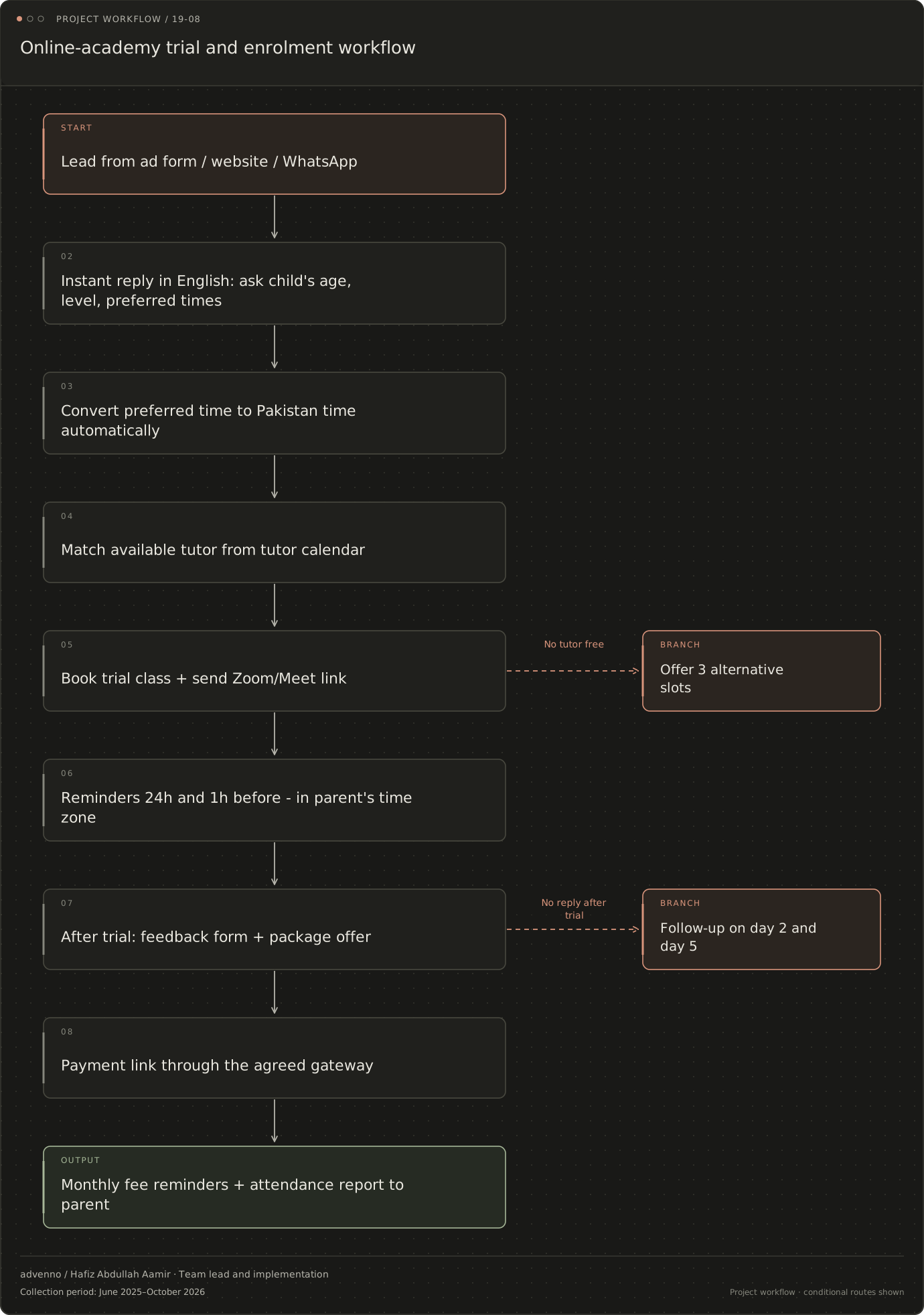
Online-academy trial and enrolment workflow
The project’s operational flow, including decision points and exception routes. Named channels reflect the original project context; a similar implementation is scoped around your systems.
Read the stages and decision branches
- Lead from ad form / website / WhatsApp
- Instant reply in English: ask child's age, level, preferred times
- Convert preferred time to Pakistan time automatically
- Match available tutor from tutor calendar
- Book trial class + send Zoom/Meet link
- Reminders 24h and 1h before - in parent's time zone
- After trial: feedback form + package offer
- Payment link through the agreed gateway
- No reply after trial: Follow-up on day 2 and day 5
- Payment link through the agreed gateway
- Monthly fee reminders + attendance report to parent
- Offer 3 alternative slots
- Follow-up on day 2 and day 5
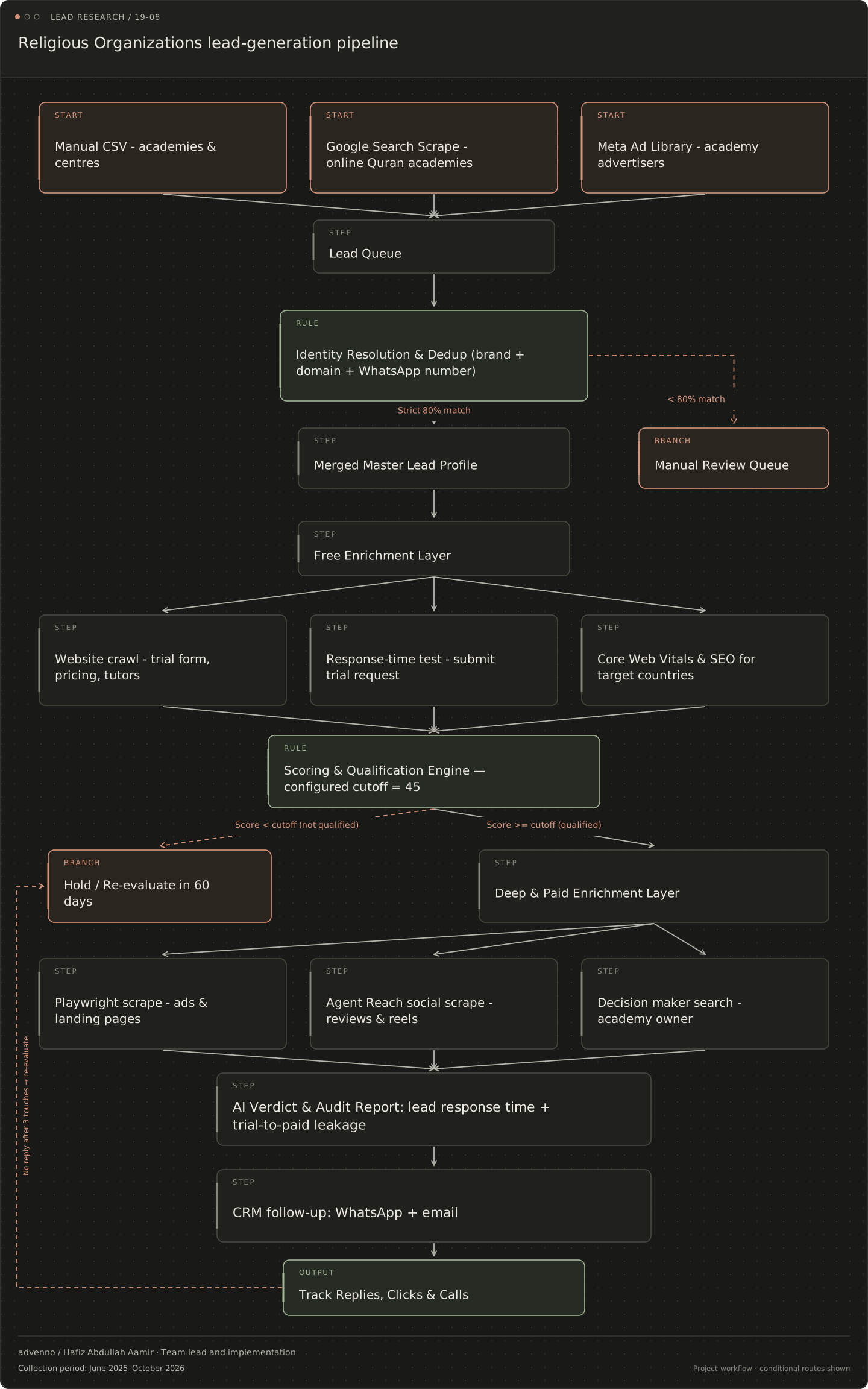
Related acquisition workflow: Online religious education academies
A separate lead-research and CRM workflow configured for this business niche. It connects evidence gathering, qualification and follow-up; it is distinct from the operational system shown above.
Read the stages and decision branches
- Manual CSV - academies & centres
- Google Search Scrape - online Quran academies
- Meta Ad Library - academy advertisers
- Lead Queue
- Identity Resolution & Dedup (brand + domain + WhatsApp number)
- Strict 80% match: Merged Master Lead Profile
- < 80% match: Manual Review Queue
- Merged Master Lead Profile
- Manual Review Queue
- Free Enrichment Layer
- Website crawl - trial form, pricing, tutors
- Response-time test - submit trial request
- Core Web Vitals & SEO for target countries
- Scoring & Qualification Engine — configured cutoff = 45
- Score < cutoff (not qualified): Hold / Re-evaluate in 60 days
- Score >= cutoff (qualified): Deep & Paid Enrichment Layer
- Hold / Re-evaluate in 60 days
- Deep & Paid Enrichment Layer
- Playwright scrape - ads & landing pages
- Agent Reach social scrape - reviews & reels
- Decision maker search - academy owner
- AI Verdict & Audit Report: lead response time + trial-to-paid leakage
- CRM follow-up: WhatsApp + email
- Track Replies, Clicks & Calls
- no reply after 3 touches: Hold / Re-evaluate in 60 days
What makes the system useful.
Which academy and faith-organisation workflows were included?
The online-academy journey connected an interested family with a trial lesson, tutor availability and later enrolment administration. The wider collection also included donation records for faith organisations and student admissions, attendance and fee records. Those are separate operational lanes: tuition scheduling, community donations and student administration should not be presented as the same transaction.
The original academy context involved Quran and Islamic-studies teaching for families in countries including the UK and US. The automation handled administration, package questions and scheduling. It did not take on the role of religious instruction or issuing religious rulings.
How do enquiry response, time zones and payment follow-up connect?
The academy approach joined a scripted administrative assistant with calendar availability. A family could move from a question about a package to a trial booking that matched the tutor's schedule. Cross-time-zone coordination needed to represent the family's and tutor's local times correctly, including daylight-saving changes rather than assuming a permanently fixed time difference.
Fee reminders and failed-payment follow-up covered the continuing relationship after the trial. This is distinct from a confirmed enrolment or completed payment. The organisation's donation and student-record modules used their own intake, ledger and attendance information, with access appropriate to the people administering each service.
What should be evaluated when adapting these workflows?
Suggested academy measures include response time, trial bookings, trial-to-enrolment progression and timely fee collection. These are possible measures, not achieved conversion or revenue results. Scheduling review should include daylight-saving changes, unavailable tutors and the local time shown to the family.
The assistant's boundary is also testable: an administrative package question should receive approved information, while a religious question goes to a qualified person. Student records may concern children, so the collection and access requirements should be kept narrow. Payment integration and cross-border collection options need checking for the actual organisation rather than assuming that any named provider is available everywhere.