Professional association CPD, member service and conference workflows
Hafiz Abdullah Aamir developed professional-association automation projects covering CPD registration, attendance and certificates, source-cited member assistance, policy and circular summaries, conference operations and joining-document review. The collection supports training and ongoing member administration, with the association retaining authority over its rules and professional standing.
By Advenno · Project team lead: Hafiz Abdullah Aamir · Published · Updated
Where the work gets stuck.
A professional association's training event produces several connected records. Someone registers, attends a session and may then need a certificate, while the association needs a record of the activity. These stages can be handled at different times by different staff, even though they all relate to the same member and training event.
The project addressed that continuity. CPD administration connected registration with the certificate and training record. The wider collection also covered member questions, policy and circular summaries, conference operations and joining-document review, bringing training into the association’s ongoing service to members. It kept the event's operational sequence central, rather than treating the certificate as an isolated document produced after the session.
A system built around the work.
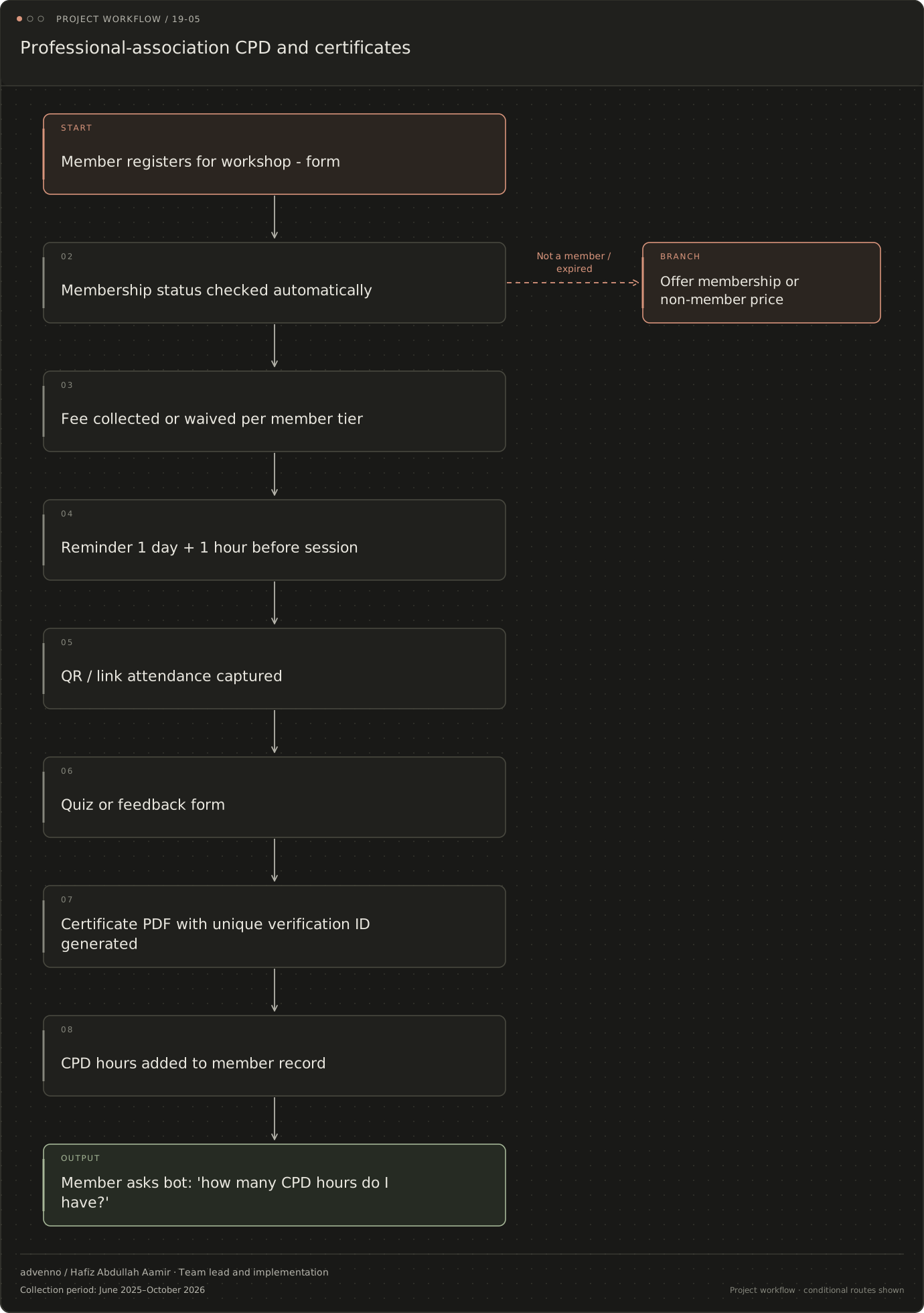
The completed workflow connected registration, reminders, attendance capture and certificate generation. Certificate records included identifiers and a verification step so that the issued output related back to the recorded training activity. The training record formed the continuing administrative view after the event was completed.
This brought event coordination and certificate administration together. Registration established the participant context, attendance supplied the session record and certificate generation completed the documented sequence. The certificate records the training activity within the association's process; any professional standing attached to it depends on the issuing body's rules.
How the pieces connect.
Register the participant
Collect the member and session information needed to begin the registration process for the association's training activity.
Coordinate the session
Use registration information for reminders and the administrative preparation leading into the training event.
Record participation
Bring attendance information into the workflow so the completed session has a corresponding participant record.
Generate and record the certificate
Produce the certificate with its identifier and verification information, connecting the issued document to the recorded training activity.
What the project delivered.
The project delivered a CPD administration process linking the participant's registration with attendance and certificate records. The association could manage these stages as a connected workflow, with certificate information tied to the training activity. The resulting capability supported course administration and record keeping; the professional meaning of a certificate remains a matter for the issuing association.
The systems behind the workflow.
Each module handles a different part of the work. Together, they connect the operational handoffs around this project.
CPD participation and certificates
Training administration connected registration and reminders with attendance, certificates and continuing records. It kept the issued document tied to the participant's recorded training activity.
- How it works
Forms, event records and document generation create uniquely identified certificates with a verification route.
- Operational consideration
Review old-record migration and participant corrections. A certificate verifies an issued record within this process; recognition depends on the issuing body's own rules.
Source-cited member helpdesk
The member assistant addressed questions using bylaws, circulars and fee schedules. It supported the team handling recurring enquiries while keeping the reference material visible.
- How it works
Retrieval connects the question to approved documents, with citations supporting the answer.
- Operational consideration
A citation helps identify evidence but does not make an interpretation infallible. Regulatory or ambiguous questions need the association's responsible reviewer.
Policy and circular summaries
The communications module helped turn new circulars or policy updates into a clearer member-facing draft. It supported distribution after the organisation checked the meaning and relevance.
- How it works
A language model prepares a summary from the original document; human approval precedes publication or email.
- Operational consideration
Keep the original available and distinguish it from the summary. Do not alter exceptions, conditions or effective dates while simplifying the wording.
Conference operations
Conference administration covered registration, badges and sponsor-related records. It connected pre-event preparation with the activity the team needed to manage on the day.
- How it works
Forms and event records support QR badges and the associated coordination workflow.
- Operational consideration
Peak load, access to sponsor information and incorrect attendee records need planning. A working registration form alone does not prove event-day readiness.
Joining and document verification
The membership module connected online applications with uploaded documents and a review stage. It helped organise the information needed for an association to decide on a new member.
- How it works
Forms, OCR assistance and an approval workflow support application preparation and review.
- Operational consideration
Extracted document fields are not proof of authenticity or eligibility. A responsible reviewer makes the membership decision against the association's criteria.
Inside the system.
Choose a workflow to open the full diagram. Zoom in to follow its decisions and handoffs, or read the stages in the text view.
Professional-association CPD and certificates
The project’s operational flow, including decision points and exception routes. Named channels reflect the original project context; a similar implementation is scoped around your systems.
Read the stages and decision branches
- Member registers for workshop - form
- Membership status checked automatically
- Fee collected or waived per member tier
- Not a member / expired: Offer membership or non-member price
- Fee collected or waived per member tier
- Reminder 1 day + 1 hour before session
- QR / link attendance captured
- Quiz or feedback form
- Certificate PDF with unique verification ID generated
- CPD hours added to member record
- Member asks bot: 'how many CPD hours do I have?'
- Offer membership or non-member price
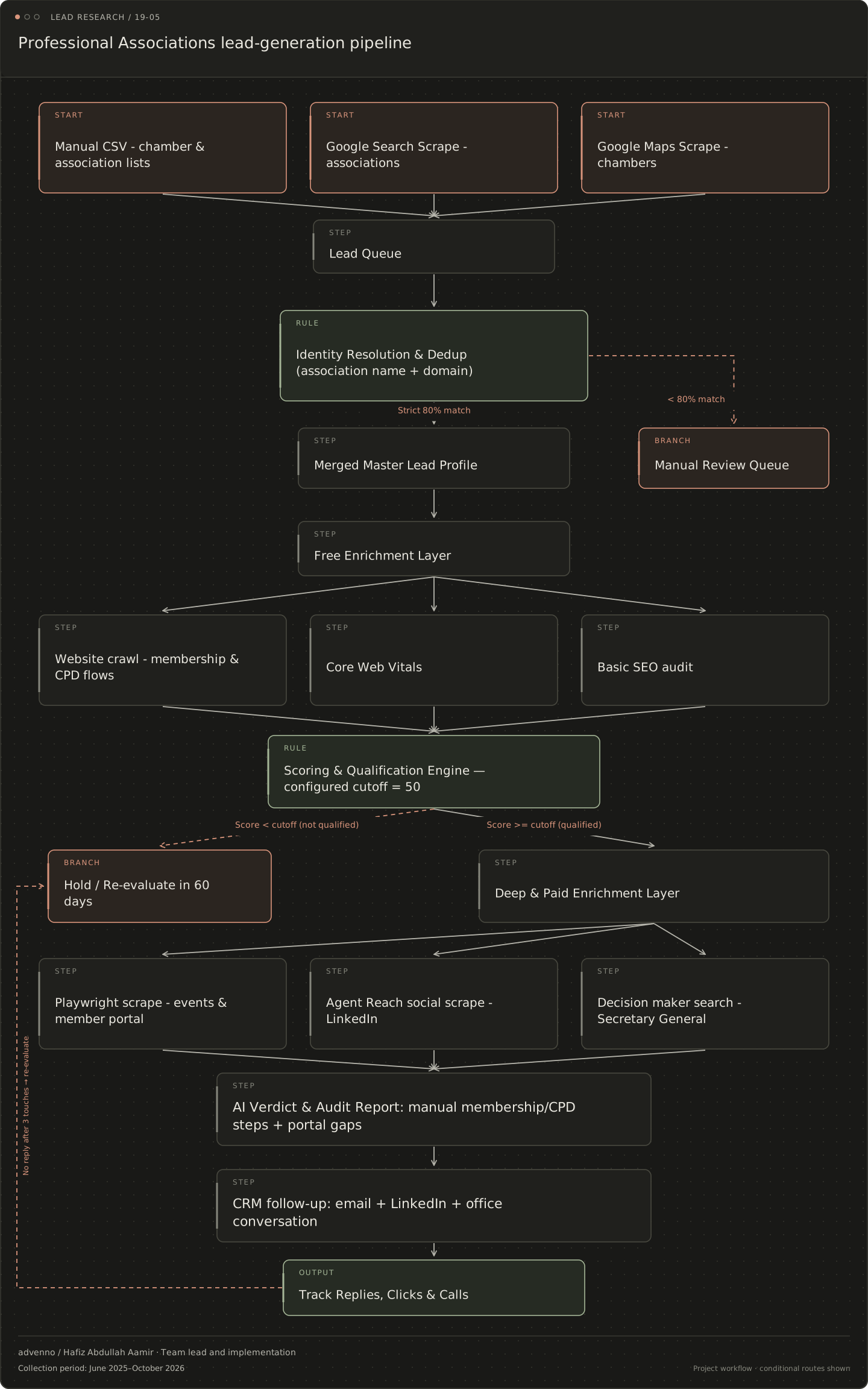
Related acquisition workflow: Professional associations
A separate lead-research and CRM workflow configured for this business niche. It connects evidence gathering, qualification and follow-up; it is distinct from the operational system shown above.
Read the stages and decision branches
- Manual CSV - chamber & association lists
- Google Search Scrape - associations
- Google Maps Scrape - chambers
- Lead Queue
- Identity Resolution & Dedup (association name + domain)
- Strict 80% match: Merged Master Lead Profile
- < 80% match: Manual Review Queue
- Merged Master Lead Profile
- Manual Review Queue
- Free Enrichment Layer
- Website crawl - membership & CPD flows
- Core Web Vitals
- Basic SEO audit
- Scoring & Qualification Engine — configured cutoff = 50
- Score < cutoff (not qualified): Hold / Re-evaluate in 60 days
- Score >= cutoff (qualified): Deep & Paid Enrichment Layer
- Hold / Re-evaluate in 60 days
- Deep & Paid Enrichment Layer
- Playwright scrape - events & member portal
- Agent Reach social scrape - LinkedIn
- Decision maker search - Secretary General
- AI Verdict & Audit Report: manual membership/CPD steps + portal gaps
- CRM follow-up: email + LinkedIn + office conversation
- Track Replies, Clicks & Calls
- no reply after 3 touches: Hold / Re-evaluate in 60 days
What makes the system useful.
What did the professional-association project collection include?
CPD certificates were one part of a wider association workflow. The collection connected training registration and attendance with certificates, a member helpdesk, reviewed circular summaries, conference administration and membership applications. Training staff, membership colleagues and communications teams need different information, even when they support the same professional community.
A participant's attendance record supports a certificate. An approved circular supports a member answer. A membership application needs document review. Keeping those evidence paths visible prevents the system from treating a generated PDF, a retrieved policy and an approved membership decision as equivalent outputs. Reporting on member engagement and training revenue uses those underlying activity records, so the communications team and training staff can work from a consistent operational picture.
How do certificate records and source-cited member answers work?
The CPD workflow linked registration, reminders and attendance with certificate generation. Unique identifiers and a verification page connected the issued document back to its record. This makes certificate administration more than mail-merging a name onto a design, but it does not independently establish professional accreditation or regulatory recognition.
The member-information workflow used bylaws, circulars and fee schedules as reference material. Source citations help a reader understand what supports the answer. Summaries of policy or circular changes needed approval before distribution, because a shorter explanation can alter the meaning of the original if it is not checked carefully.
What should an association evaluate during adoption?
Useful measures include certificate corrections, administrative effort per event and the types of member questions resolved. These are evaluation suggestions, not reported outcomes. Check that each certificate corresponds to the correct participant and session, including records migrated from an earlier process.
Conferences create a different operational test: peak-day registrations, badge access and event check-in. New membership adds document authenticity and approval requirements. An association can reuse components across these activities, but it still needs clear owners for certificate criteria, reference-document updates and membership decisions.