Recruitment intake, matching and candidate operations automation
Hafiz Abdullah Aamir developed recruitment automation projects covering searchable CV intake, job-order matching, candidate status assistance, identity and certificate document checks, employer-demand research and client shortlist reports. The collection connects candidate information with recruiter review and employer-facing preparation, while shortlist and hiring decisions remain with people.
By Advenno · Project team lead: Hafiz Abdullah Aamir · Published · Updated
Where the work gets stuck.
A recruitment request starts with a job requirement, but the information needed to fill it can arrive across documents and conversations. CVs contain different layouts and levels of detail, while candidates also need answers about what happens next. The work therefore involves more than reading applications: a recruiter needs to connect each candidate's information to a specific role and keep the process understandable as it moves forward.
The project addressed these connected intake, matching and communication tasks. Its scope centred on assisting the recruitment team with organising information and preparing candidate review, rather than treating an automated match as a hiring decision.
A system built around the work.
The delivered workflow combined CV intake with structured candidate information, AI-assisted matching and candidate-status assistance. Incoming application details became usable inputs for comparing candidates with job requirements. Matching supported the recruiter's review of relevant information, and the status component addressed questions about progress and outstanding documentation.
These capabilities formed a connected recruitment workflow: information collected at intake could inform the review stage, while candidate communication related to the stage of the process. Recruiters remained responsible for approving the shortlist.
How the pieces connect.
Receive candidate information
Bring incoming CV material into the intake workflow so the application can be considered against a defined recruitment requirement.
Structure the application
Organise relevant CV details into candidate information that the recruitment team can use during its review.
Support shortlist preparation
Compare candidate information with job requirements and present matching assistance for a recruiter to consider and approve.
Explain the next step
Support candidate-status questions and document-checklist communication as the application moves through the recruitment process.
What the project delivered.
The delivered capability brought candidate intake, review assistance and status communication into one project. Recruitment teams could work with structured application information and use matching support when preparing a shortlist. Candidate updates and document-checklist assistance formed the communication side of the workflow. The practical connection is between the application record, the recruiter's review and the information a candidate receives about the next step.
The systems behind the workflow.
Each module handles a different part of the work. Together, they connect the operational handoffs around this project.
Searchable CV intake
Applications were organised into candidate information that recruiters could search and review. The scope included image and document extraction instead of leaving every CV as an isolated attachment in an inbox or messaging thread.
- How it works
OCR and LLM extraction feed searchable candidate storage, with structured fields available for recruiter review and job-order matching.
- Operational consideration
A recruiter checks uncertain or incomplete fields before those values influence a shortlist. Keep original documents available for that comparison.
Job-order matching
The matching module connected candidate information to a specific job order. It combined relevance in the candidate's experience with explicit requirements, allowing the recruiter to review why a person appeared in a suggested shortlist.
- How it works
Embeddings support semantic comparison; rules represent trade, experience and document requirements. Human approval completes shortlist preparation.
- Operational consideration
Matching should expose relevant evidence and missing requirements. A ranking is assistance for a recruiter, not an automatic rejection decision.
Candidate status and document checklist
Candidate-service work covered routine progress questions and the documents needed for the next step. Linking answers to the workflow record kept the assistant connected to the agency's operational process.
- How it works
A messaging assistant reads the candidate status and outstanding-document checklist, including the multilingual communication used in the project.
- Operational consideration
When a status is missing, disputed or out of date, the enquiry needs staff attention. The assistant must not invent a processing milestone.
Identity and certificate document checks
Document handling covered passports, identity documents and certificates. Extracted values and a checklist helped staff see which material had arrived and what still needed checking before the candidate could progress.
- How it works
MRZ or OCR extraction supports structured document checks. The method assists the documentation officer rather than replacing external verification.
- Operational consideration
These records contain sensitive personal information. Collection, access and retention need explicit operational boundaries; OCR output alone cannot establish authenticity.
Employer-demand research
A connected business-development module organised signals about employers hiring and the roles they needed. Its purpose was to support job-order research for the recruitment business, separate from reviewing candidate applications.
- How it works
Permitted job-board and news information can be organised into reviewed employer-demand notes with language-model assistance.
- Operational consideration
Public research can be incomplete or outdated. Verify the employer, vacancy and relevance of a research note before using it in a business-development decision.
Client shortlist reports
The reporting module turned approved candidate information into employer-facing submissions. This connected the recruiter's decision with a consistent report instead of requiring the team to rewrite each profile from scattered notes.
- How it works
PDF templates provide structure, with reviewed narrative summaries drawn from the candidate record and approved shortlist.
- Operational consideration
Claims about a candidate must remain supported by the underlying information. A well-formatted report is not evidence that a qualification has been verified.
Inside the system.
Choose a workflow to open the full diagram. Zoom in to follow its decisions and handoffs, or read the stages in the text view.
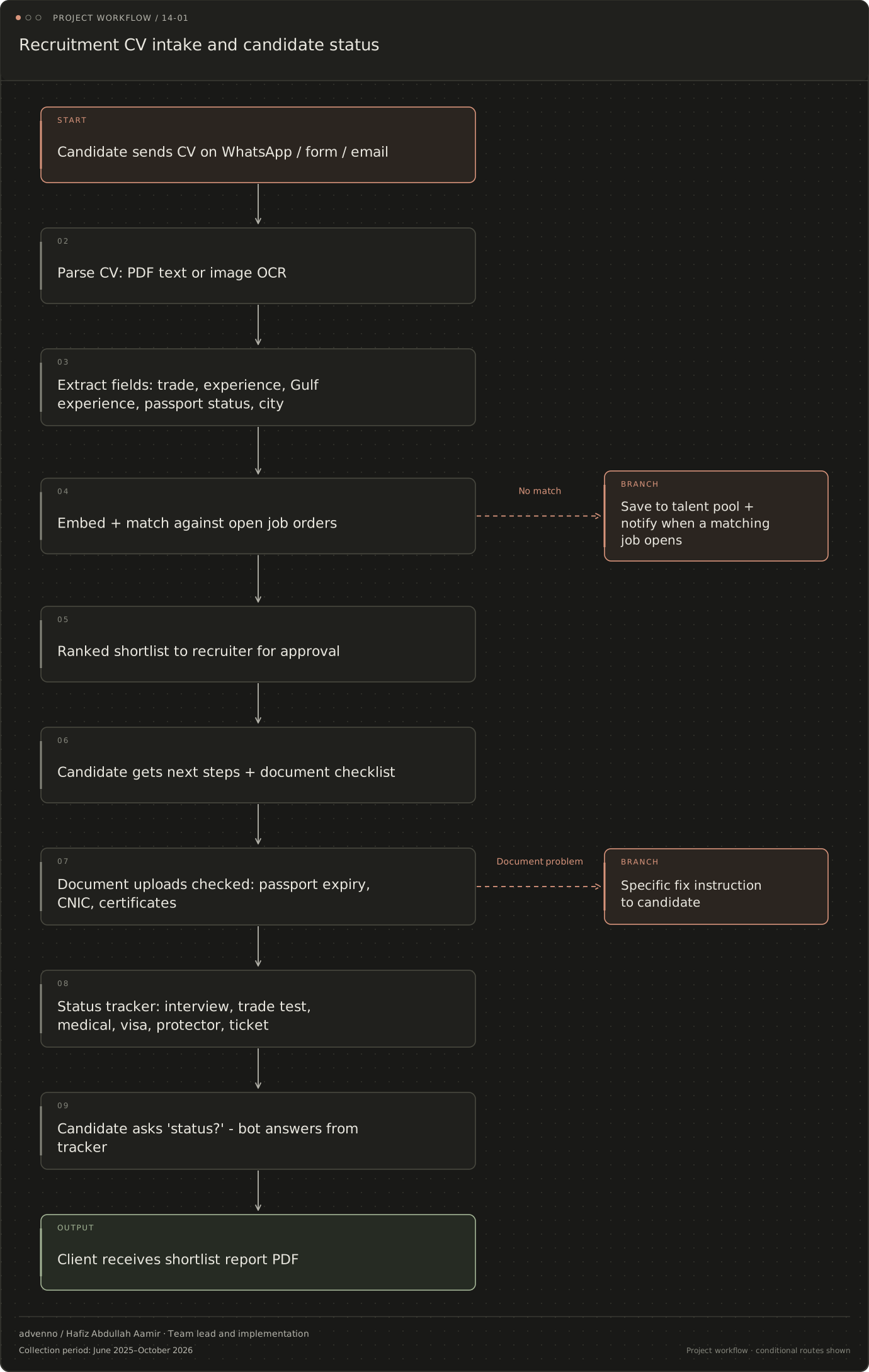
Recruitment CV intake and candidate status
The project’s operational flow, including decision points and exception routes. Named channels reflect the original project context; a similar implementation is scoped around your systems.
Read the stages and decision branches
- Candidate sends CV on WhatsApp / form / email
- Parse CV: PDF text or image OCR
- Extract fields: trade, experience, Gulf experience, passport status, city
- Embed + match against open job orders
- Ranked shortlist to recruiter for approval
- Candidate gets next steps + document checklist
- Document uploads checked: passport expiry, CNIC, certificates
- Status tracker: interview, trade test, medical, visa, protector, ticket
- Candidate asks 'status?' - bot answers from tracker
- Client receives shortlist report PDF
- Save to talent pool + notify when a matching job opens
- Specific fix instruction to candidate
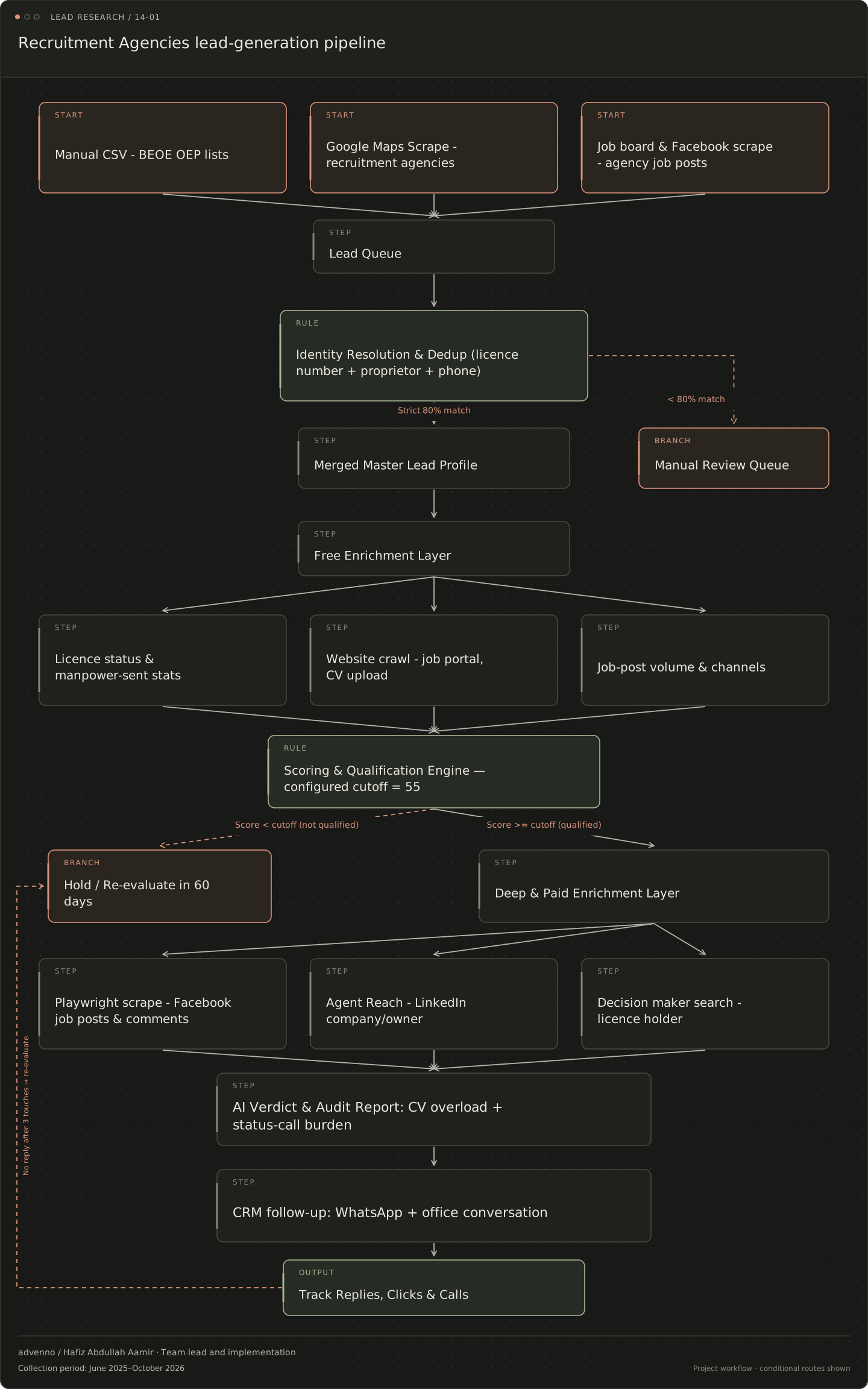
Related acquisition workflow: Recruitment agencies
A separate lead-research and CRM workflow configured for this business niche. It connects evidence gathering, qualification and follow-up; it is distinct from the operational system shown above.
Read the stages and decision branches
- Manual CSV - BEOE OEP lists
- Google Maps Scrape - recruitment agencies
- Job board & Facebook scrape - agency job posts
- Lead Queue
- Identity Resolution & Dedup (licence number + proprietor + phone)
- Strict 80% match: Merged Master Lead Profile
- < 80% match: Manual Review Queue
- Merged Master Lead Profile
- Manual Review Queue
- Free Enrichment Layer
- Licence status & manpower-sent stats
- Website crawl - job portal, CV upload
- Job-post volume & channels
- Scoring & Qualification Engine — configured cutoff = 55
- Score < cutoff (not qualified): Hold / Re-evaluate in 60 days
- Score >= cutoff (qualified): Deep & Paid Enrichment Layer
- Hold / Re-evaluate in 60 days
- Deep & Paid Enrichment Layer
- Playwright scrape - Facebook job posts & comments
- Agent Reach - LinkedIn company/owner
- Decision maker search - licence holder
- AI Verdict & Audit Report: CV overload + status-call burden
- CRM follow-up: WhatsApp + office conversation
- Track Replies, Clicks & Calls
- no reply after 3 touches: Hold / Re-evaluate in 60 days
What makes the system useful.
What recruitment work does this project collection connect?
The recruitment work covered more than a candidate chatbot. It connected the recruiter receiving applications, the person checking documents, the consultant preparing a shortlist and the candidate asking what happens next. Applications arrived in mixed formats, including CV documents, images and voice material. Job requirements, candidate information and outstanding documents therefore needed a usable structure before the agency could make a hiring recommendation.
The wider collection included searchable candidate records, job-order matching, document checks and employer-facing reports. Employer-demand research supported the agency's business-development work as a separate module. These functions have related inputs, but a new employer opportunity, an eligible candidate and an approved shortlist are different records and different decisions.
How do extraction, matching and recruiter decisions work together?
The implementation approach separated information extraction from selection. OCR and language-model extraction made CV information searchable. Semantic matching helped identify relevant experience, while explicit criteria represented requirements such as trade, experience and required documents. A matching result supplied material for a recruiter to assess; it did not make the final shortlist decision.
Candidate status was another layer. A status assistant needed the current workflow record and document checklist, rather than an open-ended guess about interview, visa or hiring progress. The workflow included Urdu and Roman Urdu communication. Adapting it to another market requires testing the language, candidate terminology and local recruitment stages used by that team.
What would a recruitment team measure when adapting the system?
Useful evaluation measures include time from CV receipt to a reviewed shortlist, correction rates in extracted fields, recruiter time per placement and the number of routine status enquiries. These are proposed measures for an implementation review, not published results from this project. A meaningful comparison also checks whether the same job requirements and review standards were used.
Operational checks include incorrect document readings, stale candidate status, duplicate applications and mismatches between semantic relevance and eligibility. A candidate with a similar job title is not automatically qualified, and an extracted passport number does not establish document authenticity.