Temporary staffing shifts, worker records and payment preparation
Hafiz Abdullah Aamir developed temporary-staffing automation projects spanning shift communication, booking and waitlists, check-in and check-out, payout and invoice preparation, worker reliability history and registration-document extraction. The collection follows the assignment from an available shift through recorded attendance and administrative completion, with worker decisions remaining reviewable by the staffing team.
By Advenno · Project team lead: Hafiz Abdullah Aamir · Published · Updated
Where the work gets stuck.
A temporary staffing assignment can move quickly from a client request to a scheduled event or work period. Coordinators need to communicate the available shift, gather responses and know who is expected to attend. The work continues after confirmation: attendance must be recorded and the completed assignment must feed the payment and client-billing process.
The project addressed that sequence as an operational workflow. Its focus was the connection between filling a shift and recording what happened, so the staffing team had a defined path through booking, check-in and timesheet preparation. The scope did not depend on treating a worker score as an employment decision.
A system built around the work.
The completed shift-fill system connected shift communication, worker acceptance and booking, confirmations and waitlists. It also included attendance capture and the resulting timesheet and payment-preparation stages. These functions followed the same assignment from its initial staffing need through to the administrative work after the shift.
The project brought the coordinator's main actions into an internal operational tool. An available shift could progress to confirmed staffing, and completed attendance could be used in the following records. The operational distinction is between a worker accepting an assignment, being expected at the shift and having attendance recorded for the completed work.
How the pieces connect.
Publish the shift requirement
Communicate an available assignment and collect worker responses so the coordinator can move from a request to a staffing plan.
Confirm the staffing
Manage acceptance, booking and waitlist information as the shift moves towards a confirmed set of expected workers.
Record the attendance
Capture check-in and check-out information to connect the scheduled assignment with the attendance recorded for the shift.
Prepare completion records
Use the completed shift information for timesheets, worker-payment preparation and the associated client-invoicing work.
What the project delivered.
The delivered capability covered the temporary-staffing assignment from shift availability to attendance and payment preparation. Booking, confirmations and waitlist handling formed the staffing side, while timesheets and payout preparation formed the completion side. The connection between these stages gives the assignment a continuous administrative path from the client's request to the completed staffing record.
The systems behind the workflow.
Each module handles a different part of the work. Together, they connect the operational handoffs around this project.
Shift broadcast, booking and waitlist
The booking module connected an open assignment with worker responses, confirmations and reserve availability. It brought the progression of a shift into an operational record rather than treating every reply in a group as a booking.
- How it works
Messaging introduces the shift; structured booking and worker records support acceptance, confirmation and waitlist states.
- Operational consideration
First acceptance and final confirmation are different events. Coordinators need a route for cancellations, replacements and responses that arrive after the shift is filled.
QR or location check-in and check-out
Attendance capture recorded the beginning and end of the worker's assignment. That supplied a more useful basis for timesheets than the earlier promise to attend.
- How it works
A web check-in can use QR or location validation where suitable, connected to the worker and shift record.
- Operational consideration
Phone problems, venue connectivity and inaccurate location need a manual exception route. A check-in method should support the operation rather than prevent legitimate attendance.
Payout lists and client invoices
Completion records fed payment preparation for workers and invoicing for clients. The module separated the administrative calculation and document stage from the earlier booking and attendance work.
- How it works
Scripts and document templates prepare payout lists and client invoices from the recorded completed assignment.
- Operational consideration
Preparing a payment list and transferring funds are separate steps. Confirm the payment provider's supported workflow and settlement record before treating a worker as paid.
Worker reliability history
The quality module organised worker history into a reliability signal for coordinators. It was intended to help the team understand previous assignment behaviour when planning later shifts.
- How it works
A history-based scoring process uses recorded attendance and assignment activity rather than unsupported impressions.
- Operational consideration
The underlying history can contain mistakes or exceptional circumstances. Review the evidence and fairness of using it before a score influences future opportunities.
Worker registration and identity extraction
New-worker registration collected the information needed to join the staffing pool. Document extraction supported the administrative work of creating a usable worker record.
- How it works
Forms and OCR assist identity-field capture and the worker onboarding checklist.
- Operational consideration
Identity extraction is not independent identity verification. Sensitive records and age-related checks need appropriate human handling and limited access.
Inside the system.
Choose a workflow to open the full diagram. Zoom in to follow its decisions and handoffs, or read the stages in the text view.
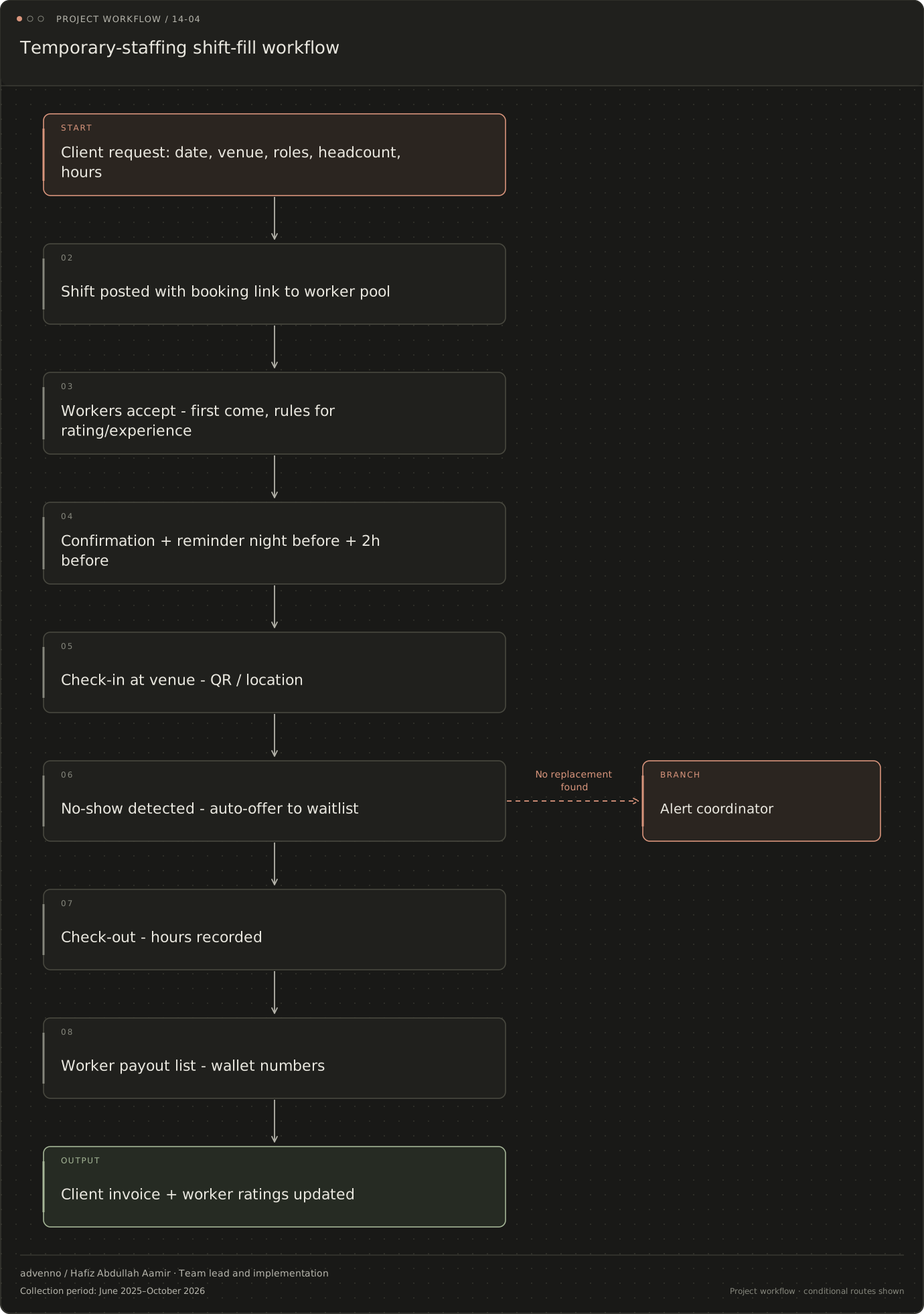
Temporary-staffing shift-fill workflow
The project’s operational flow, including decision points and exception routes. Named channels reflect the original project context; a similar implementation is scoped around your systems.
Read the stages and decision branches
- Client request: date, venue, roles, headcount, hours
- Shift posted with booking link to worker pool
- Workers accept - first come, rules for rating/experience
- Confirmation + reminder night before + 2h before
- Check-in at venue - QR / location
- No-show detected - auto-offer to waitlist
- Check-out - hours recorded
- No replacement found: Alert coordinator
- Check-out - hours recorded
- Worker payout list - wallet numbers
- Client invoice + worker ratings updated
- Alert coordinator
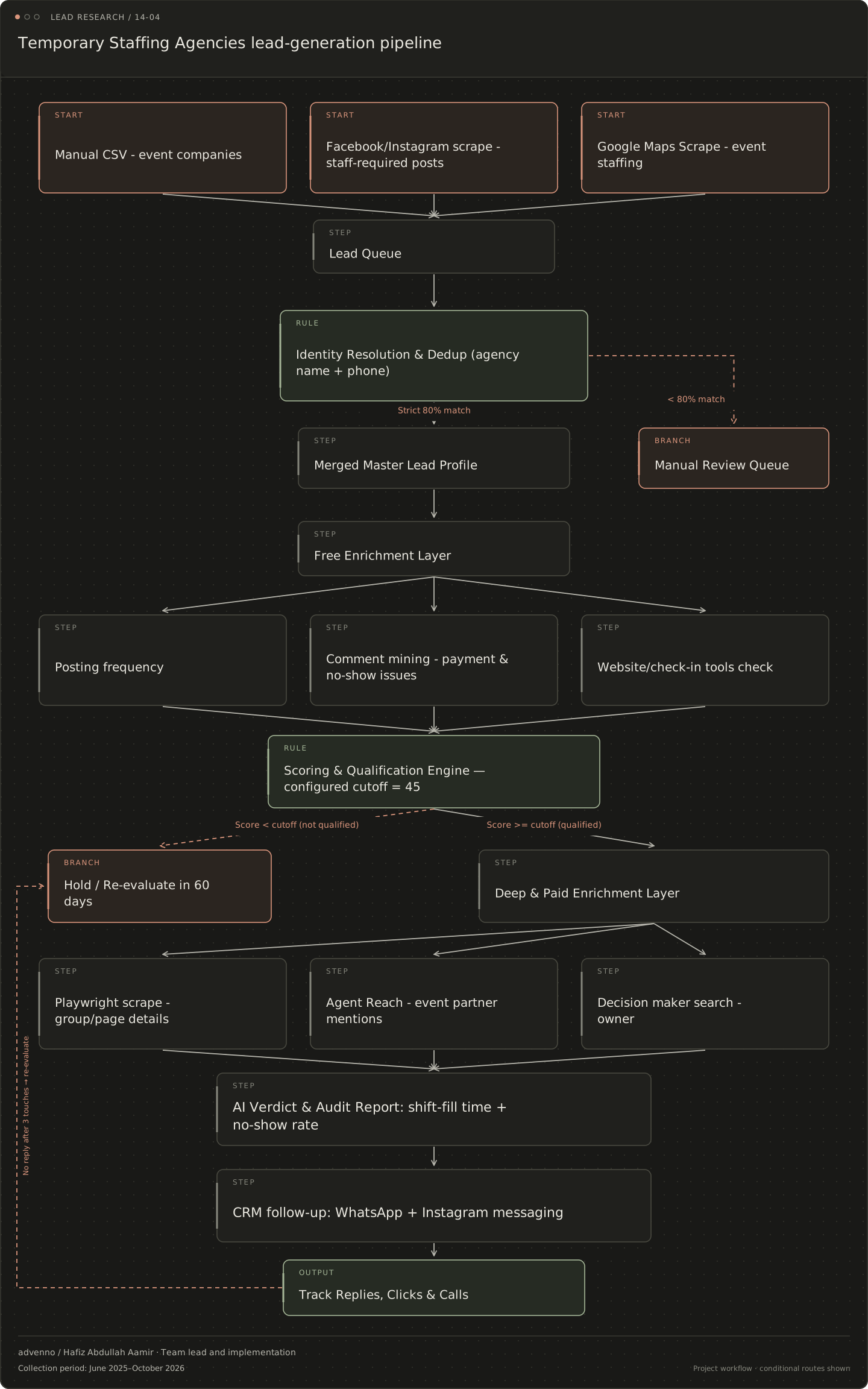
Related acquisition workflow: Temporary staffing agencies
A separate lead-research and CRM workflow configured for this business niche. It connects evidence gathering, qualification and follow-up; it is distinct from the operational system shown above.
Read the stages and decision branches
- Manual CSV - event companies
- Facebook/Instagram scrape - staff-required posts
- Google Maps Scrape - event staffing
- Lead Queue
- Identity Resolution & Dedup (agency name + phone)
- Strict 80% match: Merged Master Lead Profile
- < 80% match: Manual Review Queue
- Merged Master Lead Profile
- Manual Review Queue
- Free Enrichment Layer
- Posting frequency
- Comment mining - payment & no-show issues
- Website/check-in tools check
- Scoring & Qualification Engine — configured cutoff = 45
- Score < cutoff (not qualified): Hold / Re-evaluate in 60 days
- Score >= cutoff (qualified): Deep & Paid Enrichment Layer
- Hold / Re-evaluate in 60 days
- Deep & Paid Enrichment Layer
- Playwright scrape - group/page details
- Agent Reach - event partner mentions
- Decision maker search - owner
- AI Verdict & Audit Report: shift-fill time + no-show rate
- CRM follow-up: WhatsApp + Instagram messaging
- Track Replies, Clicks & Calls
- no reply after 3 touches: Hold / Re-evaluate in 60 days
What makes the system useful.
Why does a shift-fill system need more than group messages?
Temporary staffing connects a client's open shift with a worker who accepts it, a coordinator who confirms it and an event or site leader who records the actual work. The project collection covered broadcast and booking, waitlists, check-in/out, payment preparation, worker reliability and new-worker registration. Each stage answers a different question: is the shift open, is somebody booked, did they attend and what work should be paid?
Keeping those states distinct matters when the first person to accept becomes unavailable. A waitlisted worker is not a confirmed replacement, and a confirmed booking is not proof of attendance. The operational record needs to follow the assignment across these changes.
How do booking rules, attendance and payment preparation connect?
The workflow uses first-come booking logic with confirmations, waitlists and replacement handling. Attendance then uses QR or location-supported check-in/out to provide the timesheet input. Payment lists and client invoices follow from completed work, not simply from the original broadcast. The payment workflow prepares payout lists; actual settlement is a separate step that depends on the selected provider and its supported integration.
Reliability scoring is a supporting module based on worker history. It should not hide incorrect attendance data or turn an unexplained score into a final decision. Coordinators need to understand the record behind the score and handle exceptions, including phone problems and disputed check-ins.
What should a temporary staffing team check during evaluation?
Shift-fill time, fill rate, no-show rate and payout delay are useful measurement categories. Those figures are not supplied as achieved outcomes. An evaluation should distinguish an accepted offer from confirmed coverage and from actual completed attendance.
Operational review also covers duplicate bookings, stale availability, check-out omissions and a worker's ability to correct a mistaken record. Worker registration introduces identity information, and some temporary workers may be young. Collect only the information needed for the assignment and keep access appropriate to the coordinator's task.