Tour booking, itinerary and departure coordination automation
Hafiz Abdullah Aamir developed tour-operator automation projects connecting social enquiries, seat inventory, waitlists and advances with group onboarding, packing information and schedules. The collection also covers relevant communication to past travellers, custom-itinerary drafting and reviewed weather and route updates, with feasibility and safety decisions retained by the operator.
By Advenno · Project team lead: Hafiz Abdullah Aamir · Published · Updated
Where the work gets stuck.
A group departure brings sales and operations together. Before booking, customers ask about the trip and available seats. After booking, the operator needs to collect the advance, organise the group and communicate schedules and preparation details. Seat availability connects both sides of that work. The project addressed the transition from answering departure enquiries to coordinating a booked group, so the customer conversation, seat count and trip communication could follow the same departure instead of being managed independently.
A system built around the work.
The implementation connected enquiry responses with seat booking and availability. The booking process included advance collection and supported waitlists for the departure workflow. Once travellers entered the booked group, onboarding communication carried the schedule, packing information and other trip details into the journey. Pre-trip weather and road updates supported operational communication, with human confirmation retained for safety-relevant information. The system brought these stages together around a fixed departure, linking the process of accepting passengers with the work of preparing them for the trip rather than treating booking and group coordination as separate projects.
How the pieces connect.
Answer the departure enquiry
The enquiry stage responded to customer interest in a planned trip and directed the conversation towards the information needed to move from a question to a seat booking.
Connect the request with seat availability
Seat management related the customer's booking request to the places available on the departure, with waitlist handling supporting the same trip-level booking process.
Progress the booking and advance
The selected departure and seat booking connected with the advance-payment step, carrying the traveller from the sales conversation towards participation in the booked group.
Prepare the travelling group
Group onboarding brought schedules, packing information and trip communication into the workflow, giving passengers a connected preparation stage after the initial booking had been made.
Share reviewed pre-trip updates
Weather and road information supported the final communication before departure, with human confirmation retained for safety-relevant updates instead of leaving those judgements to generated text.
What the project delivered.
The delivered capability covered departure enquiries, seat management, booking progression and group preparation. It connected available places with customer responses and carried booked travellers into the communication needed before departure. The project supported the operational journey around a group trip, while leaving route and safety judgements with the people responsible for conducting it.
The systems behind the workflow.
Each module handles a different part of the work. Together, they connect the operational handoffs around this project.
Social enquiries, seats, waitlists and advances
The booking workflow connected comment or DM interest with the available seats for a planned departure. It carried the conversation towards a booking or waitlist and the advance-payment stage rather than leaving seat counts separate from sales communication.
- How it works
An approved social messaging connection, form input and structured departure inventory support booking progression.
- Operational consideration
Platform access and app review affect supported automation. Seat information must correspond to the actual departure; a quick reply should not imply availability from an outdated record.
Group onboarding, packing information and schedules
After booking, the group-preparation workflow supplied onboarding information, packing guidance and schedules. It connected the customer’s place on a departure with the material needed to prepare for the trip.
- How it works
Workflow orchestration and supported group or direct communication deliver the relevant preparation material.
- Operational consideration
Group-message limits and participants’ communication preferences matter. Consent is relevant when a group chat exposes personal numbers to other travellers.
Relevant communication to past travellers
The retention module segmented past travellers for suitable upcoming departures, including departures with remaining places. It gave repeat communication its own audience context rather than sending the same trip to everyone in a contact list.
- How it works
Customer segments and a departure communication workflow support relevant re-engagement.
- Operational consideration
Message cost and audience suitability need review. Returning-traveller communication should reflect suitable trips and the customer’s communication preferences, rather than simply the presence of an empty seat.
Private and custom itinerary drafts
The itinerary module prepared drafts from owner templates for custom or private-tour requests. It helped turn requirements into material the operator could assess and edit before using it in a customer proposal.
- How it works
Language-model drafting combines customer requirements with owner-maintained itinerary templates.
- Operational consideration
The operator checks feasibility and edits unrealistic plans. A generated itinerary is not proof that hotels, transport or activities have been reserved.
Reviewed weather and route updates
Pre-trip communication included weather and road context, with human confirmation for safety-relevant updates. It connected current information with the booked group while retaining a clear boundary between communication support and operational judgement.
- How it works
Weather information and route context feed a message that the owner confirms before safety-related use.
- Operational consideration
A weather forecast does not establish road status. The operator remains responsible for assessing the information and deciding whether or how the trip should proceed.
Inside the system.
Choose a workflow to open the full diagram. Zoom in to follow its decisions and handoffs, or read the stages in the text view.
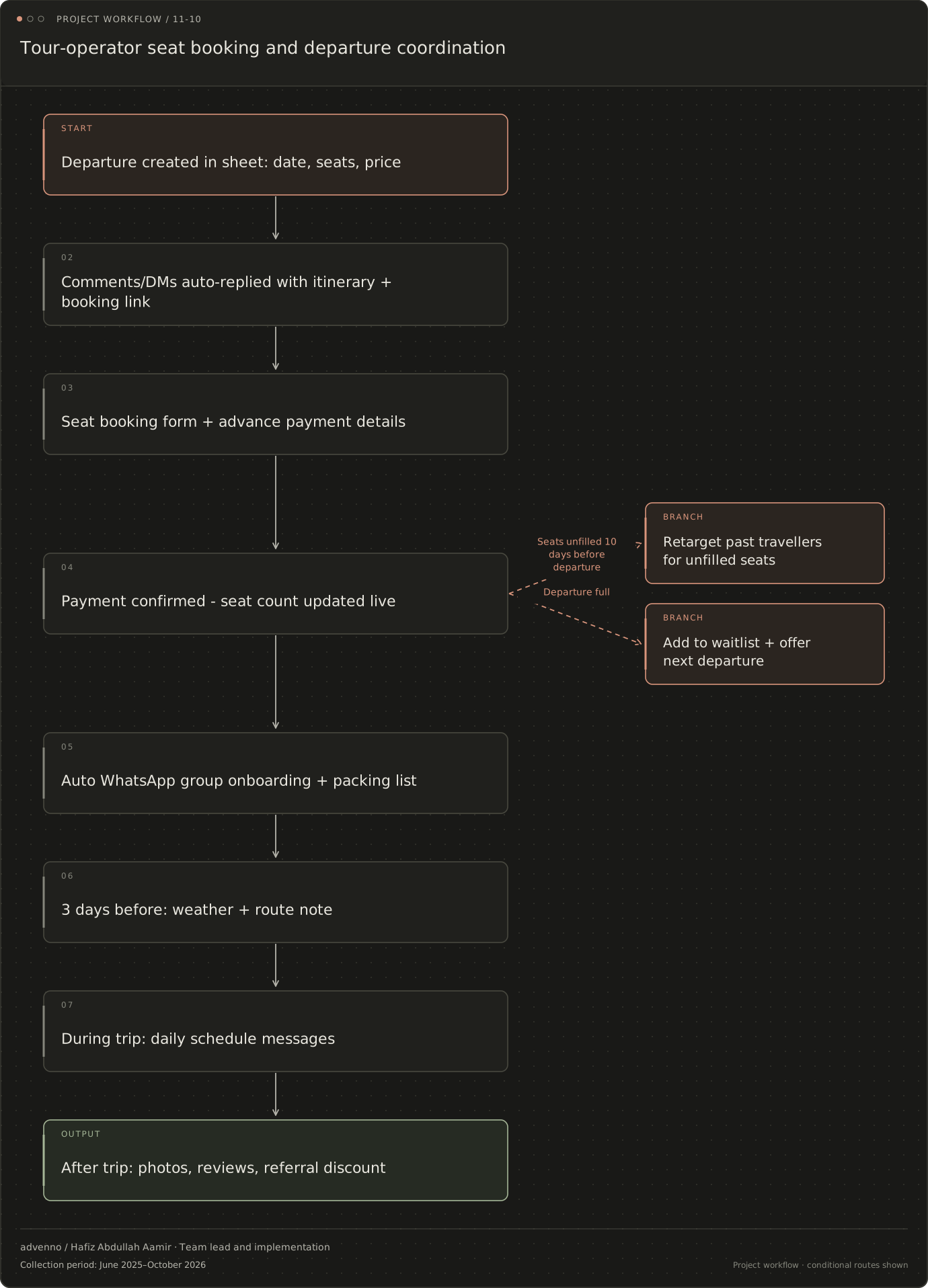
Tour-operator seat booking and departure coordination
The project’s operational flow, including decision points and exception routes. Named channels reflect the original project context; a similar implementation is scoped around your systems.
Read the stages and decision branches
- Departure created in sheet: date, seats, price
- Comments/DMs auto-replied with itinerary + booking link
- Seat booking form + advance payment details
- Payment confirmed - seat count updated live
- Auto WhatsApp group onboarding + packing list
- Departure full: Add to waitlist + offer next departure
- Seats unfilled 10 days before departure: Retarget past travellers for unfilled seats
- Auto WhatsApp group onboarding + packing list
- 3 days before: weather + route note
- During trip: daily schedule messages
- After trip: photos, reviews, referral discount
- Retarget past travellers for unfilled seats
- Add to waitlist + offer next departure
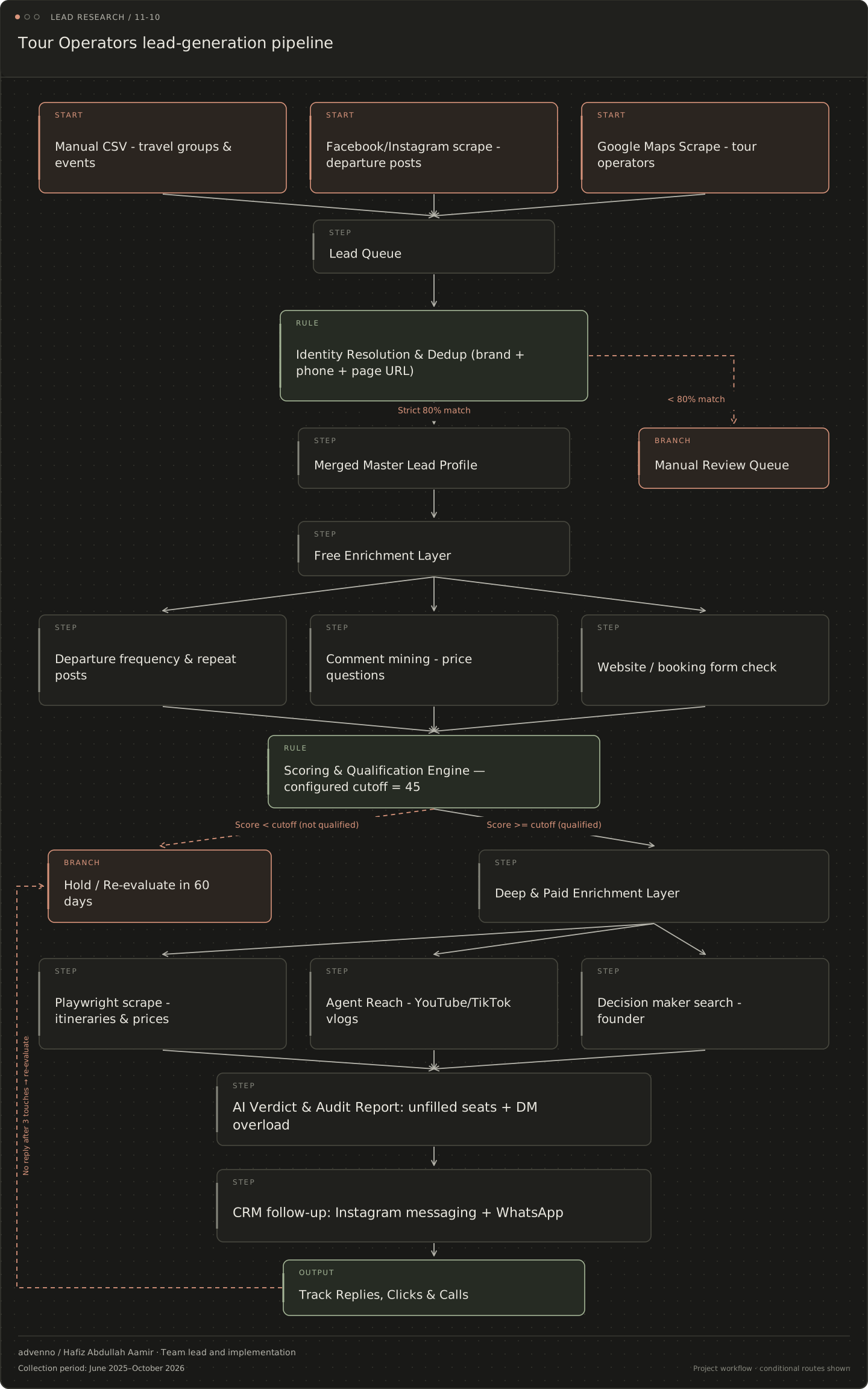
Related acquisition workflow: Tour operators
A separate lead-research and CRM workflow configured for this business niche. It connects evidence gathering, qualification and follow-up; it is distinct from the operational system shown above.
Read the stages and decision branches
- Manual CSV - travel groups & events
- Facebook/Instagram scrape - departure posts
- Google Maps Scrape - tour operators
- Lead Queue
- Identity Resolution & Dedup (brand + phone + page URL)
- Strict 80% match: Merged Master Lead Profile
- < 80% match: Manual Review Queue
- Merged Master Lead Profile
- Manual Review Queue
- Free Enrichment Layer
- Departure frequency & repeat posts
- Comment mining - price questions
- Website / booking form check
- Scoring & Qualification Engine — configured cutoff = 45
- Score < cutoff (not qualified): Hold / Re-evaluate in 60 days
- Score >= cutoff (qualified): Deep & Paid Enrichment Layer
- Hold / Re-evaluate in 60 days
- Deep & Paid Enrichment Layer
- Playwright scrape - itineraries & prices
- Agent Reach - YouTube/TikTok vlogs
- Decision maker search - founder
- AI Verdict & Audit Report: unfilled seats + DM overload
- CRM follow-up: Instagram messaging + WhatsApp
- Track Replies, Clicks & Calls
- no reply after 3 touches: Hold / Re-evaluate in 60 days
What makes the system useful.
A departure links selling seats with preparing a group
A tour enquiry may begin in a comment or direct message, but a confirmed traveller needs a place on a specific departure, an advance-payment step and practical information before leaving. The founder, sales colleague, operations team, guides and drivers each handle part of that journey. The project collection connected seat inventory and waitlists with group onboarding, schedules and reviewed updates. It also included relevant communication to past travellers and owner-reviewed drafts for private itineraries, reflecting both fixed-departure and custom-tour work.
Seat state and itinerary drafts serve different purposes
Seat management made availability specific to a departure rather than a generic response to a price enquiry. Booking and waitlist handling carried that context towards advance collection and group preparation. A private itinerary followed another route: requirements and owner templates supported a draft, which the operator edited for feasibility. Weather information and road updates also had separate review needs. Neither an itinerary draft nor a forecast established that a supplier booking was complete or that a route was safe to operate.
Evaluate the departure workflow with the operator’s judgement intact
Seat-fill rate, DM response time and the relationship between advances and cancellations are useful evaluation categories. They are not reported numerical outcomes from these projects. Review whether the seat record stays current, group messages reach the intended participants and the operator checks practical itinerary details. Social-platform access and group-message limits affect delivery, while group chats may expose participants’ personal numbers. The system supports preparation and communication; the operator remains responsible for safety-relevant information and the decision to conduct a trip.