Training proposals, programme delivery and reporting automation
Hafiz Abdullah Aamir developed training-provider automation projects spanning needs-led proposal drafts, enrolment and attendance, certificates, HR report preparation, workshop-enquiry nurturing and reviewed quiz generation. The collection follows the administrative and content work around a programme, with trainers and programme owners reviewing the material and its interpretation.
By Advenno · Project team lead: Hafiz Abdullah Aamir · Published · Updated
Where the work gets stuck.
A training provider's work starts before a learner joins a course and continues after the session finishes. Enquiries lead to proposals or course selection, followed by enrolment and scheduling. During delivery, attendance and learning activity produce information needed for certificates and feedback. Corporate buyers may also need a report explaining what took place.
The project addressed these linked administrative stages. Its focus was the journey around training delivery, where information collected during an enquiry needs to remain useful for the coordinator, trainer and reporting process. A certificate or participant survey documents part of that journey; it does not by itself prove a wider business impact.
A system built around the work.
The completed pipeline connected enquiry and proposal preparation with enrolment, learning delivery, certificate generation and feedback reporting. Course information supported the proposal stage, and enrolment led into the administrative work around the learning programme. Attendance, certificates and participant feedback formed the later stages of the workflow.
The project therefore covered more than issuing a certificate at the end of a session. It brought the steps before and after training into the same operational sequence. Enrolment establishes who is taking part, while the delivery record and participant feedback support different parts of the programme's completion and reporting.
How the pieces connect.
Develop the training enquiry
Use the enquiry and relevant course information to support proposal preparation and the next step towards a training programme.
Enrol the participants
Connect the agreed training activity with participant enrolment and the administrative information needed for course delivery.
Complete the delivery records
Bring attendance and learning-delivery information into the workflow so the completion and certificate stages have the relevant inputs.
Issue certificates and feedback reports
Generate the training certificates and bring participant feedback into the reporting that follows the completed programme.
What the project delivered.
The project delivered an enquiry-to-certificate workflow for training administration. Its scope brought proposal preparation, enrolment, delivery records, certificates and feedback together as related parts of the programme. Reporting connected the training activity with participant feedback, giving the provider an administrative account of the programme alongside the individual completion documents.
The systems behind the workflow.
Each module handles a different part of the work. Together, they connect the operational handoffs around this project.
Needs-led training proposal drafts
The proposal module connected a prospective client's requirements with the provider's course library. It supported a draft built around the needs survey and relevant teaching material instead of generating a generic training pitch.
- How it works
Retrieval and language-model assistance organise course information and survey themes into a structured proposal template.
- Operational consideration
The trainer reviews suitability, commitments and wording. A retrieved course description may be accurate yet still inappropriate for the client's learning need.
Enrolment, attendance and certificates
The delivery-administration module linked participant enrolment with reminders, learning access, attendance and certificates. This made the certificate part of a recorded participant journey rather than an isolated end-of-course PDF.
- How it works
Learning-system integration and workflow orchestration connect participant records with attendance and certificate generation.
- Operational consideration
The provider must define completion criteria and handle incorrect participant details. An issued certificate records the provider's process; it does not imply external accreditation.
HR impact-report preparation
Reporting brought together the available programme measures and feedback for a client HR team. It supported a reviewed account of what was delivered and what the evidence showed.
- How it works
Code computes the agreed metrics; a language model drafts narrative around those figures and reviewed feedback themes.
- Operational consideration
Do not convert attendance or positive feedback into an unsupported productivity or financial ROI claim. Explain what the measurement actually captures.
Workshop enquiry nurturing
The communication module supported follow-up around public workshops and course enquiries. Its role was to connect an interested person's questions and next administrative step with the enrolment process.
- How it works
Email or opted-in messaging sequences use course and enquiry context to prepare relevant follow-up.
- Operational consideration
Communication permissions and opt-outs matter. Keep follow-up relevant to the person's course enquiry and current enrolment stage.
Reviewed quiz generation
Quiz preparation used teaching slides as source material for draft questions. It helped the trainer prepare assessment content while retaining a review step before learners received it.
- How it works
Language-model drafts are generated from the selected material and reviewed against the course by the trainer.
- Operational consideration
Check the answer key, wording and difficulty. A plausible question can contain a wrong answer or test something the course never taught.
Inside the system.
Choose a workflow to open the full diagram. Zoom in to follow its decisions and handoffs, or read the stages in the text view.
Training enquiry-to-certificate workflow
The project’s operational flow, including decision points and exception routes. Named channels reflect the original project context; a similar implementation is scoped around your systems.
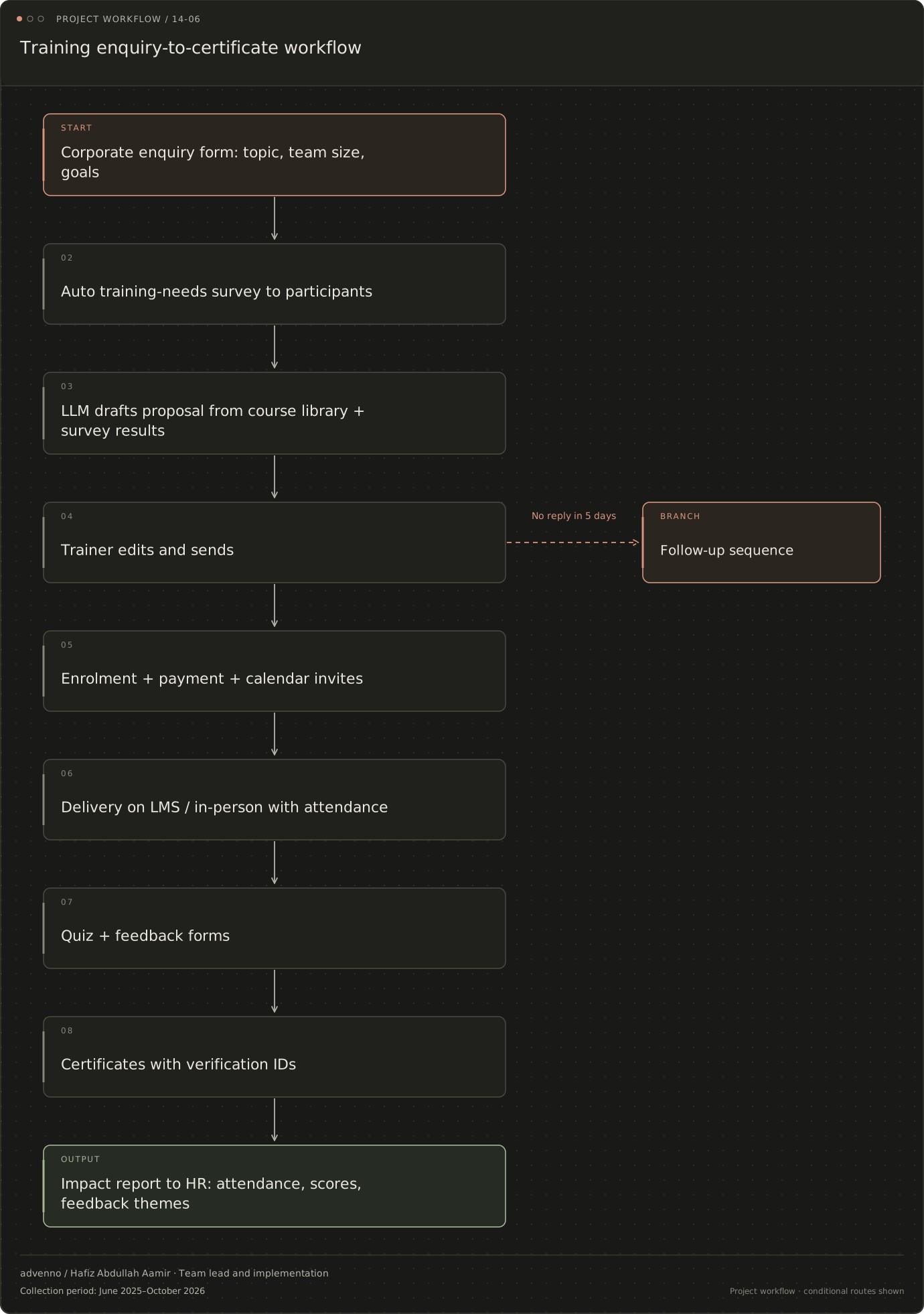
Read the stages and decision branches
- Corporate enquiry form: topic, team size, goals
- Auto training-needs survey to participants
- LLM drafts proposal from course library + survey results
- Trainer edits and sends
- Enrolment + payment + calendar invites
- No reply in 5 days: Follow-up sequence
- Enrolment + payment + calendar invites
- Delivery on LMS / in-person with attendance
- Quiz + feedback forms
- Certificates with verification IDs
- Impact report to HR: attendance, scores, feedback themes
- Follow-up sequence
Related acquisition workflow: Employee training providers
A separate lead-research and CRM workflow configured for this business niche. It connects evidence gathering, qualification and follow-up; it is distinct from the operational system shown above.
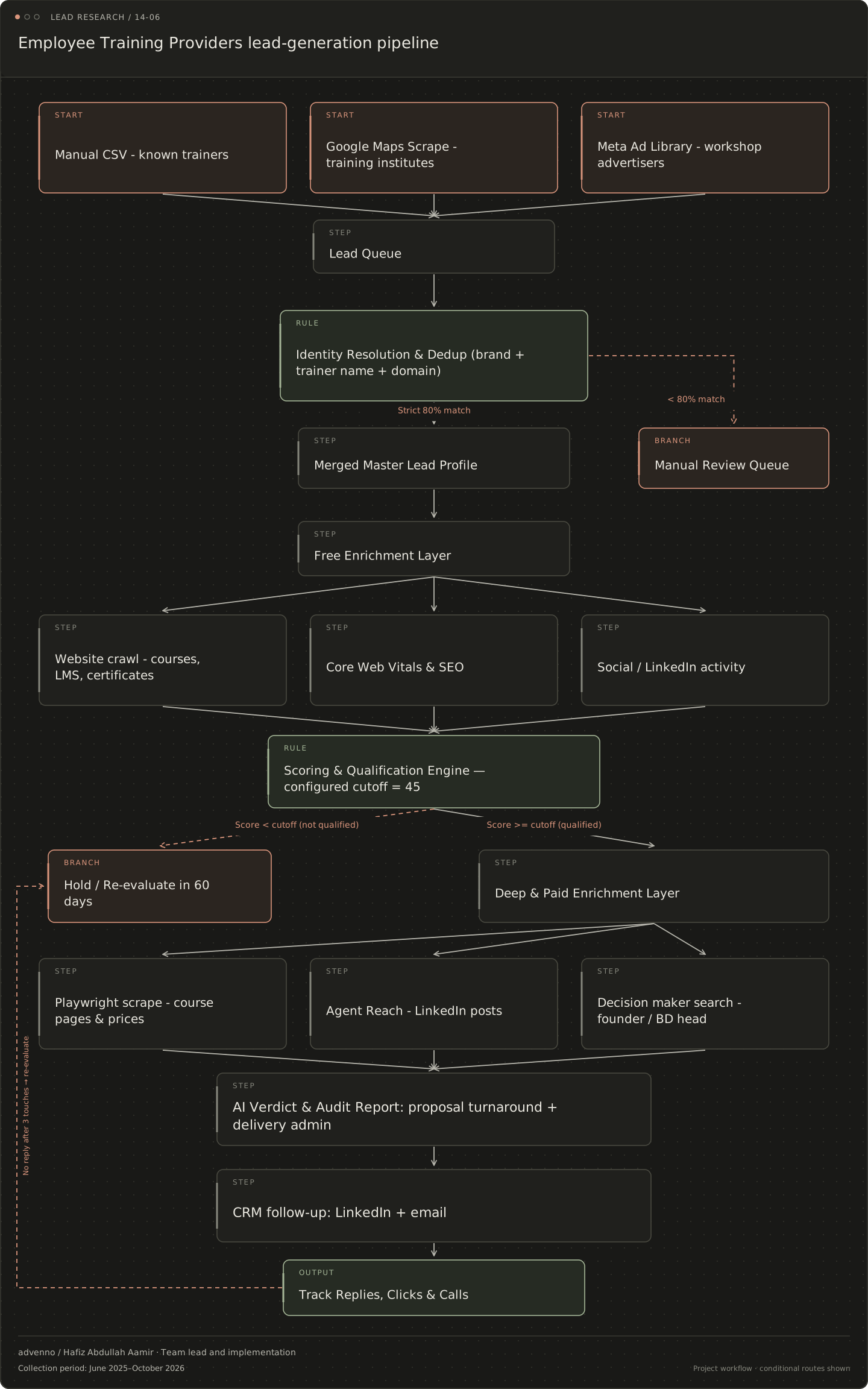
Read the stages and decision branches
- Manual CSV - known trainers
- Google Maps Scrape - training institutes
- Meta Ad Library - workshop advertisers
- Lead Queue
- Identity Resolution & Dedup (brand + trainer name + domain)
- Strict 80% match: Merged Master Lead Profile
- < 80% match: Manual Review Queue
- Merged Master Lead Profile
- Manual Review Queue
- Free Enrichment Layer
- Website crawl - courses, LMS, certificates
- Core Web Vitals & SEO
- Social / LinkedIn activity
- Scoring & Qualification Engine — configured cutoff = 45
- Score < cutoff (not qualified): Hold / Re-evaluate in 60 days
- Score >= cutoff (qualified): Deep & Paid Enrichment Layer
- Hold / Re-evaluate in 60 days
- Deep & Paid Enrichment Layer
- Playwright scrape - course pages & prices
- Agent Reach - LinkedIn posts
- Decision maker search - founder / BD head
- AI Verdict & Audit Report: proposal turnaround + delivery admin
- CRM follow-up: LinkedIn + email
- Track Replies, Clicks & Calls
- no reply after 3 touches: Hold / Re-evaluate in 60 days
What makes the system useful.
What does a training operations system connect before and after teaching?
Training administration starts before a learner enters a course. A corporate enquiry needs a needs assessment and a suitable proposal; participants then need enrolment, course access and scheduling. After delivery, the provider manages attendance, certificates, feedback and the report an HR team expects. The project collection covered that sequence alongside workshop-enquiry nurturing and reviewed quiz preparation.
The roles are different at each stage. A business-development colleague prepares a proposal, a coordinator manages the batch and a trainer judges whether the material and assessment fit the learning need. Automation connects their information; it does not make a generic proposal or a generated quiz educationally appropriate by itself.
How are course knowledge, delivery records and reports connected?
The proposal approach retrieved relevant material from a course library and combined it with needs-survey information. During delivery, the LMS or learning records supplied attendance, quizzes and participation details. Certificate generation used those records, while feedback analysis helped organise themes for the provider and the client's HR team.
Report preparation kept calculated figures separate from the narrative. Attendance and survey results can support an account of delivery, but they do not automatically prove improved job performance or financial return. Similarly, drafting quiz questions from slides is a preparation task; a trainer still checks the answer key and the relevance of each question.
What should a training provider measure during adoption?
Proposal turnaround, enrolment conversion, administrative effort per batch and repeat corporate work are useful evaluation measures. Those are not reported project outcomes. A useful evaluation also checks certificate corrections, access problems and whether the report clearly distinguishes observed evidence from interpretation.
For an adaptation, define which course materials may be used, who approves proposal wording and what qualifies a participant for a certificate. The provider's course content and intellectual property need an agreed handling arrangement. Communication sequences should follow the learner's actual enquiry and communication choices rather than treating every contact as permission for repeated promotion.