Travel agency quotations, documents and departure automation
Hafiz Abdullah Aamir developed travel-agency automation projects covering package enquiries and rate-based quotes, document collection and MRZ/OCR checks, traveller-state tracking, payments and receipts, group manifests and departure material. The collection connects sales, document handling, accounts and operations while keeping review of prices, sensitive records and external travel decisions with the responsible people.
By Advenno · Project team lead: Hafiz Abdullah Aamir · Published · Updated
Where the work gets stuck.
A travel booking can involve a package conversation, traveller documents, several payments and repeated questions about progress. Each stage refers to the same traveller, but it serves a different operational purpose. A document may be missing while a payment is recorded and a customer is waiting for an update. The project addressed the coordination of those activities, linking the enquiry and quotation with the document checklist and status information needed to move the travel process forward.
A system built around the work.
The implementation collected package enquiries and used rate information for the quotation stage. Document collection brought traveller records into a checklist-based process, with extraction and checking of document details supporting the handling work. A workflow state tracked each traveller's progress, giving customer updates a defined source rather than requiring staff to reconstruct the position for every enquiry. Payment schedules and receipts connected the financial steps with that journey. Departure-related communication completed the operational sequence. The system supported agency administration and traveller communication; it did not treat document processing as authority to guarantee a visa or other travel decision.
How the pieces connect.
Receive the package enquiry
The initial conversation captured the customer's package request and relevant travel requirements, creating the entry point for the quotation and traveller-handling steps that followed.
Prepare the package quotation
Rate information supported the package quote, connecting the sales conversation with the commercial details the agency needed to discuss before progressing the customer's travel arrangements.
Collect and check the documents
The document step combined collection with a checklist and extraction of relevant details, supporting the agency's review of the information required for the traveller's process.
Connect payments with traveller progress
Payment schedules and receipts accompanied the traveller workflow, bringing the financial steps into the same operational journey as the documents and package under discussion.
Communicate status and departure information
Recorded workflow states supported traveller updates and departure reminders, linking customer communication to the progress of the individual travel process rather than to a disconnected message history.
What the project delivered.
The delivered capability connected lead handling with traveller documents, payments and progress communication. It provided a workflow for collecting the information required at each stage and relating status updates to the traveller's position in the process. The project covered the administration surrounding a travel booking through departure preparation, rather than limiting automation to the initial sales enquiry.
The systems behind the workflow.
Each module handles a different part of the work. Together, they connect the operational handoffs around this project.
Package enquiries and rate-based quotes
The sales workflow captured package requirements and connected them with quotation information. It moved the customer towards a concrete discussion of the trip while preserving a review point for rates that could change quickly.
- How it works
A WhatsApp or form-based assistant, maintained rate sheets and workflow orchestration support the quotation stage.
- Operational consideration
Flight rates can change rapidly. Ranges and human confirmation are preferable to presenting an old or generated value as a guaranteed final fare.
Document collection and MRZ or OCR checks
The document module joined upload and checklist work with extraction of passport details, including MRZ and expiry checks. It supported the agency’s review of the information needed for the traveller’s process rather than treating a file upload as proof that everything was complete.
- How it works
Upload forms, document checklists and MRZ/OCR extraction support structured handling of traveller records.
- Operational consideration
Passport and identity data need appropriate access control and storage protection. Extraction results can require review; they do not establish eligibility or approval from an external authority.
Per-traveller states and status updates
The workflow recorded progress for each traveller and used that context for updates. It made the current stage explicit instead of requiring staff to infer it from scattered documents, payment messages and previous conversations.
- How it works
A state record supplies event-driven customer communication through the appropriate messaging templates.
- Operational consideration
The state must reflect the actual process. A well-written status message cannot compensate for a record that has not been updated when the agency completes or changes a step.
Payment schedules, receipts and reminders
The finance module connected payment stages and receipt documents with the traveller’s journey. It kept the financial follow-up associated with the package and customer rather than as an unrelated accounts conversation.
- How it works
Structured payment records, PDF or receipt generation and reminders support the schedule.
- Operational consideration
Reconciliation exceptions require attention. The finance owner should define how payments are checked and how unresolved differences reach the people responsible for the account.
Group manifests and departure briefing packs
The operations module used traveller information to prepare group manifests and briefing material. It extended the workflow beyond status messages into the documents and practical communication needed to prepare a travelling group.
- How it works
Templates and document generation turn recorded group information into manifests and departure packs.
- Operational consideration
Traveller data must be accurate before the material is used. Generation supports preparation, while the agency reviews the details and coordinates the actual departure.
Inside the system.
Choose a workflow to open the full diagram. Zoom in to follow its decisions and handoffs, or read the stages in the text view.
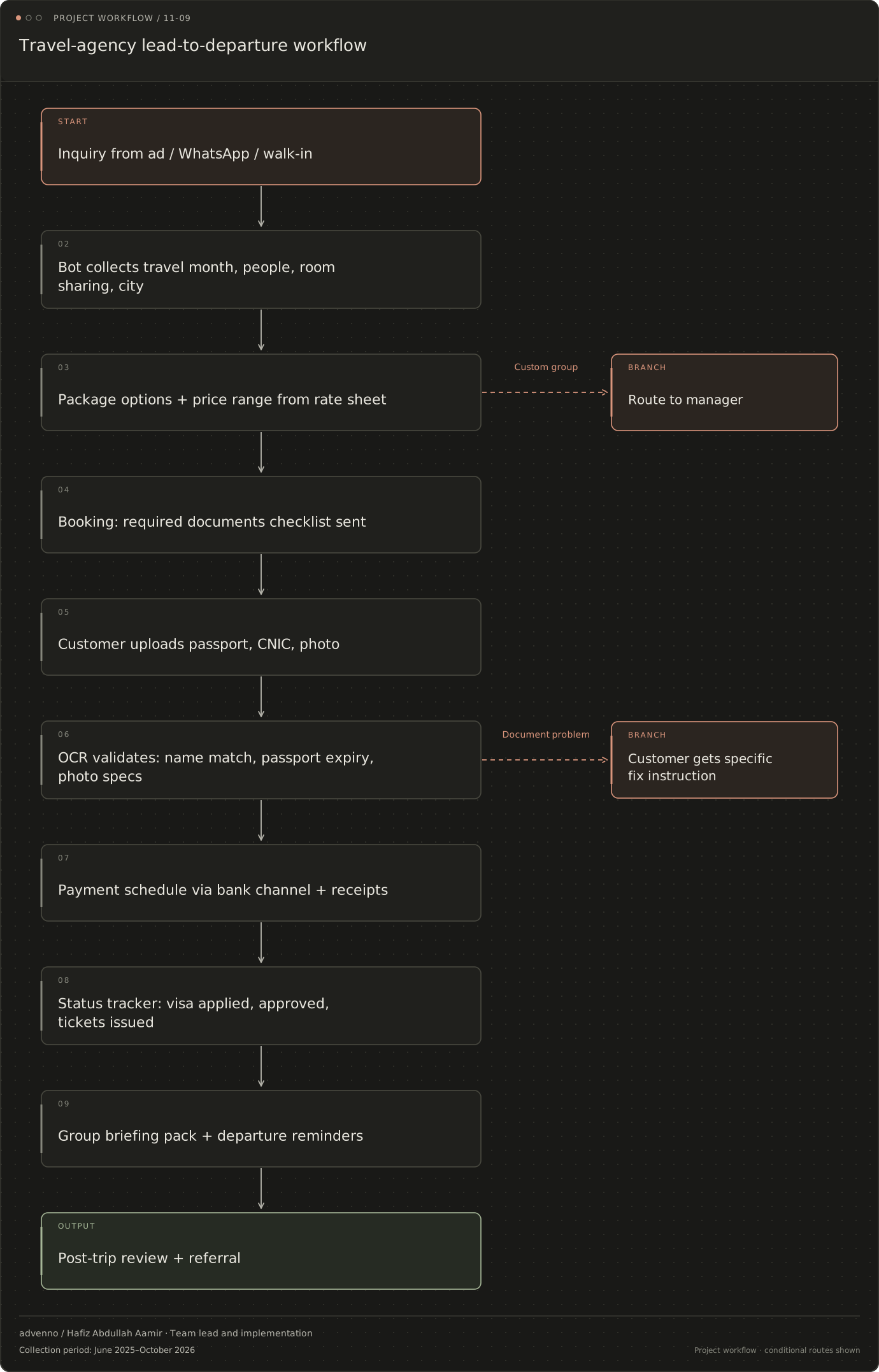
Travel-agency lead-to-departure workflow
The project’s operational flow, including decision points and exception routes. Named channels reflect the original project context; a similar implementation is scoped around your systems.
Read the stages and decision branches
- Inquiry from ad / WhatsApp / walk-in
- Bot collects travel month, people, room sharing, city
- Package options + price range from rate sheet
- Booking: required documents checklist sent
- Custom group: Route to manager
- Booking: required documents checklist sent
- Customer uploads passport, CNIC, photo
- OCR validates: name match, passport expiry, photo specs
- Payment schedule via bank channel + receipts
- Status tracker: visa applied, approved, tickets issued
- Group briefing pack + departure reminders
- Post-trip review + referral
- Route to manager
- Customer gets specific fix instruction
Related acquisition workflow: Travel agencies
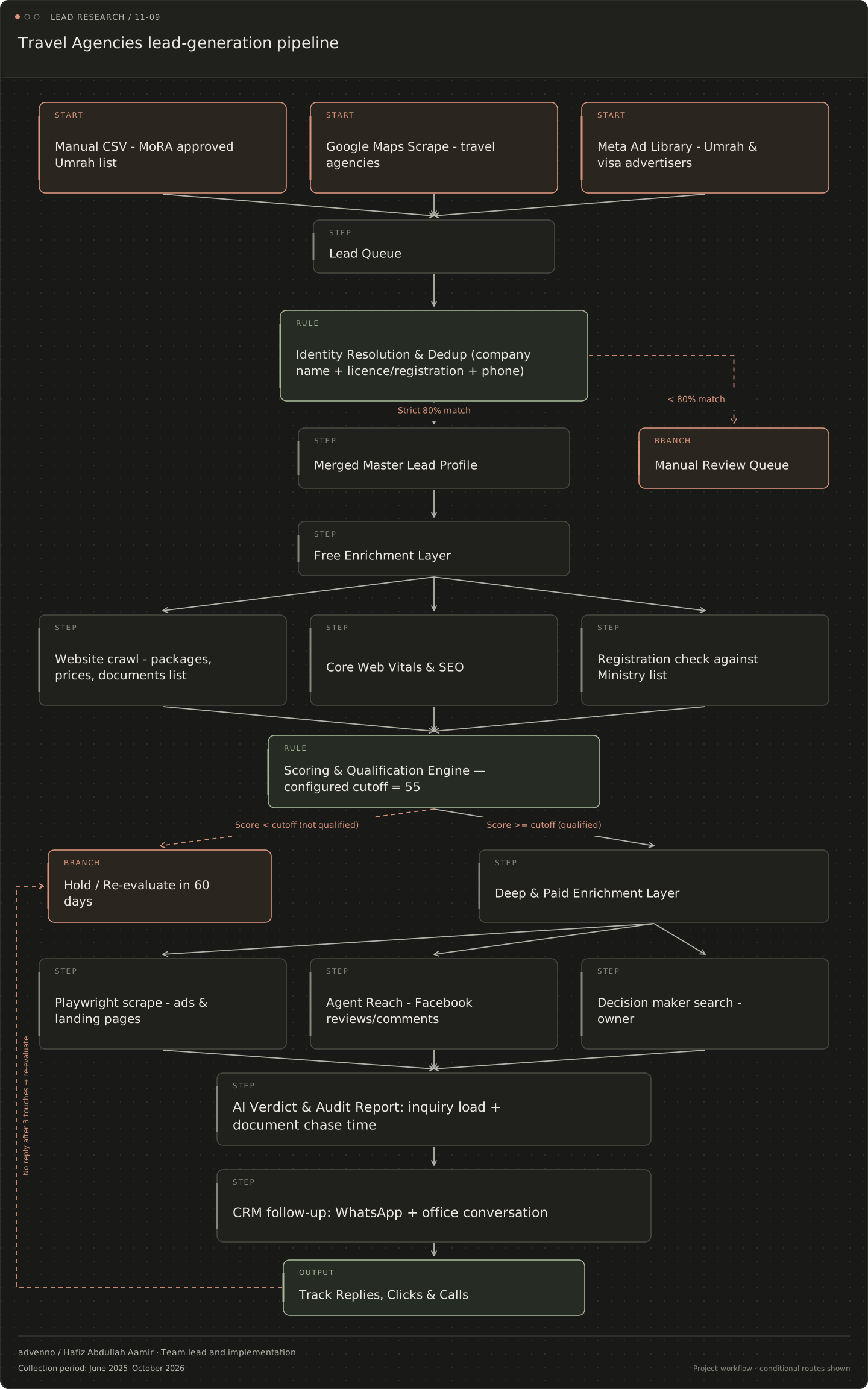
A separate lead-research and CRM workflow configured for this business niche. It connects evidence gathering, qualification and follow-up; it is distinct from the operational system shown above.
Read the stages and decision branches
- Manual CSV - MoRA approved Umrah list
- Google Maps Scrape - travel agencies
- Meta Ad Library - Umrah & visa advertisers
- Lead Queue
- Identity Resolution & Dedup (company name + licence/registration + phone)
- Strict 80% match: Merged Master Lead Profile
- < 80% match: Manual Review Queue
- Merged Master Lead Profile
- Manual Review Queue
- Free Enrichment Layer
- Website crawl - packages, prices, documents list
- Core Web Vitals & SEO
- Registration check against Ministry list
- Scoring & Qualification Engine — configured cutoff = 55
- Score < cutoff (not qualified): Hold / Re-evaluate in 60 days
- Score >= cutoff (qualified): Deep & Paid Enrichment Layer
- Hold / Re-evaluate in 60 days
- Deep & Paid Enrichment Layer
- Playwright scrape - ads & landing pages
- Agent Reach - Facebook reviews/comments
- Decision maker search - owner
- AI Verdict & Audit Report: inquiry load + document chase time
- CRM follow-up: WhatsApp + office conversation
- Track Replies, Clicks & Calls
- no reply after 3 touches: Hold / Re-evaluate in 60 days
What makes the system useful.
One traveller moves through several agency responsibilities
Travel-agency work can involve package enquiries, changing rates, passport and other document collection, payments, status questions and group departure preparation. Sales, document-handling colleagues, accounts and operations each need a different part of the traveller’s record. The project collection connected those responsibilities from enquiry towards departure, including document extraction and checklists, per-traveller states, payment communication and generated group material. Its purpose was to organise agency work around the traveller instead of making staff reconstruct progress from separate conversations and files.
The state record, rate sheet and document checklist have different authority
Maintained rates supplied package quotations, with rapidly changing flight prices requiring ranges or human confirmation rather than a generated final promise. Document capture used passport MRZ and OCR concepts to extract details and flag expiry or completeness issues. A workflow state machine tracked each traveller’s progress and supplied the source for status communication. These layers perform different jobs: extracted data is not an approval, a payment record is not a completed document checklist, and an agency workflow state is not the decision of an external authority.
Evaluate administration while preserving traveller judgement
Enquiry response time, document exceptions, status enquiries per traveller and enquiry conversion are useful evaluation categories. They are not numerical improvements reported for this project. The quality of document input and review matters as much as the speed of extraction. Identity records require controlled handling appropriate to their sensitivity, and group manifests need accurate traveller information. The project supports agency administration and communication; it does not guarantee visa outcomes or replace the people responsible for reviewing fares, documents and departure arrangements.